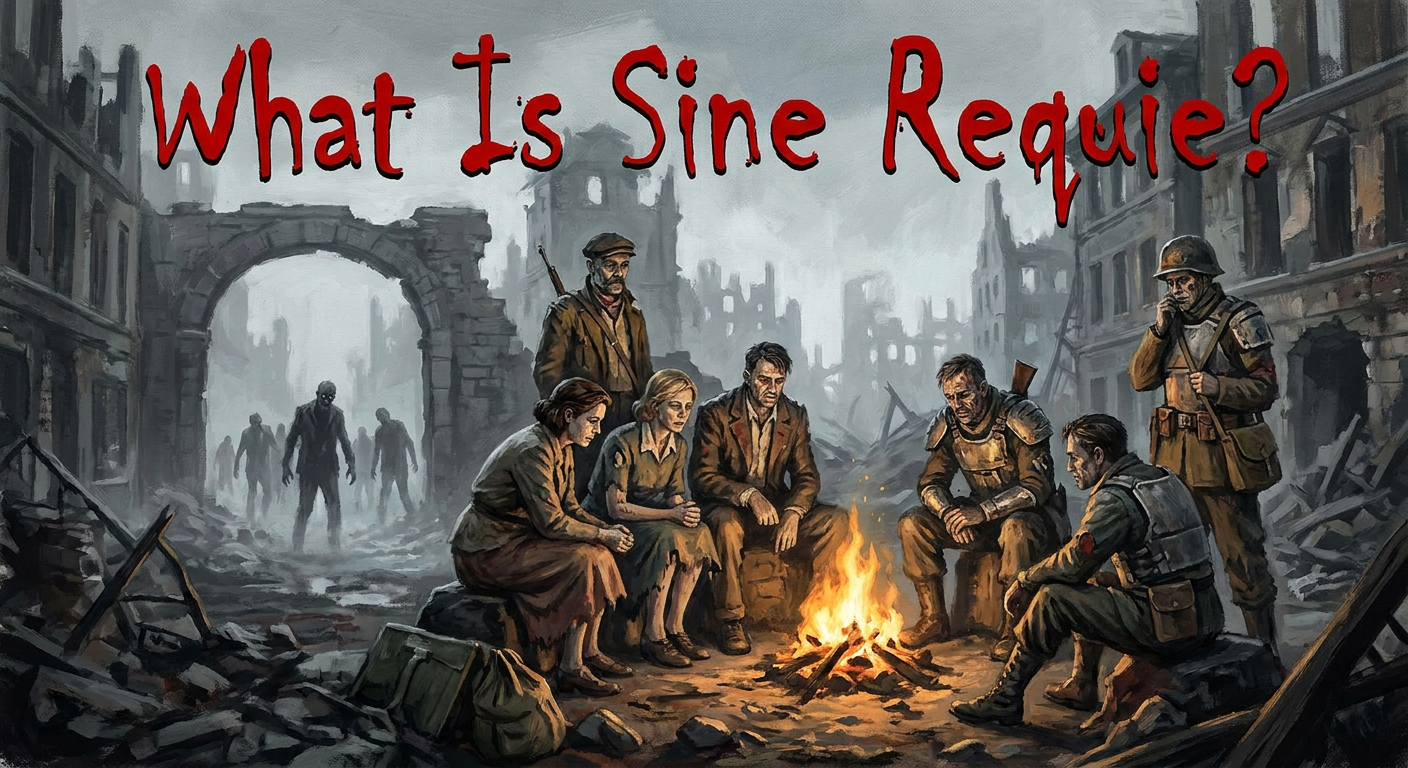
If you’ve ever wondered what Sine Requie is, you’re about to discover one of the most original tabletop role-playing games ever created.
Unlike traditional fantasy RPGs, Sine Requie combines alternate history, psychological horror, survival, and zombie apocalypse themes into a unique role-playing experience. Instead of rolling dice, players use Tarot cards to determine the outcome of their actions, making every session feel unpredictable and deeply atmospheric. The game is set in a grim alternate timeline where the dead rose on D-Day, forever changing the course of human history.
Whether you’re a fan of horror games, Lovecraftian storytelling, or post-apocalyptic settings, this guide explains everything you need to know about Sine Requie.
What Is Sine Requie?
Sine Requie is an Italian horror tabletop role-playing game (TTRPG) created by Matteo Cortini and Leonardo Moretti.
Originally published in 2003, the game quickly became one of Italy’s most celebrated RPGs thanks to its unique setting, innovative mechanics, and cinematic storytelling. It has received multiple awards at the Lucca Comics & Games, including Best Italian Game and Best Role-Playing Game.
Rather than becoming powerful heroes, players portray ordinary people struggling to survive in a terrifying world where death is never the end.
The Setting: A World After Judgment Day
One of Sine Requie’s greatest strengths is its unforgettable setting.
History changes forever on June 6, 1944—the day known in our world as D-Day.
In Sine Requie, this date becomes Judgment Day, when every dead person suddenly rises from the grave and begins hunting the living. The zombie apocalypse interrupts the Second World War, causing governments and entire nations to collapse.
Thirteen years later, humanity barely survives in a devastated world where different regions have evolved into radically different societies.
Some of the best-known settings include:
- The Sanctum Imperium, a theocratic empire ruled by the Church.
- The Fourth Reich, where Nazi ideology survives in horrifying new forms.
- The Soviet Union, transformed into an oppressive mechanized regime.
- The Lost Lands, lawless territories overrun by the dead.
Every region has its own culture, dangers, and political conflicts.
How Does Sine Requie Work?
Like most tabletop RPGs, Sine Requie is played with:
- One Game Master (called the Cartomancer)
- Several players
The Cartomancer:
- Describes the world
- Controls NPCs
- Creates mysteries and adventures
- Interprets the rules
- Guides the story
Players describe what their characters attempt to do, while the game’s unique mechanics determine the outcome.
Character Creation
Players create ordinary survivors rather than legendary heroes.
Depending on the campaign setting, characters may be:
- Soldiers
- Priests
- Doctors
- Investigators
- Merchants
- Survivors
- Inquisitors
- Scholars
Each character possesses:
- Characteristics
- Skills
- Equipment
- Personal history
- Psychological traits
Because the world is so dangerous, even experienced characters remain vulnerable throughout the campaign.
Tarot Cards Instead of Dice
Perhaps the most distinctive feature of Sine Requie is that it does not use dice.
Instead, every important action is resolved using a Tarot deck.
The system uses:
- Minor Arcana for most skill checks and actions.
- Major Arcana for dramatic narrative events and story developments.
Each card carries symbolic meaning that influences not only success or failure but also the tone of the story itself. This creates a unique experience where fate feels mysterious and unpredictable.
Horror, Survival, and Investigation
Sine Requie is not about defeating endless waves of enemies.
Instead, players spend much of their time:
- Investigating mysteries
- Managing scarce resources
- Avoiding overwhelming threats
- Negotiating with dangerous factions
- Exploring abandoned cities
- Surviving against impossible odds
Every decision can have lasting consequences.
Combat Is Extremely Dangerous
Combat exists, but it is intentionally lethal.
The undead are relentless, ammunition is limited, and injuries can quickly become fatal.
Many encounters are better solved through:
- Careful planning
- Stealth
- Diplomacy
- Escape
Survival is often a greater victory than winning a fight.
Themes of Sine Requie
Unlike many zombie stories, Sine Requie explores mature themes beyond simple survival.
Campaigns often focus on:
- Faith
- Totalitarianism
- Human nature
- Fear
- Morality
- Sacrifice
- Psychological trauma
- Hope in hopeless situations
The game asks difficult questions about what people are willing to do when civilization collapses.
What Makes Sine Requie Unique?
Several elements distinguish Sine Requie from other tabletop RPGs.
An Original Alternate History
Instead of creating a fictional fantasy world, the game reimagines real-world history after a supernatural catastrophe.
Tarot-Based Mechanics
Very few RPGs replace dice with Tarot cards, giving Sine Requie a unique identity and narrative style.
Horror Over Heroism
Characters are fragile, resources are scarce, and victory often comes at a terrible cost.
Strong Narrative Focus
The game encourages immersive storytelling, emotional role-playing, and morally complex decisions.
Is Sine Requie Good for Beginners?
Yes—with one important consideration.
The rules themselves are not especially difficult, but the game’s mature themes, unique Tarot mechanics, and narrative style make it most enjoyable for players who appreciate immersive storytelling.
If you enjoy:
- Horror movies
- Zombie fiction
- Alternate history
- Psychological drama
- Narrative-driven RPGs
Sine Requie offers one of the most distinctive tabletop experiences available.
Why Is Sine Requie So Popular?
Although it is primarily known in Italy, Sine Requie has earned a loyal fan base thanks to its originality.
Players praise it for:
- A memorable alternate-history setting
- Innovative Tarot-based gameplay
- Deep storytelling
- Atmospheric horror
- Complex moral choices
- Rich world-building
Its combination of history, horror, and narrative freedom has made it a landmark in the Italian tabletop RPG scene.
Final Thoughts
Sine Requie is unlike almost any other tabletop role-playing game.
Its haunting alternate history, Tarot-based mechanics, and emphasis on survival create a tense and unforgettable experience where every decision matters.
Whether you’re uncovering dark conspiracies inside the Sanctum Imperium, crossing the deadly Lost Lands, or trying to preserve your humanity in a world ruled by fear and the undead, Sine Requie delivers a role-playing experience that is both terrifying and unforgettable.
If you’re looking for a horror RPG that breaks away from traditional fantasy adventures, Sine Requie deserves a place on your table.
Frequently Asked Questions (FAQ)
What is Sine Requie?
Sine Requie is an Italian horror tabletop role-playing game set in an alternate history where the dead rise on D-Day, plunging the world into a zombie apocalypse.
Who created Sine Requie?
The game was created by Matteo Cortini and Leonardo Moretti and first published in 2003.
Does Sine Requie use dice?
No. Instead of dice, Sine Requie uses a Tarot deck to resolve actions and influence the story.
Is Sine Requie a zombie RPG?
Yes, but it is much more than a zombie survival game. It combines horror, investigation, alternate history, political intrigue, and psychological storytelling.
Is Sine Requie beginner-friendly?
Yes. While its themes are mature and its mechanics differ from traditional RPGs, the rules are approachable, especially with an experienced Cartomancer guiding the game.
What makes Sine Requie different from Call of Cthulhu?
Both games emphasize horror and investigation, but Call of Cthulhu focuses on cosmic horror inspired by H. P. Lovecraft, while Sine Requie centers on an alternate-history zombie apocalypse, Tarot-based mechanics, and the collapse of civilization.
Can Sine Requie be played outside Italy?
Yes. Although it originated in Italy and remains most popular there, its unique setting and mechanics have attracted international attention, and adaptations and related projects have introduced the game to a broader audience.