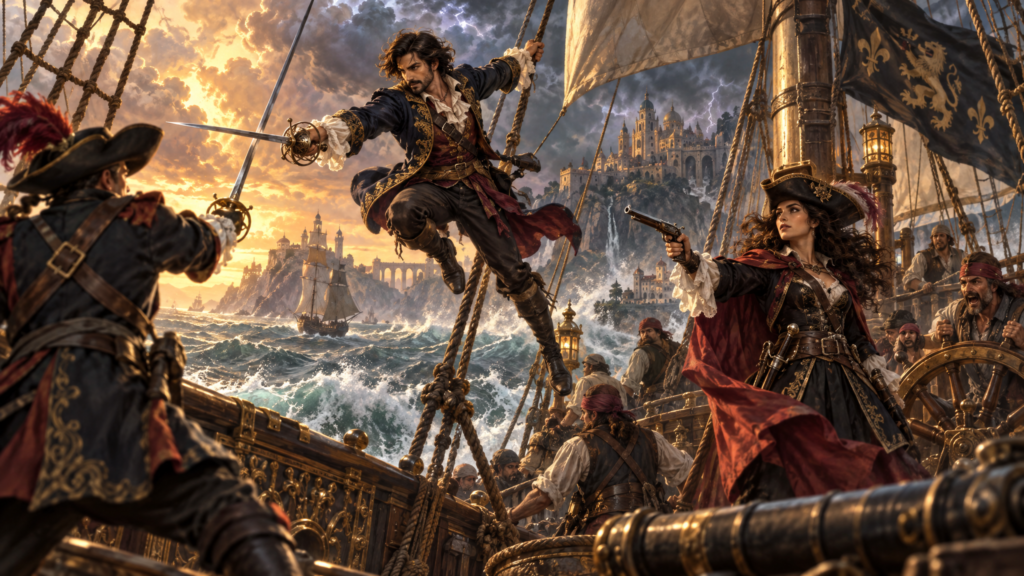
If you love pirate adventures, sword fights, mysterious conspiracies, daring escapes, and larger-than-life heroes, 7th Sea might be the tabletop roleplaying game you have been looking for.
Created by game designer John Wick, 7th Sea is a tabletop RPG built around swashbuckling adventure, political intrigue, exploration, romance, and magic. Its fictional world combines the atmosphere of historical Europe with supernatural mysteries and cinematic action.
Unlike traditional fantasy RPGs that often focus on dungeon exploration, tactical combat, and collecting treasure, 7th Sea encourages players to act like the heroes of an adventure novel. A character might duel a notorious villain, infiltrate a royal court, command a ship, uncover a secret society, or risk everything to save a kingdom.
But how does the game actually work? Is it suitable for beginners? What makes its rules different from Dungeons & Dragons, and which books do you need to start playing?
In this guide, we will explore everything you need to know about 7th Sea, with a particular focus on its Second Edition.
What Is 7th Sea?
7th Sea is a tabletop roleplaying game in which players portray heroes in a world of swashbuckling adventure, political intrigue, magic, and mystery.
The game was originally released in 1999. Its Second Edition followed in 2016, introducing a more narrative-focused approach to action and character heroism.
The game’s central setting is Théah, a fictional continent inspired by early modern Europe. It features powerful nations, ambitious rulers, secret societies, pirates, supernatural forces, and ancient mysteries.
The official description emphasizes a world where sharp wits can be just as important as swordsmanship. Heroes are expected to take risks, pursue meaningful causes, and perform spectacular feats rather than behave like ordinary adventurers struggling to survive
Quick Facts About 7th Sea
| Feature | Details |
|---|---|
| Game type | Tabletop roleplaying game |
| Main genre | Swashbuckling fantasy and adventure |
| Primary setting | Théah |
| Original edition | 1999 |
| Second Edition | 2016 |
| Original creator | John Wick |
| Core mechanics | D10 dice pools and narrative action resolution |
| Main themes | Heroism, intrigue, piracy, exploration, romance, magic |
| Best suited for | Players who enjoy cinematic storytelling |
| Typical group roles | Players and a Game Master |
One of the most important things to understand is that 7th Sea is designed to make characters feel heroic. It is not primarily about carefully conserving resources while fighting increasingly dangerous monsters. Instead, it focuses on exciting situations, bold decisions, dramatic consequences, and memorable scenes.
The Setting: Welcome to Théah
Théah is the heart of 7th Sea. Although it resembles Europe during the age of exploration and political intrigue, it is a fictional setting with its own history, nations, religions, legends, and supernatural elements.
The result is a world that feels familiar enough to understand but different enough to support extraordinary adventures.
A Fantasy Version of Early Modern Europe
Théah draws inspiration from historical European cultures and political systems. Its nations evoke recognizable historical influences without being exact copies of real countries.
This gives the Game Master plenty of material for adventures involving rival kingdoms, royal courts, religious institutions, merchant families, explorers, and military organizations.
A campaign might revolve around a diplomatic mission, a disputed succession, a dangerous expedition, or a conspiracy threatening several nations.
The setting is particularly useful for groups that enjoy political and social conflicts as much as physical danger.
Nations, Politics, and Rivalries
The nations of Théah have their own identities, traditions, and political interests. These differences can shape a character’s background and determine how they interact with the world.
Players might portray a noble involved in court politics, a swordsman with a personal code of honor, a merchant seeking influence, or an adventurer who has spent years traveling between ports.
National rivalries and competing interests provide natural sources of conflict. A character’s homeland might be at war, a powerful family might be plotting against the crown, or a secret organization might be manipulating events behind the scenes.
For the Game Master, these conflicts offer countless story hooks without requiring every adventure to revolve around defeating a monster.
Pirates, Ships, and Exploration
Piracy is one of the most recognizable themes associated with 7th Sea.
The world supports adventures involving sea voyages, dangerous waters, rival captains, hidden treasure, mysterious islands, and encounters with powerful enemies.
However, the game is not exclusively about pirates. A group can spend an entire campaign navigating royal courts, investigating conspiracies, exploring ancient ruins, or protecting important political figures.
The setting is flexible enough to support different kinds of swashbuckling stories while maintaining a consistent sense of adventure.
Magic and Supernatural Mysteries
Although Théah resembles a historical setting, magic and supernatural forces are important parts of its identity.
Sorcery, mysterious organizations, ancient civilizations, strange creatures, and religious mysteries can all influence a campaign.
Magic is not necessarily the everyday solution to every problem. Its presence can create wonder, danger, suspicion, and political tension.
This balance helps 7th Sea maintain the atmosphere of a swashbuckling adventure while allowing the Game Master to introduce fantastical elements when appropriate.
How Does 7th Sea Gameplay Work?
The defining characteristic of 7th Sea Second Edition is its narrative approach to resolving actions.
The game uses pools of ten-sided dice, commonly called D10s. Players roll dice based on their characters’ Traits and Skills, then combine results to create sets of ten. These sets are called Raises.
Rather than focusing exclusively on whether a character succeeds or fails, the system gives players opportunities to influence how a scene unfolds.
The Five Traits
In Second Edition, characters have five core Traits:
- Brawn: Physical strength and power.
- Finesse: Coordination, precision, and agility.
- Resolve: Determination, endurance, and mental resilience.
- Wits: Intelligence, perception, and quick thinking.
- Panache: Charm, presence, and the ability to act boldly.
Skills represent more specific areas of training and experience. The combination of a Trait and an appropriate Skill helps determine the dice a character rolls for a particular action.
For example, a character attempting an athletic feat might rely on Brawn, while someone trying to outmaneuver a rival in a duel might use Finesse or another relevant combination, depending on the situation and the rules being applied.
The Game Master determines the relevant Traits and Skills based on what the character is attempting.
What Are Raises?
Raises are one of the most distinctive mechanics in 7th Sea Second Edition.
After rolling their dice, players group results into sets that add up to ten. Each valid set creates a Raise that can be spent to accomplish goals, overcome obstacles, or deal with consequences in a scene.
Imagine that your character is trying to escape from a palace while guards pursue them.
You might spend Raises to overcome obstacles, reach a particular location, protect an ally, or achieve another goal supported by the scene.
This creates a more flexible approach to action than simply rolling once and waiting for the Game Master to announce a binary success or failure.
The exact options available depend on the scene and the rules involved, but the central idea is that players actively shape the outcome of dramatic situations.
A More Cinematic Approach to Combat
Combat in 7th Sea is designed to evoke swashbuckling fiction rather than reproduce every movement of a realistic fight.
Characters are heroes who can perform spectacular feats, take on groups of opponents, and turn a confrontation into an exciting sequence of decisions.
The system encourages players to think about what they want to accomplish during a fight rather than treating every encounter as a simple exchange of attacks and damage.
For example, a duel might involve disarming an opponent, protecting a bystander, escaping a collapsing balcony, or reaching a fleeing villain.
These objectives can make combat feel connected to the story rather than isolated from it.
That does not mean violence is irrelevant or that every outcome is guaranteed. The rules still create risks and consequences, but they are designed around the game’s heroic tone.
The Game Master and Collaborative Storytelling
As in other tabletop RPGs, the Game Master presents situations, portrays non-player characters, describes the world, and helps adjudicate the rules.
However, 7th Sea places particular emphasis on collaboration between the Game Master and the players.
Players are encouraged to describe bold actions, propose creative solutions, and engage with the story. The Game Master helps translate those ideas into scenes and meaningful choices.
This works especially well for groups that enjoy improvisation and cinematic storytelling.
It may be less appealing to players who prefer highly tactical encounters with precise positioning, extensive equipment management, and detailed combat simulations.
Creating a Character in 7th Sea
Character creation is about more than choosing a set of abilities. A character’s identity, motivations, relationships, and personal ambitions help determine what kind of stories they will experience.
The Second Edition core rules provide the framework for creating heroes with distinctive backgrounds and capabilities.
Choose a Character Concept
Start by imagining the kind of hero you want to portray.
Perhaps you want to play a charismatic pirate captain, a noble swordsman, a mysterious scholar, a daring explorer, or a diplomat who survives through intelligence and charm.
Your concept gives the character a personality and a direction. It also helps the Game Master create situations that connect to your interests.
Define Your Background and Abilities
Your character’s nation, occupation, Traits, Skills, and Advantages help determine what they can do.
A character with strong social abilities might excel at negotiating with nobles or manipulating political rivals. Someone focused on physical skills might be better suited to duels, athletic challenges, and daring escapes.
The goal is not necessarily to build the most powerful character possible. Instead, the game encourages players to create memorable heroes who have reasons to get involved in dangerous situations.
Give Your Hero Personal Goals
A compelling character usually wants something.
They might seek revenge against a corrupt noble, protect their homeland, uncover the truth about a mysterious organization, or prove themselves worthy of a family legacy.
These ambitions give the Game Master material for future adventures and help connect individual characters to the wider campaign.
Personal goals also create opportunities for character development. A hero might discover that their assumptions were wrong, form an unexpected alliance, or face a difficult choice between loyalty and justice.
Build Relationships and Connections
Relationships are valuable sources of drama.
A character might have a trusted friend in a royal court, a rival who wants to destroy their reputation, or a family member whose actions threaten to create a political crisis.
Such connections make the world feel personal. They can also give the Game Master reasons to bring the character into new adventures.
For players who enjoy roleplaying and character-driven stories, this is one of the most appealing aspects of the game.
What Kind of Adventures Can You Play?
One of the strengths of 7th Sea is its flexibility. The same setting can support many different styles of campaign.
Pirate Adventures
A pirate campaign might involve rival captains, naval pursuits, hidden treasure, dangerous ports, and voyages into unknown waters.
Players could form a crew, pursue a legendary prize, or become entangled in a conflict between competing maritime powers.
Political Intrigue
A campaign focused on intrigue might revolve around royal courts, noble families, secret negotiations, and conspiracies.
Characters could protect a monarch, expose a traitor, prevent an assassination, or negotiate a fragile alliance.
This style rewards players who enjoy investigation, social interaction, and strategic thinking.
Swashbuckling Action
For groups that want fast-paced adventure, the campaign might focus on duels, daring rescues, rooftop chases, and dramatic confrontations with villains.
The narrative rules support situations where characters attempt spectacular feats rather than relying solely on conventional combat.
Exploration and Mystery
Exploration-focused campaigns can take characters to forgotten ruins, mysterious islands, ancient sites, and locations associated with supernatural secrets.
These adventures combine discovery with danger and can gradually reveal information about the wider world.
Romance and Personal Drama
Romance, loyalty, betrayal, and difficult moral choices can be important parts of a 7th Sea campaign.
The game is particularly well suited to stories in which relationships influence decisions and characters must choose between competing responsibilities.
Romance is not compulsory, however. Groups can focus on action, exploration, politics, or other themes according to their preferences.
7th Sea vs. Dungeons & Dragons: What Are the Differences?
Both 7th Sea and Dungeons & Dragons support fantasy adventures, but they emphasize different experiences.
D&D is a broad fantasy RPG with a substantial focus on character classes, tactical combat, exploration, and progression. 7th Sea concentrates more specifically on swashbuckling heroes, cinematic action, political intrigue, and collaborative storytelling.
| Feature | 7th Sea Second Edition | Dungeons & Dragons 5e |
|---|---|---|
| Main atmosphere | Swashbuckling adventure | Broad fantasy adventure |
| Typical heroes | Larger-than-life adventurers | Characters with a wide range of power levels and roles |
| Main resolution system | D10 dice pools and Raises | Primarily D20-based checks and attacks |
| Combat style | Cinematic and narrative-focused | More structured, with substantial tactical options |
| Character identity | Traits, Skills, Advantages, background, goals | Classes, species, backgrounds, abilities, and other options |
| Common themes | Intrigue, piracy, romance, exploration | Fantasy exploration, combat, quests, and storytelling |
| Setting | Primarily Théah | Multiple settings and campaign worlds |
| Best fit | Players who enjoy dramatic, heroic stories | Players who want a flexible fantasy system with extensive character and combat options |
Neither game is universally better. The right choice depends on the kind of experience your group wants.
Choose 7th Sea if you want to feel like the hero of a swashbuckling novel. Choose D&D if you prefer a broader fantasy framework with familiar class-based character building and a greater emphasis on tactical combat.
Is 7th Sea Good for Beginners?
Yes, 7th Sea can be an excellent choice for beginners, especially those who enjoy storytelling and improvisation.
Its focus on heroic action can make it easy to imagine what your character might attempt. You do not necessarily need extensive experience with tabletop RPGs to understand the appeal of a daring duel, a dangerous voyage, or a conspiracy that threatens an entire kingdom.
However, the game’s narrative mechanics require players to think about their objectives and how they want a scene to develop. Groups accustomed to highly structured combat may need time to adapt to this approach.
For a smoother introduction, consider the following advice:
- Start with a short adventure rather than a complex political campaign.
- Create characters with clear motivations and relationships.
- Ask the Game Master to explain Raises and action resolution during play.
- Focus on a few central storylines instead of introducing every faction at once.
- Agree on the tone of the campaign, especially if romance, political intrigue, or darker themes are involved.
A supportive Game Master can make the learning process much easier.
What Books Do You Need to Play 7th Sea?
The 7th Sea Second Edition Core Rulebook is the main starting point for learning the game. It introduces the setting, explains character creation and the rules, and provides material for running adventures.
You do not need to purchase every supplement before beginning. The core book provides the foundation for creating heroes and starting a campaign.
Additional books can expand the setting, provide more character options, or explore specific regions and themes.
Before purchasing, check which edition a book belongs to and whether it is compatible with your group’s rules. This is particularly important because the game’s publisher and development plans have changed.
What About the First Edition?
The original 7th Sea was released in 1999 and has its own rules and supplements. It is a separate rules edition from the Second Edition published in 2016.
Players interested in older game systems may enjoy exploring the original version, but beginners will generally find it easier to choose one edition and learn its rules rather than mixing material from different versions without guidance.
Is a New Edition Coming?
There has been an important development for the game’s future.
In July 2025, Chaosium announced that Studio Agate would take over development of 7th Sea. In September 2025, Studio Agate announced that a new edition was in development.
The announcement described the project as a continuation rather than a complete reboot, stating that Second Edition books would remain relevant for the setting and that the new edition would build on its foundations.
This means that players interested in starting with Second Edition should check official announcements for the latest release information before making plans around a future edition.
Pros and Cons of 7th Sea
Like every tabletop RPG, 7th Sea works better for some groups than others.
Pros
1. A distinctive setting
Théah combines recognizable historical influences with fantasy, magic, and political intrigue.
2. Cinematic action
The rules encourage daring feats and dramatic encounters, making sword fights and escapes feel like scenes from an adventure film.
3. Strong character-driven storytelling
Personal goals, relationships, and moral choices can become important parts of a campaign.
4. Flexible adventures
The game supports piracy, exploration, political intrigue, romance, and supernatural mysteries without requiring every session to follow the same structure.
5. A different approach to action resolution
The Raises system encourages players to think about objectives and consequences, not simply whether a roll succeeds.
Cons
1. A different style of play
Players who prefer detailed tactical combat may find the narrative approach less satisfying than a more mechanically structured system.
2. It rewards improvisation
The game is often at its best when players and the Game Master contribute ideas and respond creatively to unexpected developments. This may be challenging for groups that prefer a more rigid structure.
3. Its genre focus is specific
The swashbuckling tone is a major strength, but it may not suit players looking for dungeon-crawling, survival horror, or a generic fantasy campaign.
4. The edition transition can be confusing
With a new edition in development, newcomers should pay attention to the edition and publication details of any books they purchase.
Frequently Asked Questions About 7th Sea
Is 7th Sea a pirate RPG?
It can be, but it is not exclusively about pirates. The game supports sea voyages and pirate adventures alongside political intrigue, exploration, romance, duels, and supernatural mysteries.
Is 7th Sea similar to Dungeons & Dragons?
Both are fantasy tabletop RPGs, but they have different priorities. D&D offers a broad fantasy framework with class-based characters and substantial tactical combat. 7th Sea emphasizes swashbuckling heroes, cinematic action, and narrative storytelling.
How many players do you need for 7th Sea?
Like many tabletop RPGs, it is designed for a group with a Game Master and players portraying heroes. The ideal group size depends on the Game Master’s preferences and the campaign, but a small group can work well for a character-driven adventure.
Does 7th Sea use miniatures?
The Second Edition does not require miniatures or a tactical battle map as a basic prerequisite. The game focuses on narrative action, so groups can describe scenes and resolve them through the rules without relying on a miniature-based battlefield.
Is 7th Sea suitable for a one-shot?
Yes. A short adventure involving a duel, a rescue, a mysterious invitation, or an attempt to stop an assassination can introduce the game’s central themes without requiring a long campaign.
Is 7th Sea still worth playing?
For players who enjoy swashbuckling adventures, political intrigue, and cinematic storytelling, Second Edition remains a compelling option. With a new edition in development, it is worth checking official announcements if you are deciding which books to purchase.
Final Verdict: Should You Play 7th Sea?
7th Sea is a strong choice for groups that want their tabletop adventures to feel like swashbuckling novels filled with daring heroes, dangerous villains, secret conspiracies, and spectacular action.
Its greatest strength is its focus on cinematic storytelling. Rather than treating every encounter as a tactical problem, it encourages players to pursue bold goals, take risks, and help shape the story through their decisions.
The setting of Théah offers plenty of inspiration for campaigns involving pirates, royal courts, exploration, magic, and personal drama. Its narrative mechanics provide a distinctive alternative to more traditional fantasy RPG systems.
However, it is not the ideal game for every group. Players who primarily want detailed tactical combat or traditional dungeon-crawling may prefer another system.
If you enjoy stories about daring swordsmen, secret societies, dangerous voyages, and heroes who change the world through courage and ingenuity, 7th Sea deserves a place on your tabletop RPG shortlist.