Magic is one of the most fascinating elements of Dungeons & Dragons. From devastating fireballs to reality-altering spells, spellcasters can influence almost every aspect of an adventure.
However, not all spellcasters are created equal.
Among the most popular magical classes in D&D 5e are the Wizard, Sorcerer, and Warlock. Although all three use arcane magic, their powers come from very different sources, and their approaches to spellcasting can make them feel like completely different characters.
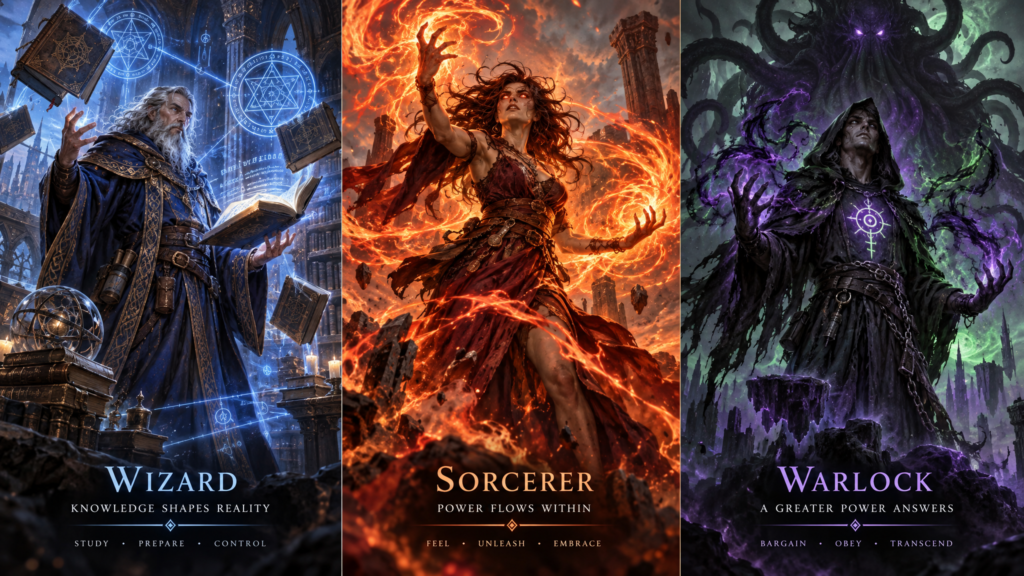
The Wizard studies magic, the Sorcerer is born with an innate connection to it, and the Warlock obtains supernatural powers through a pact with a mysterious patron.
But which class is the strongest? Which one is easiest to play? And which should beginners choose?
In this guide, we’ll compare the Wizard, Sorcerer, and Warlock, examining their origins, abilities, spellcasting mechanics, subclasses, strengths, and weaknesses.
This article focuses on the revised 2024 D&D 5e rules, while also highlighting some differences that players coming from the 2014 version should know.
1. Wizard: The Master of Arcane Knowledge
The Wizard is perhaps the most traditional spellcaster in Dungeons & Dragons.
Unlike other magical characters, Wizards do not rely on supernatural bloodlines or mysterious patrons. Instead, they acquire their abilities through years of study, experimentation, research, and practice.
They view magic as a discipline that can be understood, analyzed, and mastered.
A Wizard might spend years studying ancient manuscripts, exploring forgotten libraries, or experimenting with magical artifacts to discover new spells.
How does the Wizard work?
The Wizard’s defining feature is its spellbook.
Rather than relying exclusively on a limited selection of known spells, Wizards gradually build a collection of magical knowledge that can expand throughout an entire campaign.
They can learn additional spells by discovering spellbooks, scrolls, or other magical sources, subject to the rules and opportunities provided by the Dungeon Master.
Under the 2024 rules, Wizards prepare their spells after a Long Rest, choosing from the spells recorded in their spellbook.
This gives them considerable flexibility: a Wizard can change their prepared spells to adapt to different challenges and situations.
Other important features include:
- Ritual Adept: Allows the Wizard to cast qualifying ritual spells from their spellbook without preparing them.
- Arcane Recovery: Helps restore expended spell slots after a Short Rest, subject to its limitations.
- Memorize Spell: Allows the Wizard to replace a prepared spell with another spell from their spellbook after a Short Rest.
- Spell Mastery: Eventually allows the Wizard to cast selected low-level spells without expending spell slots.
Best Wizard subclasses
The 2024 Player’s Handbook includes four Wizard subclasses:
| Subclass | Main specialization |
|---|---|
| Abjurer | Defensive magic and protection |
| Diviner | Prediction, information, and manipulation of fate |
| Evoker | Destructive elemental magic |
| Illusionist | Illusions, deception, and battlefield manipulation |
The Evoker is particularly attractive for players who want to specialize in offensive magic, while the Abjurer is ideal for those who prefer protection and magical defense.
Strengths and weaknesses
Strengths:
- Extremely versatile spell selection.
- Access to a broad range of magical effects.
- Excellent utility outside combat.
- Ability to adapt prepared spells to upcoming challenges.
- Powerful high-level spellcasting.
Weaknesses:
- Requires careful preparation and spell management.
- Relatively fragile compared with many martial classes.
- Depends heavily on the spells available in the spellbook.
- Can be challenging for inexperienced players.
Best for: Players who enjoy planning, studying magical abilities, and having a solution for almost every situation.
2. Sorcerer: The Power of Innate Magic
While Wizards learn magic, Sorcerers are born with it.
A Sorcerer’s magical abilities come from an innate source of power, such as a supernatural bloodline, an extraordinary event, or an unusual connection to magical forces.
For example, a character might inherit the power of an ancient dragon, develop magical abilities after exposure to another plane of existence, or be born with a connection to chaotic magical energy.
Unlike the Wizard, the Sorcerer does not need to study magic to understand how to use it. Magic is part of their nature.
How does the Sorcerer work?
The Sorcerer’s greatest strength is its ability to manipulate magic.
Its signature mechanic is Metamagic, which allows the character to modify how spells work.
Depending on the chosen options, a Sorcerer can:
- Cast certain spells more quickly.
- Increase the difficulty of resisting their spells.
- Improve the effectiveness of damage rolls.
- Cast spells without verbal or somatic components under the appropriate conditions.
- Affect additional targets with certain spells.
Metamagic is powered by Sorcery Points, which can also be used through the Font of Magic feature to create spell slots or convert spell slots into Sorcery Points.
The 2024 version introduces another important feature: Innate Sorcery.
This ability allows the Sorcerer to temporarily unleash their inner magical power, improving their spellcasting through increased spell save DC and advantage on Sorcerer spell attack rolls.
The Sorcerer therefore specializes in controlling and modifying magic rather than simply learning a large collection of spells.
Best Sorcerer subclasses
The 2024 Player’s Handbook includes four Sorcerer subclasses:
| Subclass | Main specialization |
|---|---|
| Aberrant Sorcery | Psionic and otherworldly magic |
| Clockwork Sorcery | Order, balance, and magical control |
| Draconic Sorcery | Draconic power and elemental magic |
| Wild Magic Sorcery | Unpredictable and chaotic magic |
The Draconic Sorcerer is particularly appealing for offensive spellcasters, while the Aberrant Sorcerer offers interesting psychic and control-oriented abilities.
Strengths and weaknesses
Strengths:
- Excellent ability to modify spells through Metamagic.
- Powerful offensive potential.
- Innate Sorcery improves spellcasting effectiveness.
- Strong specialization and distinctive magical identity.
- Flexible use of Sorcery Points.
Weaknesses:
- Generally has fewer spells available than a Wizard.
- Must make careful choices when selecting spells.
- Sorcery Points and spell slots require resource management.
- Some Metamagic combinations can be expensive.
Best for: Players who enjoy powerful magic, customization, and modifying spells to achieve specific effects.
3. Warlock: The Power of a Pact
The Warlock is perhaps the most unusual of the three classes.
Unlike the Wizard and Sorcerer, a Warlock gains magical power through a pact with a supernatural entity known as a patron.
This patron might be a powerful demon, an ancient entity from another dimension, a mysterious archfey, or even a celestial being.
The relationship between the Warlock and their patron can take many forms.
Some Warlocks willingly serve their patrons in exchange for power, while others might have entered into a pact without fully understanding its consequences.
This creates excellent opportunities for roleplaying, character development, and storytelling.
How does the Warlock work?
The Warlock uses a unique spellcasting system called Pact Magic.
Unlike Wizards and Sorcerers, who use the traditional Spellcasting feature, Warlocks have a smaller number of spell slots that are generally regained after a Short or Long Rest.
Their spell slots also increase in level as they advance, allowing Warlocks to cast increasingly powerful spells without needing a large number of different spell slots.
Another defining feature is Eldritch Invocations.
These special abilities allow Warlocks to customize their characters in several ways.
Depending on their choices, they can improve their magical attacks, gain additional spells, acquire utility abilities, or even develop melee-focused combat options.
One of the most iconic Warlock abilities is Eldritch Blast, a powerful offensive cantrip that can become particularly effective when combined with the right invocations.
The 2024 rules also introduce Magical Cunning, which allows Warlocks to recover some expended Pact Magic spell slots through a special ritual once per Long Rest.
At higher levels, Warlocks gain access to Mystic Arcanum, allowing them to cast powerful spells of higher levels.
Best Warlock subclasses
The 2024 Player’s Handbook includes four Warlock subclasses:
| Subclass | Main specialization |
|---|---|
| Archfey Patron | Fey magic, teleportation, and deception |
| Celestial Patron | Healing and radiant magic |
| Fiend Patron | Destructive magic and infernal power |
| Great Old One Patron | Psychic powers and eldritch abilities |
The Fiend is an excellent option for players who want an aggressive offensive spellcaster, while the Great Old One offers a more mysterious and mind-oriented approach.
Strengths and weaknesses
Strengths:
- Highly customizable through Eldritch Invocations.
- Powerful and reliable offensive cantrips.
- Spell slots recover on Short Rests as well as Long Rests.
- Excellent roleplaying opportunities through the patron relationship.
- Can specialize in ranged magic, utility, or melee combat.
Weaknesses:
- Fewer spell slots than traditional full spellcasters.
- Requires careful management of limited resources.
- Some builds depend heavily on specific invocations.
- Spellcasting progression works differently from that of Wizards and Sorcerers.
Best for: Players who enjoy customization, supernatural storytelling, and a spellcaster with a distinctive combination of magical and combat abilities.
4. Wizard vs Sorcerer vs Warlock: Main Differences
Although all three classes use arcane magic, their mechanics and playstyles are significantly different.
Here is a direct comparison:
| Feature | Wizard | Sorcerer | Warlock |
|---|---|---|---|
| Source of magic | Study and knowledge | Innate magical power | Pact with a patron |
| Main ability | Intelligence | Charisma | Charisma |
| Spellcasting system | Spellcasting | Spellcasting | Pact Magic |
| Spell preparation | Spellbook-based, after Long Rest | Changes when gaining a level | Changes when gaining a level |
| Main resource | Spell slots | Spell slots and Sorcery Points | Pact Magic spell slots |
| Special ability | Spellbook and Ritual Adept | Metamagic | Eldritch Invocations |
| Main strength | Versatility | Spell manipulation | Customization |
| Typical playstyle | Tactical and adaptable | Flexible and explosive | Specialized and resource-conscious |
Ability scores
Another important difference concerns the ability scores used by each class.
Wizard – Intelligence
Intelligence represents the character’s knowledge, research, and understanding of magical principles.
A Wizard should prioritize Intelligence to improve spellcasting effectiveness.
Sorcerer – Charisma
Charisma represents the force of personality and innate magical presence.
Sorcerers use this ability to determine the effectiveness of their spells.
Warlock – Charisma
Warlocks also rely on Charisma, reflecting their ability to channel the supernatural power obtained through their pact.
This makes Charisma important for both spellcasting and many of their class abilities.
5. Which Class Is Better in Combat?
One of the most common questions among new D&D players is which of these three classes is the strongest.
The answer depends on the type of combat and the role you want to perform.
Best for versatility: Wizard
The Wizard has access to an enormous variety of magical effects.
It can specialize in offensive spells, defensive magic, battlefield control, summoning, and utility.
Its ability to change prepared spells after a Long Rest makes it particularly effective in campaigns with varied challenges.
Best for magical burst damage: Sorcerer
The Sorcerer excels at modifying spells to suit specific situations.
Metamagic can provide powerful combinations, making it an excellent choice for players who want to maximize the effectiveness of their magic.
It is particularly attractive for players who enjoy dealing damage while maintaining a high degree of magical flexibility.
Best for consistent magical attacks: Warlock
The Warlock is famous for Eldritch Blast, which can become a highly effective source of repeatable ranged damage.
Unlike powerful leveled spells, cantrips do not normally consume spell slots.
The Warlock also has interesting ways to customize its combat role through Eldritch Invocations.
However, the best option depends on the campaign’s resting opportunities and how frequently the character can recover resources.
6. Which Class Is Best for Beginners?
If you are new to Dungeons & Dragons, choosing between these three classes can be difficult.
Each has a different learning curve.
| Class | Difficulty | Why? |
|---|---|---|
| Wizard | High | Large spellbook and preparation choices |
| Sorcerer | Medium | Spell selection and Metamagic management |
| Warlock | Medium | Pact Magic and Eldritch Invocation choices |
Choose Wizard if…
You enjoy researching abilities, preparing strategies, and having a wide selection of spells.
The Wizard is particularly rewarding for players who like to plan ahead and adapt to different situations.
Choose Sorcerer if…
You want to play a powerful spellcaster with a more intuitive magical identity.
Metamagic offers a distinctive playstyle, although learning how different options interact requires some experience.
Choose Warlock if…
You enjoy mysterious characters, supernatural bargains, and customizable abilities.
The Warlock is particularly interesting if you want to combine spellcasting with a more specialized combat role.
7. Can You Combine Wizard, Sorcerer, and Warlock Through Multiclassing?
Yes! D&D allows characters to combine different classes through a system called multiclassing.
For example, a character could begin as a Sorcerer and later acquire levels in Warlock.
One popular combination is the Sorcerer/Warlock multiclass, sometimes called a Sorlock.
This combination can bring together Metamagic, Pact Magic, and Eldritch Invocations, creating interesting offensive and utility options.
However, multiclassing also comes with disadvantages.
You delay access to higher-level class features and spells, and you need to meet the relevant ability score requirements.
A Wizard/Sorcerer combination can also be interesting, particularly for players who want to combine Intelligence-based spell preparation with Charisma-based magical abilities.
However, these combinations are not automatically stronger than a single-class character.
For beginners, sticking to one class is generally the easiest way to understand the game and experience the full progression of a character.
Final Verdict: Which Spellcaster Should You Choose?
The Wizard, Sorcerer, and Warlock are three of the most distinctive magical classes in Dungeons & Dragons.
Although they share access to arcane magic, their origins, abilities, and mechanics create very different experiences.
The Wizard is the ideal choice for players who want versatility and an extensive collection of spells.
The Sorcerer is perfect for those who want to manipulate magic and unleash powerful combinations through Metamagic.
The Warlock is an excellent option for players who enjoy customization, supernatural stories, and a different approach to spellcasting.
There is no universally superior class. The best choice depends on your preferred playstyle, the campaign, and the kind of character you want to create.
Whether you want to become a master of ancient magical knowledge, a living source of arcane power, or the servant of an enigmatic supernatural patron, D&D offers plenty of opportunities to create an unforgettable spellcaster.
Frequently Asked Questions
What is the main difference between Wizard, Sorcerer, and Warlock in D&D?
The main difference is the source of their magical abilities. Wizards learn magic through study, Sorcerers possess innate magical powers, and Warlocks obtain supernatural abilities through a pact with a patron.
Is Wizard stronger than Sorcerer in D&D 5e?
Neither class is universally stronger. Wizards generally offer greater spell versatility, while Sorcerers specialize in modifying spells through Metamagic. Their effectiveness depends on the campaign and the player’s strategy.
Is Warlock a full spellcaster in D&D 5e?
Yes. Warlocks have access to powerful spells and can reach the highest spell levels through Mystic Arcanum. However, their Pact Magic system works differently from the traditional spellcasting progression used by Wizards and Sorcerers.
What is the best class for dealing magic damage?
Sorcerers are particularly effective at offensive spell combinations thanks to Metamagic. Wizards have access to a broad selection of damaging spells, while Warlocks can specialize in repeatable attacks such as Eldritch Blast.
Which class is easiest to play: Wizard, Sorcerer, or Warlock?
The Warlock can be a relatively accessible option once its Pact Magic system is understood. Sorcerers have fewer spell choices to manage than Wizards, but Metamagic introduces additional decisions. Wizards generally require more preparation and planning.
Can a Wizard, Sorcerer, and Warlock use the same spells?
Some spells appear on multiple class spell lists, but not all. Each class has its own spell list and spellcasting rules. A character can also gain access to additional spells through certain subclasses, feats, and multiclassing options.
Can you multiclass Wizard, Sorcerer, and Warlock?
Yes. D&D allows multiclassing between these classes, provided the character meets the relevant ability score prerequisites. Combining classes can create interesting builds, but it can also delay access to higher-level spells and class features.