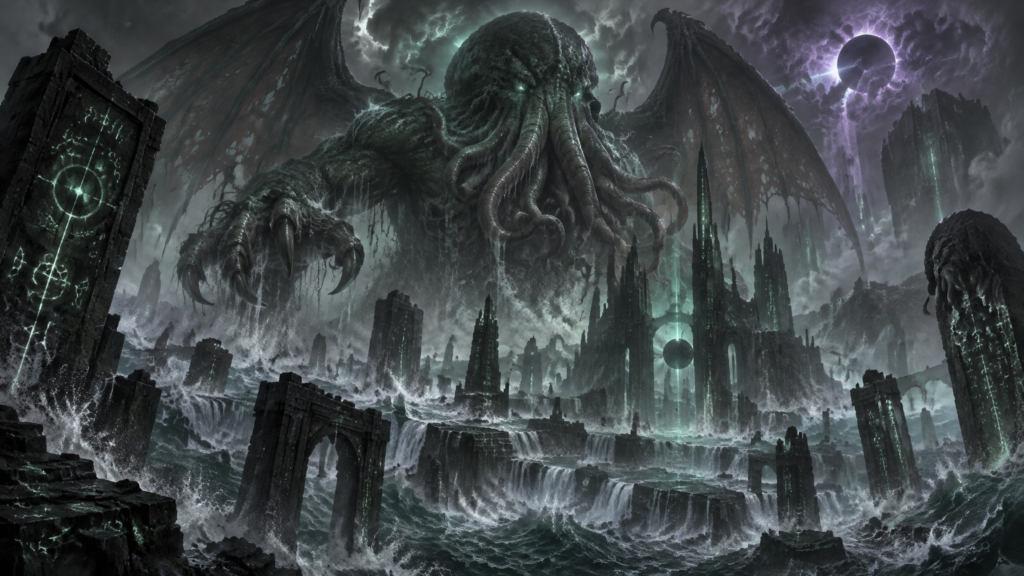
Few fictional creatures have achieved the cultural impact of Cthulhu. With his enormous body, tentacled face, monstrous wings, and connection to an ancient civilization beneath the ocean, he has become one of the most recognizable figures in horror literature.
Created by American writer H. P. Lovecraft, Cthulhu first appeared in the short story The Call of Cthulhu, published in Weird Tales in February 1928. Since then, the creature has inspired countless books, films, video games, and tabletop roleplaying adventures.
But who is Cthulhu? Where does he come from? What are his powers, and why do so many people worship him?
In this guide, we explore Cthulhu’s origins, physical appearance, supernatural abilities, mythology, and role in the Call of Cthulhu tabletop RPG.
Who Is Cthulhu?
Cthulhu is an ancient cosmic entity created by H. P. Lovecraft. He is one of the most famous beings associated with the Cthulhu Mythos, a shared fictional universe populated by alien gods, mysterious civilizations, forbidden knowledge, and entities beyond human comprehension.
In Lovecraft’s original story, Cthulhu is associated with the Great Old Ones, ancient beings that existed long before humanity appeared on Earth. These entities came from beyond the stars and eventually became hidden or dormant in remote places, including beneath the oceans.
Cthulhu himself lies imprisoned or dormant in the sunken city of R’lyeh, waiting for the stars to become right again.
His existence is closely connected to a mysterious worldwide cult that worships him and anticipates his eventual return.
Unlike traditional fantasy villains, Cthulhu is not simply an evil monster seeking power or revenge. He represents something much more unsettling: the possibility that humanity is insignificant in a universe filled with ancient forces that operate according to rules we cannot understand.
Cthulhu at a glance:
- Creator: H. P. Lovecraft
- First appearance: The Call of Cthulhu (1928)
- Nature: Ancient cosmic entity
- Associated beings: The Great Old Ones
- Residence: R’lyeh, a sunken city beneath the Pacific Ocean
- Worshippers: Cultists spread across different parts of the world
- Main themes: Cosmic horror, forbidden knowledge, madness, and humanity’s insignificance
Cthulhu’s Origins: The Creation of a Cosmic Horror Icon
To understand Cthulhu, it is important to understand the literary universe in which he was created.
H. P. Lovecraft and the Birth of Cthulhu
Howard Phillips Lovecraft was an American horror writer born in Providence, Rhode Island, in 1890. His stories explored themes of ancient civilizations, alien entities, forbidden knowledge, and the terrifying possibility that humanity was not the center of the universe.
Lovecraft’s approach to horror was different from traditional supernatural fiction.
Instead of focusing exclusively on ghosts, demons, or familiar monsters, he imagined entities whose existence challenged human understanding. Their motivations were often incomprehensible, their physical forms defied conventional biology, and their power made humanity appear insignificant.
Cthulhu became the most recognizable expression of this literary philosophy.
Lovecraft wrote The Call of Cthulhu in 1926, and the story was published in February 1928. It follows Francis Wayland Thurston, who investigates the mysterious papers of his deceased grand-uncle, Professor George Gammell Angell.
As Thurston examines documents, sculptures, and reports from different parts of the world, he gradually discovers evidence of an ancient cult worshipping an entity called Cthulhu.
The investigation eventually leads to the discovery of R’lyeh and a terrifying encounter with the creature itself.
Where Does Cthulhu Come From?
One of the most interesting aspects of Cthulhu’s mythology is that his ultimate origin is never fully explained in Lovecraft’s original story.
The cultists describe the Great Old Ones as ancient beings who existed long before humanity and came to the young Earth from the sky.
They eventually became associated with places beneath the earth and under the sea. Their knowledge survived through dreams, strange rituals, and mysterious religious traditions.
Cthulhu is connected to this ancient history, but Lovecraft deliberately leaves many questions unanswered.
We do not receive a complete biography, a precise account of his birth, or a detailed explanation of his civilization.
This uncertainty is intentional. Cthulhu is supposed to represent something beyond the limits of human knowledge.
Later writers expanded the mythology and developed additional interpretations of Cthulhu’s origins and relationships with other cosmic entities. However, these additions should not be confused with everything established in Lovecraft’s original fiction.
What Does Cthulhu Look Like?
Cthulhu’s physical appearance is one of the most distinctive elements of the character.
In The Call of Cthulhu, Lovecraft describes a gigantic humanoid creature with an octopus-like head, a body covered in scales, enormous claws, and rudimentary wings.
His appearance combines several different forms of life, creating something that seems familiar enough to recognize but fundamentally unnatural.
Cthulhu is often represented with the following characteristics:
- Tentacled head: His face resembles an enormous octopus, with numerous tentacles surrounding his mouth.
- Humanoid body: His general shape resembles a gigantic human figure, although his proportions are monstrous.
- Wings: Large wings extend from his back, adding to his intimidating silhouette.
- Claws: His enormous hands and feet are equipped with powerful claws.
- Scaly skin: His body is covered in strange, reptilian-looking scales.
- Gigantic size: He is so enormous that an ordinary human appears insignificant beside him.
The original story also includes a small sculpture representing Cthulhu. Its strange appearance is enough to disturb those who encounter it, suggesting that even a limited artistic representation cannot properly communicate the creature’s true nature.
Importantly, Lovecraft does not provide a complete anatomical description. Different artists, writers, and game designers have interpreted Cthulhu in different ways over the decades.
Cthulhu’s Powers and Abilities
Cthulhu is not simply a gigantic creature with supernatural strength. His abilities are connected to the cosmic nature of the Mythos.
Although Lovecraft’s original story does not provide a conventional list of powers, several extraordinary characteristics can be identified through the events and descriptions presented in the narrative.
1. Immortality and Dormancy
Cthulhu exists on a scale of time that makes ordinary human lifespans almost meaningless.
He is not described as a creature that can be permanently defeated through conventional means. Instead, he remains dormant in R’lyeh, preserved through mysterious forces associated with the Great Old Ones.
His condition is closely connected to the alignment of the stars. When the stars are right, the ancient beings may become capable of returning.
This creates one of the central elements of Cthulhu’s mythology: his apparent defeat or imprisonment is not necessarily permanent.
2. Psychic Communication and Dreams
One of Cthulhu’s most important abilities is his connection to dreams.
Even while dormant beneath the ocean, his influence can reach human minds through strange dreams and visions.
In the original story, artists and sensitive individuals experience disturbing dreams involving enormous stone cities, strange symbols, and an incomprehensible presence.
These experiences are connected to Cthulhu and the mysterious cult that worships him.
His influence demonstrates that physical distance does not necessarily protect humanity from the Mythos.
3. Superhuman Physical Strength
Cthulhu’s enormous body gives him extraordinary physical power.
During the story’s climactic encounter, a ship collides with the creature in an attempt to stop him. Although the impact temporarily disrupts his form, Cthulhu begins to reform.
This scene illustrates how ineffective conventional human weapons can be against an entity of his nature.
The encounter also suggests that his physical body does not behave according to ordinary biological rules.
4. Regeneration
One of the most memorable moments in The Call of Cthulhu occurs when Cthulhu’s body is struck by a ship.
The collision appears to destroy or disperse part of his physical form. However, the creature rapidly reforms and continues its pursuit.
This ability makes Cthulhu particularly terrifying.
Even when humans manage to damage him, there is no guarantee that their actions will have any lasting effect.
5. Influence Over Cultists
Cthulhu is worshipped by a mysterious cult that exists in different parts of the world.
Its members preserve ancient traditions, perform rituals, and wait for the return of their sleeping deity.
The cult’s existence suggests that Cthulhu’s influence can survive across generations, even when his physical presence remains hidden beneath the ocean.
However, the original story does not establish that he directly controls every cultist or that all of his followers communicate with him in the same way.
6. Cosmic Influence
Perhaps Cthulhu’s most important power is his ability to represent a threat that extends far beyond an ordinary physical encounter.
His awakening is associated with the return of the Great Old Ones and the collapse of humanity’s familiar understanding of the world.
In Lovecraft’s fictional universe, the greatest danger is not necessarily that Cthulhu will destroy a particular city or defeat an army.
It is that the return of these ancient beings could fundamentally transform the world and expose how insignificant humanity has always been.
R’lyeh: The Sunken City of Cthulhu
Ph’nglui mglw’nafh Cthulhu R’lyeh wgah’nagl fhtagn.
This famous phrase from the original story is commonly translated as:
In his house at R’lyeh dead Cthulhu waits dreaming.
R’lyeh is one of the most important locations in the Cthulhu Mythos.
It is an enormous, ancient city that lies beneath the Pacific Ocean, containing gigantic stone structures, mysterious monuments, and architectural forms that appear to defy ordinary geometry.
The city is not simply a place where Cthulhu sleeps. It is a symbol of an ancient civilization whose history stretches far beyond humanity’s understanding.
The Architecture of R’lyeh
The architecture of R’lyeh is deliberately disturbing.
Its enormous structures and strange angles create an environment that seems impossible to comprehend using conventional human geometry.
Even approaching or observing the city can produce a sense of disorientation.
Lovecraft uses this environment to reinforce one of the most important principles of cosmic horror: reality itself may be much stranger than human beings can imagine.
Why Is Cthulhu Sleeping?
According to the cultists in Lovecraft’s story, Cthulhu and the other Great Old Ones became trapped when R’lyeh sank beneath the ocean.
The stars were no longer right, and the ancient beings could not freely return to the world.
Their bodies remained preserved in their stone houses, while their consciousness continued to exist in a mysterious state of dormancy.
The cult believes that Cthulhu will eventually awaken when the cosmic conditions become favorable again.
His return is therefore not simply a matter of time. It is connected to the mysterious relationship between the stars, the ancient city, and the forces governing the universe.
The Cult of Cthulhu: Who Worships the Great Old One?
Cthulhu is associated with a mysterious worldwide cult that preserves his memory and anticipates his return.
In The Call of Cthulhu, the existence of this cult is revealed through several seemingly unrelated investigations.
Professor Angell studies strange dreams and mysterious sculptures. Inspector Legrasse investigates a disturbing ritual in Louisiana. Other accounts describe similar beliefs among people living in distant parts of the world.
Eventually, these discoveries reveal a common connection: the worship of ancient beings that existed before humanity.
The Purpose of the Cult
The cult believes that Cthulhu and the other Great Old Ones will eventually return.
Its members preserve ancient traditions, worship mysterious idols, and wait for the moment when the stars become right.
According to the mythology described in the story, the awakening of the Great Old Ones will bring an extraordinary transformation of the world.
Humanity will no longer live according to its familiar moral and social structures. Instead, the ancient powers will establish a new and incomprehensible order.
The Famous Cthulhu Chant
The most famous phrase associated with the cult is:
Ph’nglui mglw’nafh Cthulhu R’lyeh wgah’nagl fhtagn.
Although its pronunciation is intentionally difficult to reproduce, its commonly accepted translation is:
In his house at R’lyeh dead Cthulhu waits dreaming.
The phrase has become one of the most recognizable elements of Lovecraftian horror.
It expresses the central idea behind Cthulhu’s mythology: the ancient entity has not disappeared. He is simply waiting.
Cthulhu and the Great Old Ones: What Is the Difference?
One common source of confusion among readers and Call of Cthulhu players is the distinction between Cthulhu, the Great Old Ones, and other cosmic entities.
These terms are frequently used when discussing the wider Mythos, but they do not always represent a clearly defined hierarchy in Lovecraft’s original fiction.
Cthulhu
Cthulhu is an ancient cosmic entity associated with R’lyeh and the worldwide cult that worships him.
He is commonly described as one of the Great Old Ones and is the most recognizable figure in the Mythos.
The Great Old Ones
The Great Old Ones are ancient beings associated with the distant past and the cosmic forces of the Mythos.
In the original story, they are described as entities that existed before humanity and whose influence survived through dreams and cult traditions.
Later Mythos writers expanded the category and introduced additional beings, relationships, and interpretations.
The Outer Gods
The Outer Gods are another group of powerful cosmic entities that became particularly important in later Mythos literature and roleplaying adaptations.
They include beings such as Azathoth and Yog-Sothoth.
It is important to remember that the classification of Mythos entities developed over time. Lovecraft did not create a single, fully organized pantheon with a definitive hierarchy.
Cthulhu in Call of Cthulhu RPG
Cthulhu’s influence extends far beyond literature.
In 1981, Chaosium published Call of Cthulhu, a tabletop roleplaying game created by Sandy Petersen and inspired by Lovecraft’s fiction.
The game allows players to become ordinary people investigating supernatural mysteries, ancient cults, forbidden knowledge, and terrifying entities from beyond human understanding.
Cthulhu himself is one of the most important figures in the game’s mythology.
Is Cthulhu a Boss You Can Defeat?
Not in the traditional sense.
Unlike many fantasy roleplaying games, where powerful monsters are designed to be defeated through combat, Call of Cthulhu emphasizes investigation, survival, and psychological horror.
Cthulhu represents a threat far beyond the capabilities of ordinary investigators.
An encounter with him should not be treated like a conventional boss fight. Even if investigators manage to delay or disrupt his return, they are unlikely to defeat such an entity through ordinary weapons.
Cthulhu and Sanity
One of the defining mechanics of Call of Cthulhu is the Sanity system.
Investigators who encounter the Mythos may lose Sanity as they discover things that challenge their understanding of reality.
Cthulhu is an especially important example of this principle.
Simply witnessing an entity of his size and nature can be psychologically devastating. The experience forces investigators to confront the possibility that humanity is not the dominant form of intelligence in the universe.
This is what makes Cthulhu such an effective antagonist for horror roleplaying.
The danger is not limited to physical injury. Knowledge itself can become a source of terror.
Cthulhu’s Influence on Modern Horror and Popular Culture
Cthulhu has become one of the most influential characters in modern horror and speculative fiction.
His popularity has extended well beyond Lovecraft’s original stories, inspiring adaptations and references across several forms of entertainment.
Literature
Many writers have expanded the Cthulhu Mythos, introducing new creatures, locations, cults, and interpretations of its cosmic entities.
The result is a literary universe that extends far beyond the original works of Lovecraft.
Movies and Television
Cthulhu and the Mythos have inspired numerous horror films, independent productions, and television references.
Although faithfully adapting Lovecraft’s cosmic horror can be challenging, the creature’s distinctive appearance and mythology make it a natural subject for visual storytelling.
Video Games
Cthulhu has appeared in numerous video games, either as a central character or as an influence on the game’s atmosphere and mythology.
Examples include:
- Call of Cthulhu (2018): A psychological horror adventure inspired by Lovecraft’s universe.
- The Sinking City (2019): An investigative horror game featuring a fictional city influenced by the Cthulhu Mythos.
- World of Warcraft: Includes several creatures and themes influenced by cosmic horror, although these are not direct adaptations of Lovecraft’s original mythology.
Tabletop Roleplaying Games
The influence of Cthulhu is particularly strong in tabletop gaming.
Beyond Chaosium’s Call of Cthulhu, the Mythos has inspired supplements, adventures, campaigns, and horror-themed roleplaying systems.
For many players, Cthulhu has become almost synonymous with cosmic horror.
Final Thoughts: Why Is Cthulhu Still So Popular?
Cthulhu remains one of the most recognizable figures in horror because he represents something much more disturbing than an ordinary monster.
He is a reminder that humanity may not understand the universe, that ancient forces may exist beyond our perception, and that discovering the truth can be far more dangerous than remaining ignorant.
Lovecraft’s original story never provides a complete explanation of Cthulhu’s origins, motivations, or ultimate powers. Instead, it leaves readers with fragments of information, mysterious rituals, disturbing dreams, and the possibility of an approaching catastrophe.
That uncertainty is precisely what makes the character so effective.
For Call of Cthulhu players and Keepers, Cthulhu is also a perfect representation of the game’s philosophy. He is not simply an enemy waiting to be defeated. He is a cosmic force that challenges the investigators’ understanding of reality.
And somewhere beneath the Pacific Ocean, in the impossible stone city of R’lyeh, he waits.
Frequently Asked Questions About Cthulhu
Is Cthulhu a god or a monster?
Cthulhu is generally described as an ancient cosmic entity and one of the Great Old Ones. Although his followers worship him as a god, his exact nature is never fully explained in Lovecraft’s original story.
How powerful is Cthulhu?
Cthulhu possesses extraordinary physical and supernatural characteristics. He can influence dreams, is associated with ancient cosmic forces, and can recover from devastating physical damage. His true limits are never clearly established in the original story.
Where is Cthulhu located?
Cthulhu lies dormant in R’lyeh, an ancient sunken city beneath the Pacific Ocean.
When was Cthulhu created?
H. P. Lovecraft wrote The Call of Cthulhu in 1926. The story was first published in Weird Tales in February 1928.
What does the Cthulhu chant mean?
The famous phrase Ph’nglui mglw’nafh Cthulhu R’lyeh wgah’nagl fhtagn is commonly translated as: “In his house at R’lyeh dead Cthulhu waits dreaming.”
Can Cthulhu be killed?
Lovecraft’s original story does not establish a definitive way to permanently kill Cthulhu. His body reforms after being struck by a ship, suggesting that conventional physical attacks are unlikely to defeat him.
Is Cthulhu the most powerful being in the Cthulhu Mythos?
Not necessarily. The wider Mythos includes other cosmic entities, such as Azathoth and Yog-Sothoth, whose nature and power are portrayed differently across Lovecraft’s works and later interpretations. There is no universally established power ranking in the original literature.
Is Cthulhu part of the Call of Cthulhu RPG?
Yes. Cthulhu is central to the game’s mythology and is one of its most recognizable entities. However, most adventures focus on ordinary investigators uncovering cults, mysteries, and lesser Mythos threats rather than confronting Cthulhu directly.