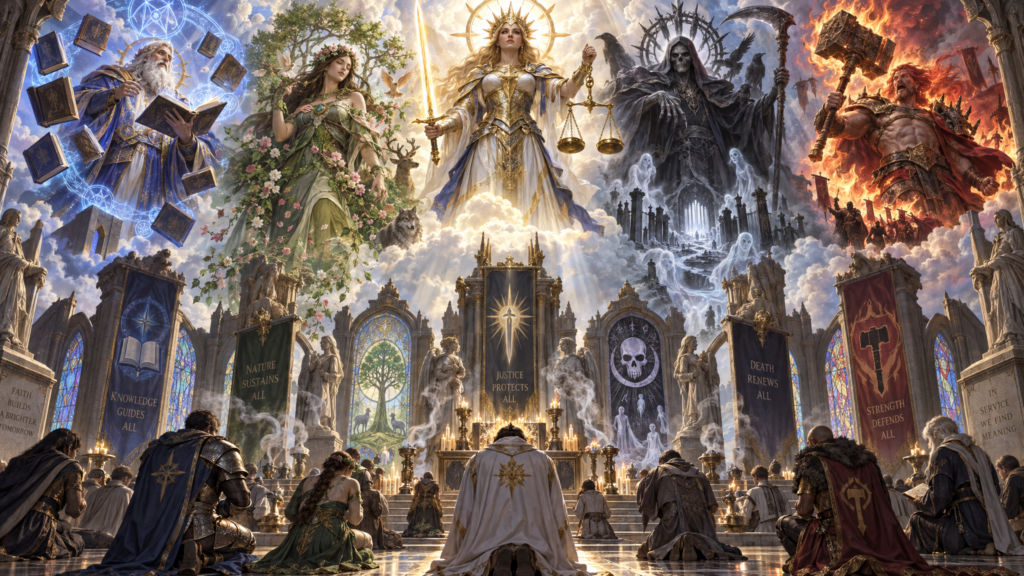
In the world of Pathfinder, religion is far more than a collection of temples, rituals and ancient legends. Gods are real, divine magic is a tangible force, and the actions of mortals can influence the balance between powerful supernatural beings.
Across Golarion, people pray for protection, ask the gods for guidance, celebrate religious festivals and follow traditions passed down through generations. Some dedicate their entire lives to a deity, while others simply offer a prayer before a dangerous journey.
For adventurers, however, religion can become something much more important. A character’s faith can determine their magical abilities, shape their moral decisions and influence how they interact with the world.
Whether you are creating your first cleric, designing a champion or simply want to understand the setting, this guide explores how religion works in Pathfinder, who the most important gods are and how divine beliefs influence life in Golarion.
1. Are the Gods Real in Pathfinder?
Yes. Unlike fantasy settings where the existence of gods might be uncertain, the divine powers of Pathfinder are undeniably real.
The gods of Golarion are immensely powerful beings who influence different aspects of existence. Their domains include the sun, death, nature, war, knowledge, freedom, love, destruction and countless other concepts.
They can communicate with their followers, grant divine magic and influence events through their servants. Their power is also reflected in the structure of the universe, including the Outer Planes and the afterlife.
However, gods are not necessarily omnipotent. They have different levels of influence, competing interests and limitations. Some cooperate, others maintain uneasy alliances, and some are bitter enemies.
Most importantly, worship does not automatically mean that a deity will personally intervene whenever a follower asks for help. Even devoted believers must make their own decisions and face the consequences.
The Gods and Golarion
Golarion is the primary setting of Pathfinder. Its inhabitants worship a wide variety of gods, with religious traditions differing between countries, cultures and communities.
A deity might be particularly important in one nation but relatively unknown in another. Some gods have enormous international followings, while others are associated with specific peoples, regions or traditions.
Religion is therefore an important part of the world’s history, politics and everyday life.
2. The Most Important Gods in Pathfinder
Pathfinder features a large pantheon of deities, each with their own personality, beliefs, followers and areas of influence.
The following are some of the best-known gods of Golarion. This is an introductory selection rather than a complete list, and the setting’s pantheon has evolved across different editions and published storylines.
Abadar – God of Cities and Wealth
Abadar represents civilization, commerce, law and wealth.
His followers believe that organized societies, fair trade and established laws are essential for building a prosperous world. Merchants, judges, bankers and city officials frequently worship him.
His temples often resemble banks or administrative institutions, and his clergy may be involved in resolving disputes, protecting trade routes and maintaining public order.
Abadar is an excellent choice for characters who value stability, justice, economic prosperity and the development of civilization.
Asmodeus – God of Tyranny and Contracts
Asmodeus is associated with contracts, pride, tyranny and domination.
He represents a strict and hierarchical vision of the world, where authority and obedience are fundamental principles. His followers often believe that power should belong to those capable of controlling others.
His religion is particularly influential in Cheliax, a nation famous for its association with infernal powers.
Although Asmodeus is an evil deity, his followers are not necessarily chaotic or irrational. Many are calculating individuals who use laws, agreements and institutions to achieve their objectives.
Desna – Goddess of Dreams and Stars
Desna represents dreams, stars, luck and freedom.
She is one of the most benevolent and adventurous deities in the Pathfinder pantheon. Her followers value exploration, personal freedom and the discovery of new experiences.
Travelers, explorers, artists and adventurers often worship her.
Desna is especially popular among people who reject oppression and believe that everyone should have the freedom to pursue their own destiny.
Erastil – God of Family and Farming
Erastil represents agriculture, hunting, family and traditional communities.
His followers value hard work, responsibility and the importance of maintaining strong relationships with family and neighbors.
He is particularly popular in rural communities, where his teachings encourage people to protect their homes and support one another.
Erastil is a natural choice for rangers, farmers, hunters and characters who prioritize community life.
Gozreh – God of Nature and the Sea
Gozreh represents the natural world, including oceans, storms, wind and wilderness.
Unlike deities who focus on civilization and society, Gozreh embodies the unpredictable power of nature.
Sailors, druids, fishermen and people living close to the wilderness often worship this deity.
Gozreh is neither simply benevolent nor malicious. Nature can provide food and shelter, but it can also destroy entire settlements through storms, floods and other disasters.
Iomedae – Goddess of Justice and Valor
Iomedae represents honor, justice, courage and righteous leadership.
She is one of the most important deities associated with heroic ideals. Her followers oppose tyranny and fight against evil, often dedicating themselves to defending the innocent.
Knights, champions, paladins and soldiers frequently worship her.
Iomedae is an excellent choice for characters who believe that strength should be used to protect others and uphold justice.
Nethys – God of Magic
Nethys represents magic, knowledge and the destructive and creative potential of arcane power.
He is a particularly unusual deity because he recognizes both the constructive and destructive aspects of magic.
His followers may dedicate themselves to magical research, the discovery of forgotten knowledge or the pursuit of power.
Wizards, scholars and magical researchers often worship him.
Nethys is a particularly interesting choice for characters who see magic as one of the fundamental forces shaping reality.
Pharasma – Goddess of Death and Fate
Pharasma governs death, fate, prophecy and the cycle of souls.
She is one of the most important deities in the cosmology of Pathfinder because she plays a central role in determining the destination of souls after death.
Her followers respect the natural cycle of life and death and generally oppose undeath, which disrupts that cycle.
Priests, healers, midwives and people who work with the dying may worship Pharasma.
Her faith is particularly important in a setting where resurrection, undead creatures and the afterlife are established parts of the world.
Sarenrae – Goddess of Healing and the Sun
Sarenrae represents the sun, healing, redemption and compassion.
Her followers believe in helping others, opposing cruelty and offering opportunities for redemption whenever possible.
She is especially popular among healers, clerics and adventurers who want to protect the innocent.
Although Sarenrae encourages forgiveness, her faith does not require passive acceptance of evil. Her followers can be fierce opponents of those who deliberately harm others.
Shelyn – Goddess of Beauty and Art
Shelyn represents beauty, art, love and music.
Her followers believe that creativity and compassion can improve the world. Artists, musicians, performers and people who appreciate beauty often worship her.
Shelyn’s faith emphasizes kindness, understanding and the importance of creating rather than destroying.
She is an interesting choice for characters who want to explore the artistic and emotional side of a fantasy world.
Torag – God of the Forge and Protection
Torag represents craftsmanship, defense, strategy and protection.
He is particularly important to dwarven communities, where his teachings emphasize responsibility, tradition and the protection of one’s people.
Blacksmiths, warriors, architects and craftsmen often worship him.
Torag is a natural choice for dwarven characters and adventurers who value discipline, loyalty and defensive combat.
Urgathoa – Goddess of Disease and Undeath
Urgathoa represents disease, indulgence, gluttony and undeath.
Her followers reject many of the natural limitations imposed on mortal life. Some pursue immortality through undeath, while others celebrate excess and the satisfaction of physical desires.
Necromancers, undead creatures and individuals who reject conventional morality may worship her.
Urgathoa is an example of how Pathfinder’s gods are not all benevolent forces. Some represent dangerous and destructive philosophies.
Zon-Kuthon – God of Darkness and Pain
Zon-Kuthon represents darkness, pain, suffering and obsession.
His faith is associated with extreme forms of devotion and the belief that suffering can reveal deeper truths.
His followers may engage in disturbing rituals and practices that are completely unacceptable to most other religions.
Zon-Kuthon is particularly suitable for dark fantasy campaigns and characters connected to horror, corruption or forbidden religious traditions.
Rovagug – God of Destruction
Rovagug represents destruction, violence and the annihilation of existence.
He is one of the most dangerous divine entities in the Pathfinder setting. His followers generally seek destruction rather than the construction of a functioning society.
The other gods have a powerful interest in keeping him imprisoned because his ultimate objective is to destroy the world.
Rovagug is an excellent source of inspiration for campaigns involving apocalyptic cults, ancient threats and catastrophic religious movements.
3. How Does Religion Work in Pathfinder 2E?
Religion is not exclusively a narrative element in Pathfinder. It can also have direct mechanical consequences for player characters.
A character can worship a deity for roleplaying reasons, but certain classes receive specific benefits from their religious devotion.
The most important examples are clerics and champions.
Clerics: Divine Magic and Religious Devotion
Clerics are among the characters most directly connected to religion.
They serve a deity and receive divine power through their devotion. Their abilities reflect the beliefs and supernatural influence of the god they worship.
Depending on their deity and character choices, clerics can specialize in healing, protection, destruction, support or offensive magic.
Their religious choices can influence several aspects of character creation, including:
- Divine spellcasting: Clerics use divine magic and gain access to spells associated with their deity.
- Divine Font: Their deity grants additional spell slots for Heal or Harm, depending on the deity’s rules.
- Domains: Clerics can select a domain connected to their deity, gaining access to a domain spell.
- Favored weapon: A deity’s favored weapon can influence the cleric’s combat options.
- Anathema: Clerics must avoid actions that directly violate their deity’s fundamental principles.
For example, a cleric of Sarenrae might focus on healing, protection and redemption, while a follower of Urgathoa could pursue a very different path involving disease and undeath.
Champions: Warriors of Divine Causes
Champions are warriors whose abilities are connected to powerful moral and religious convictions.
They often serve a deity and follow a specific cause that shapes their behavior and abilities.
Their role is not limited to fighting. Champions can defend the innocent, protect freedom, uphold authority or pursue other principles connected to their faith.
In the Remaster rules, champions can also become sanctified as holy or unholy when their deity permits it.
This system helps represent their connection to the cosmic struggle between holy and unholy forces.
Can Other Classes Worship Gods?
Absolutely.
A character does not need to be a cleric or champion to have a religion.
A fighter might worship Iomedae because they admire her ideals of courage and justice. A rogue might follow Desna because they value freedom and independence. A wizard could worship Nethys because they believe magic is the most important force in existence.
Religious devotion can also provide access to certain character options, depending on the rules and the deity involved.
In other words, religion can be an important part of almost any Pathfinder character.
4. Edicts and Anathema: The Rules of Faith
One of the most interesting aspects of Pathfinder’s religious system is the distinction between edicts and anathema.
These concepts define what a deity expects from their followers and which actions are unacceptable.
What Are Edicts?
Edicts are principles or actions that a deity encourages their followers to promote.
For example:
- A follower of Desna might explore new places and defend personal freedom.
- A follower of Sarenrae might show compassion and offer redemption.
- A follower of Torag might protect their community and respect craftsmanship.
- A follower of Abadar might support civilization and uphold fair laws.
Edicts are not simply suggestions for roleplaying. For characters whose class abilities depend on their deity, they can be important mechanical considerations.
What Is Anathema?
Anathema describes actions that directly violate a deity’s beliefs.
For example, a character devoted to a god who values freedom might be forbidden from participating in slavery. A follower of a deity who protects the natural cycle of life might be forbidden from creating undead.
Violating an anathema can have serious consequences for characters who receive divine powers.
The exact consequences depend on the character’s class rules and the circumstances of the violation. A player should discuss difficult situations with the Game Master rather than assuming that every questionable action automatically causes the loss of divine abilities.
5. Alignment, Holy and Unholy: What Changed in the Remaster?
One of the most important changes introduced by the Pathfinder Second Edition Remaster was the removal of the traditional alignment system.
Earlier versions of Pathfinder 2E used the familiar nine alignments:
- Lawful Good
- Neutral Good
- Chaotic Good
- Lawful Neutral
- True Neutral
- Chaotic Neutral
- Lawful Evil
- Neutral Evil
- Chaotic Evil
The Remaster removed these alignment categories and placed greater emphasis on individual beliefs, religious obligations and supernatural traits.
One of the most important replacements is the distinction between holy and unholy.
Holy
The holy trait represents powerful supernatural forces associated with benevolence, virtue and opposition to unholy forces.
Certain deities allow or require their devoted followers to become sanctified as holy.
Unholy
The unholy trait represents supernatural forces associated with malevolence, corruption and opposition to holy powers.
Some deities allow or require their followers to become sanctified as unholy.
What Is Sanctification?
Sanctification is a special connection between a character and holy or unholy divine power.
Depending on the deity, a devoted character may be able to choose sanctification, may be required to accept it or may not have access to it at all.
A character cannot be both holy and unholy.
This change is particularly important when creating clerics and champions using the Remaster rules. Players using older Pathfinder 2E books should consult Paizo’s official compatibility guidance to understand how previous options interact with the new system.
6. Can a Pathfinder Character Worship Multiple Gods?
Yes, but there is an important distinction between worshipping and revering a deity.
A character can respect multiple gods, attend their religious ceremonies or wear their holy symbols without necessarily being a devoted follower.
For example, a sailor might revere Gozreh for protection at sea, Desna for safe travels and Pharasma when attending a funeral.
However, a character who receives mechanical benefits through religious devotion generally chooses one primary deity.
This distinction allows Pathfinder characters to have more complex religious identities without creating unnecessary complications for character creation.
It also reflects the way religion works in many fantasy societies: people may recognize several divine powers and ask different gods for help depending on the situation.
7. Are There Atheists in Pathfinder?
Yes. Although the gods are objectively real in Golarion, not everyone chooses to worship them.
Some people reject organized religion, while others follow philosophical traditions instead of individual deities.
There are also characters who may acknowledge the existence of divine beings without considering them worthy of worship.
This is an important distinction: knowing that gods exist does not mean that everyone must devote their life to one.
In a world where divine powers are real, atheism and religious skepticism can take different forms from those found in our own world.
A character might reject the authority of the gods, distrust their motivations or believe that mortals should determine their own destiny.
These beliefs can create interesting roleplaying opportunities, especially when an adventurer encounters a cleric or a divine being.
8. Religion and the Afterlife in Pathfinder
Death is particularly important in Pathfinder because souls have a defined place in the cosmology of Golarion.
When a mortal dies, their soul eventually travels to the Boneyard, the realm associated with Pharasma.
There, the soul is judged and directed toward an appropriate afterlife.
The destination depends on several factors, including the soul’s beliefs, actions and spiritual nature.
Different Outer Planes represent different philosophies and cosmic forces. They are not simply locations where the dead live, but entire realms shaped by fundamental principles of existence.
Some souls become part of these planes, while others may eventually be transformed into different supernatural beings.
The existence of the afterlife also explains why religion is so important in Golarion. Faith is not merely about what happens during mortal life: it can influence what comes afterward.
Undeath is particularly controversial because it interferes with the natural cycle of souls. This is one of the reasons why Pharasma and her followers oppose undead creatures.
9. How to Choose a Religion for Your Pathfinder Character
Choosing a deity can be one of the most interesting parts of creating a Pathfinder character.
However, you should not simply select a god because their domain provides the most useful mechanical benefits.
A good religious choice should also reflect your character’s personality, background and motivations.
Here are some examples:
| Character concept | Suggested deity | Reason |
|---|---|---|
| Heroic knight | Iomedae | Justice, courage and honor |
| Traveling explorer | Desna | Freedom, dreams and adventure |
| Magical researcher | Nethys | Magic and knowledge |
| Healer | Sarenrae | Compassion and redemption |
| Dwarven defender | Torag | Protection and craftsmanship |
| Merchant | Abadar | Commerce and civilization |
| Nature-loving ranger | Erastil or Gozreh | Nature, hunting and wilderness |
| Dark necromancer | Urgathoa | Undeath and indulgence |
| Artist or musician | Shelyn | Beauty and creativity |
Before choosing a deity, consider these questions:
- What does your character believe about the world?
- What values are most important to them?
- Why did they choose this particular god?
- What would they refuse to do, even if it meant losing something important?
- How does their religion influence their relationships with other people?
These questions can help turn a simple religious choice into an important part of your character’s identity.
10. How Game Masters Can Use Religion in Their Campaigns
Religion offers Game Masters an enormous number of opportunities for creating memorable adventures.
Because gods, temples, religious organizations and supernatural forces are real, they can become central elements of an entire campaign.
Here are some ideas.
Religious Conflicts
Two religious organizations might disagree over the interpretation of a sacred prophecy.
The conflict could begin with political arguments but eventually develop into a much more dangerous struggle.
A Forgotten Temple
The party discovers an ancient temple dedicated to a forgotten deity.
Inside, they find relics, mysterious inscriptions and evidence that the god’s followers once controlled an important region.
A Divine Mission
A cleric receives a vision that appears to come from their deity.
The message is incomplete, however, and the party must investigate its meaning before deciding how to act.
A Dangerous Cult
A group of people secretly worships a destructive deity.
Their members have infiltrated a local government and are preparing a ritual that could threaten an entire settlement.
A Conflict Between Faith and Morality
A character discovers that following their deity’s teachings may require a difficult personal sacrifice.
This creates an opportunity to explore the difference between religious devotion, personal morality and individual freedom.
The Death of a God
The death or disappearance of a deity can have enormous consequences for the world.
Temples may lose their influence, followers may question their beliefs and rival religious organizations may attempt to take advantage of the situation.
The Pathfinder setting has already explored major divine upheavals, making this a particularly interesting direction for campaigns that use its established lore.
Conclusion
Religion is one of the most important elements of the Pathfinder setting.
The gods of Golarion are not distant legends. They influence the world, grant supernatural powers and shape the beliefs of entire civilizations.
For players, choosing a deity can provide much more than a few mechanical benefits. It can establish a character’s identity, determine their values and create meaningful roleplaying opportunities.
For Game Masters, religion provides an enormous source of conflicts, mysteries, organizations and adventures.
Whether your character follows the teachings of Iomedae, studies magic in the name of Nethys, explores the world under Desna’s stars or rejects the gods entirely, faith can become an essential part of their story.
And in a world where gods are real, even the smallest act of devotion can have extraordinary consequences.
Frequently Asked Questions About Religion in Pathfinder
How many gods are there in Pathfinder?
Pathfinder features a large number of deities, including major gods, regional divinities, demigods and other supernatural beings. The exact number depends on the edition and the sourcebooks being used.
Do all Pathfinder characters need a religion?
No. Characters can be religious, follow a philosophy, revere several deities or choose not to worship any god.
Can a fighter or rogue worship a god?
Yes. Religion is not limited to clerics and champions. Characters of almost any class can worship a deity as part of their background and personality.
Can clerics worship evil gods?
In the standard Pathfinder setting, some deities are associated with evil or destructive beliefs. Whether a character can receive their mechanical benefits depends on the deity’s rules, the campaign and any applicable restrictions.
What happens if a cleric violates their god’s anathema?
A serious violation can jeopardize the character’s relationship with their deity and their divine abilities. The exact consequences depend on the relevant class rules and the circumstances.
Did Pathfinder 2E remove alignment?
Yes. The Remaster removed the traditional alignment system and introduced greater emphasis on edicts, anathema and the holy and unholy traits.
Is Pharasma the goddess of death?
Yes. Pharasma is associated with death, fate, prophecy and the judgment of souls. She plays a central role in the afterlife of Golarion.
Can a character worship more than one god?
A character can revere multiple deities, but characters receiving mechanical benefits through worship generally choose one primary deity.