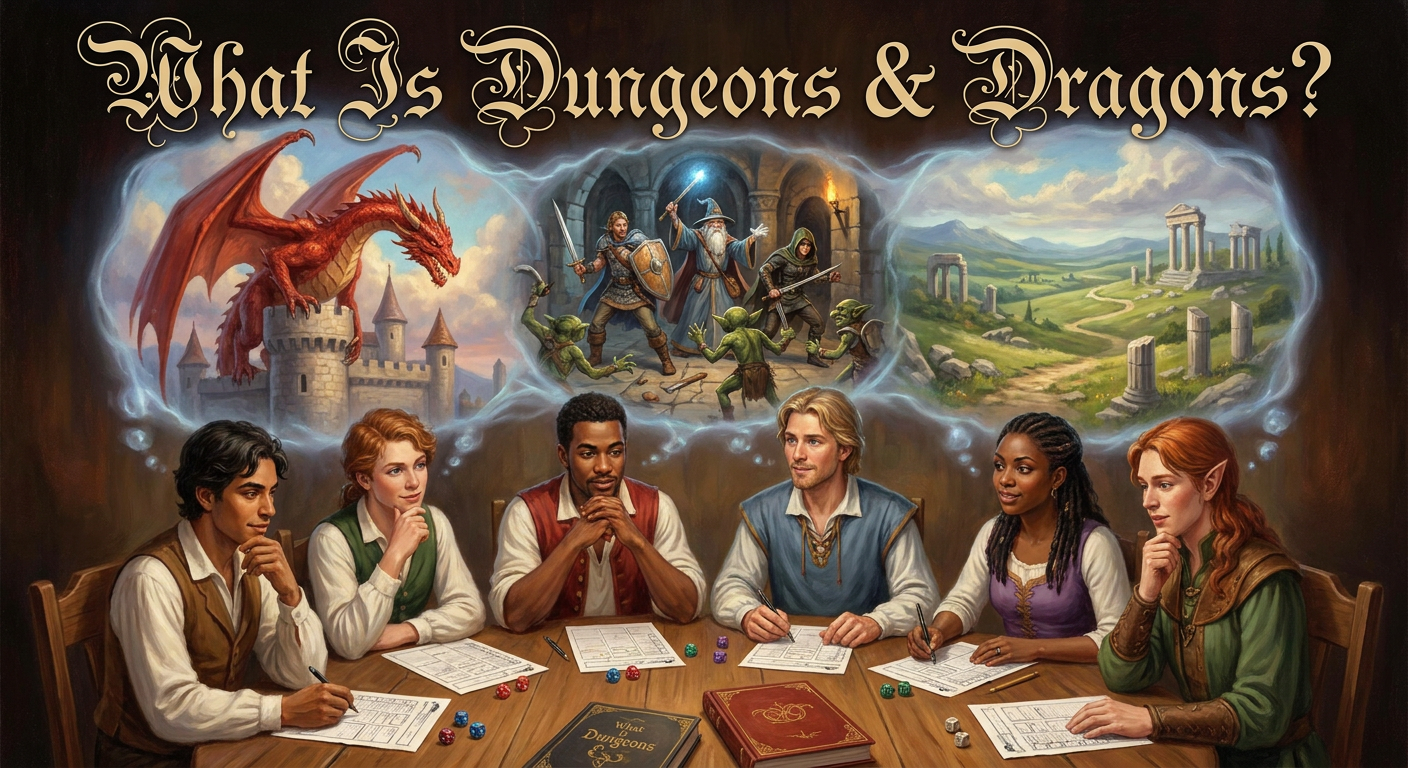
Dungeons & Dragons (D&D) is the world’s most popular tabletop role-playing game (TTRPG). It allows players to create fantasy characters and embark on cooperative storytelling adventures filled with magic, monsters, and exploration.
Originally created in the 1970s, D&D is now published by Wizards of the Coast and has become a global cultural phenomenon influencing video games, movies, and modern storytelling.
Unlike traditional board games, D&D has no single winner. Instead, players work together to build a shared narrative guided by imagination and dice rolls.
How Dungeons & Dragons Works
1. Players and the Dungeon Master (DM)
A typical D&D game includes:
- Players (Player Characters / PCs): Each player controls a fictional hero such as a wizard, rogue, fighter, or cleric.
- Dungeon Master (DM): The storyteller and referee who:
- describes the world and events
- controls non-player characters (NPCs)
- sets challenges and rules outcomes
- adapts the story based on player actions
The DM is essential because they shape the entire adventure.
2. Character Creation in D&D
Every player creates a unique character defined by:
- Race / Species (Human, Elf, Dwarf, Dragonborn, etc.)
- Class (Fighter, Wizard, Rogue, Cleric, and more)
- Ability Scores (Strength, Dexterity, Intelligence, Wisdom, Charisma)
- Skills, equipment, and background story
These elements determine what your character can do and how successful they are in different situations.
3. The Role of Dice (Especially the d20 System)
Dungeons & Dragons uses dice to determine outcomes, especially the 20-sided die (d20).
When a character attempts an uncertain action:
- Roll a d20
- Add modifiers (skills or abilities)
- Compare the result to a Difficulty Class (DC)
Example:
- Trying to persuade a guard
- Roll d20 + persuasion skill
- If the result beats the DC → success
This system adds randomness and excitement to every action.
4. Combat in Dungeons & Dragons
Combat is turn-based and strategic:
- Players and enemies take turns
- Actions include attacking, casting spells, or using items
- Damage is calculated using different dice (d4, d6, d8, d10, d12)
Combat is not just about winning—it’s about storytelling, tactics, and teamwork.
5. Role-Playing and Storytelling
At its core, D&D is a collaborative storytelling game.
Players decide:
- what their character says
- how they react to situations
- what choices they make
The DM then describes the consequences, shaping a dynamic and evolving story.
Why Dungeons & Dragons Is So Popular
D&D continues to grow in popularity because it offers:
- Creative freedom and imagination
- Social and cooperative gameplay
- Endless storytelling possibilities
- Influence on video games and pop culture
- Problem-solving and strategic thinking
It is both a game and a shared storytelling experience.
Example of a D&D Scenario
The Dungeon Master says:
“You enter a dark tavern. A hooded figure watches you silently.”
Players can respond with actions like:
- “I approach the figure and speak to them.”
- “I observe from a distance.”
- “I draw my weapon cautiously.”
The DM then decides what happens based on the players’ choices and dice rolls.
Final Summary
Dungeons & Dragons is:
- A fantasy role-playing game
- A collaborative storytelling experience
- A mix of strategy, imagination, and chance
- A system where dice shape outcomes but creativity drives the story
There are no fixed winners—only unforgettable adventures.
Frequently Asked Questions (FAQ)
What is Dungeons & Dragons in simple terms?
D&D is a tabletop role-playing game where players create characters and go on fantasy adventures guided by a Dungeon Master.
Do you need experience to play D&D?
No. Beginners can start easily, and many groups welcome new players.
How many players do you need for D&D?
Usually 3–6 players plus one Dungeon Master, but it can work with smaller or larger groups.
Is Dungeons & Dragons hard to learn?
The basic rules are simple, but the game becomes deeper as you play more.
What do you need to play D&D?
You need:
- Dice (especially a d20 set)
- Character sheets
- Rulebooks (optional but helpful)
- A group of players and a Dungeon Master
Can D&D be played online?
Yes. Many groups play online using virtual tabletops and voice chat.
Is D&D only about fighting monsters?
No. It includes exploration, dialogue, puzzles, storytelling, and role-playing.