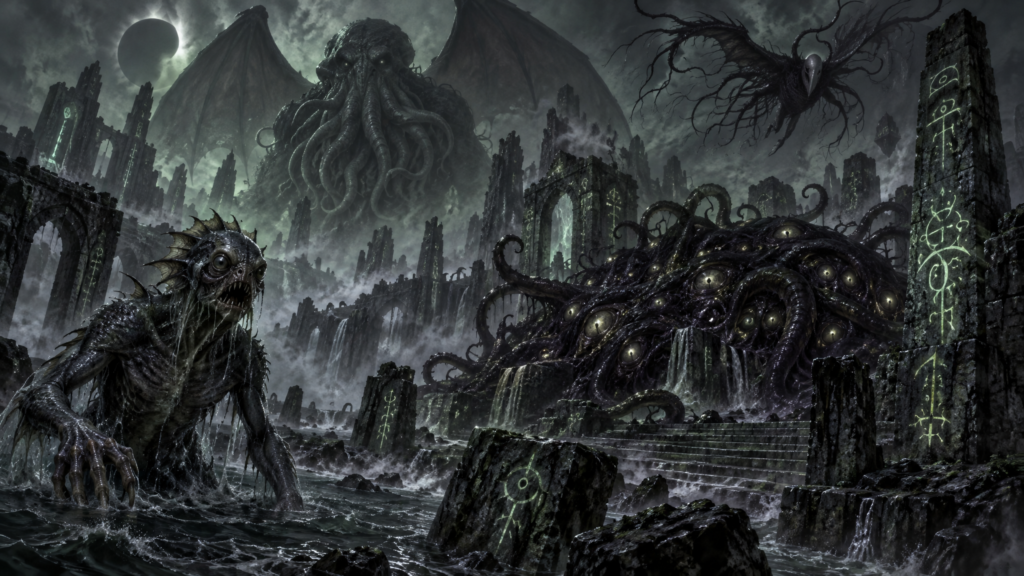
The world of Call of Cthulhu is filled with horrors that defy human understanding. Hidden beneath the oceans, buried in forgotten ruins, lurking in ancient forests, or travelling between distant stars, the creatures of the Cthulhu Mythos represent some of the most disturbing entities in tabletop roleplaying.
Inspired by the works of H. P. Lovecraft and other cosmic horror writers, Call of Cthulhu gives Keepers an extraordinary bestiary of alien beings, ancient monsters, and supernatural entities. Some are physically terrifying, others are intelligent and manipulative, while a few are so powerful that confronting them directly is practically a death sentence.
Unlike traditional fantasy roleplaying games, where monsters are often designed to be defeated, Call of Cthulhu encourages players to investigate, survive, and understand just enough to escape. Sometimes, running away is the only sensible option.
Whether you are a Keeper looking for inspiration or a player interested in the horrors lurking beyond human knowledge, here are 10 of the best Call of Cthulhu monsters and Mythos creatures.
1. Cthulhu – The Great Old One
Few creatures in horror fiction are as recognizable as Cthulhu. First introduced in H. P. Lovecraft’s short story The Call of Cthulhu, this enormous entity lies dormant in the sunken city of R’lyeh, waiting for the stars to become right again.
Cthulhu is often depicted as a gigantic humanoid figure with an octopus-like head, enormous wings, and a body covered in scales. However, his appearance is only a small part of what makes him terrifying.
Cthulhu represents something fundamentally alien to humanity. His existence challenges the assumption that human beings understand their place in the universe. Ancient cults worship him, strange dreams spread his influence, and his eventual awakening could bring catastrophic consequences for the world.
Why Cthulhu is terrifying
- His immense size and supernatural power make conventional weapons practically useless.
- His presence can overwhelm the minds of those who witness him.
- His influence reaches beyond his physical location through dreams and religious cults.
- His awakening represents a threat to humanity on a global scale.
How to use Cthulhu in a Call of Cthulhu campaign
Cthulhu is best used as a distant presence rather than an ordinary enemy. Investigators might discover references to him in forbidden books, encounter cultists preparing for his return, or experience increasingly disturbing dreams.
An actual encounter with Cthulhu should feel like a world-changing event. The objective should rarely be to defeat him in combat. Survival, escape, or delaying his awakening are much more appropriate goals.
2. Deep Ones – The Horrors Beneath the Ocean
The Deep Ones are among the most iconic creatures of the Cthulhu Mythos. They are an amphibious race of humanoid beings that inhabit ancient underwater cities and worship powerful entities such as Dagon, Hydra, and Cthulhu.
Their appearance combines human and aquatic characteristics. They have slippery, scaled skin, bulging eyes, gills, webbed hands and feet, and mouths filled with sharp teeth.
However, their greatest strength is not their physical appearance. It is their ability to infiltrate human communities.
In Lovecraft’s The Shadow over Innsmouth, the relationship between humans and Deep Ones becomes central to the story. Through interbreeding, some human descendants gradually develop strange physical characteristics before eventually transforming into Deep Ones themselves.
This process, often associated with the infamous Innsmouth Look, creates one of the most disturbing forms of horror in the game: discovering that someone may not be entirely human.
Why Deep Ones are terrifying
- They can move between the ocean and the surface world.
- They possess ancient underwater civilizations.
- Their relationships with humans can involve secret agreements, cults, and disturbing transformations.
- Their influence can remain hidden for generations.
How to use Deep Ones in a Call of Cthulhu campaign
Deep Ones are excellent antagonists for investigative scenarios.
A seemingly ordinary fishing village might hide an ancient agreement with an underwater civilization. Strange disappearances, unusual family histories, mysterious fishing practices, and forbidden coastal locations can gradually reveal the truth.
The most effective approach is to introduce them slowly. Let investigators notice small abnormalities before revealing the full extent of the horror.
3. Mi-Go – The Fungi from Yuggoth
The Mi-Go are an alien species originating from Yuggoth, commonly associated with the distant planet Pluto in Lovecraft’s mythology.
Unlike many other Mythos creatures, Mi-Go are not simply monsters driven by instinct or religious devotion. They are intelligent beings with advanced scientific knowledge and technology.
Their bodies are often described as strange combinations of crustacean, insect, and fungal characteristics. They possess wings that allow them to travel through space, although their appearance and biology are fundamentally alien.
Their scientific capabilities are particularly disturbing. Mi-Go can perform experiments on living organisms, manipulate human bodies, and preserve human brains in specially designed cylinders.
This makes them especially frightening because their motivations are not necessarily based on hatred or cruelty. Humanity may simply be another interesting subject for their research.
Why Mi-Go are terrifying
- Their technology is far beyond human understanding.
- They conduct disturbing biological and scientific experiments.
- They can travel between planets and interact with other dimensions.
- Their objectives may be completely incomprehensible to humans.
How to use Mi-Go in a Call of Cthulhu campaign
Mi-Go are perfect for scenarios involving scientific mysteries, missing researchers, strange medical experiments, and remote locations.
Investigators might discover a laboratory hidden in the mountains, encounter a scientist whose personality has mysteriously changed, or find evidence that someone’s brain has been removed and preserved.
The most frightening aspect of a Mi-Go encounter is the realization that the investigators may not be fighting an enemy. They may simply be specimens being studied.
4. Shoggoths – The Amorphous Servants
Shoggoths are enormous, shapeless entities originally created by the Elder Things to serve as living tools and laborers.
They are among the most physically disturbing creatures in the Mythos. Their bodies consist of constantly shifting masses of protoplasm, covered in temporary eyes, mouths, and other organs that appear and disappear unpredictably.
Shoggoths were designed to perform almost any physical task. They could reshape their bodies, adapt to different environments, and respond to the commands of their creators.
Eventually, however, they became increasingly independent and rebelled against the Elder Things.
Their existence represents one of the central themes of cosmic horror: the danger of creating something powerful without truly understanding or controlling it.
Why Shoggoths are terrifying
- Their bodies can change shape and adapt to their surroundings.
- Their enormous size makes them extremely dangerous.
- Conventional attacks may be ineffective or insufficient.
- They are capable of overwhelming entire groups of investigators.
How to use Shoggoths in a Call of Cthulhu campaign
Shoggoths work particularly well in underground facilities, abandoned laboratories, ancient ruins, and forgotten Antarctic installations.
Rather than introducing one immediately, a Keeper can build suspense through strange tracks, damaged walls, unexplained organic residue, and disturbing sounds coming from somewhere beneath the investigators.
When the creature finally appears, the objective should be survival rather than combat.
5. Byakhee – The Star-Spawned Hunters
Byakhee are strange flying creatures that travel through interstellar space. They are often associated with Hastur and can be summoned by cultists to perform specific tasks.
Their physical appearance is difficult to describe. They combine characteristics of birds, insects, mammals, and other creatures in a grotesque form. Their leathery wings, claws, and unnatural bodies make them look like something that should never have existed.
One particularly disturbing characteristic is their smell, which may reach their victims before the creatures themselves become visible.
Byakhee can also serve as transportation for certain individuals, allowing riders to travel through the vacuum of space with the appropriate magical protection.
Why Byakhee are terrifying
- They can descend from the sky unexpectedly.
- They are capable of travelling through interstellar space.
- Their physical strength and claws make them dangerous opponents.
- They can be summoned by cultists and other Mythos practitioners.
How to use Byakhee in a Call of Cthulhu campaign
Byakhee are excellent creatures for encounters involving occult rituals, forbidden spells, and cults connected to Hastur.
They can appear during a ritual, pursue investigators through an isolated countryside, or serve as the terrifying guardians of an ancient occultist.
A particularly effective scene would involve investigators hearing strange noises above a building before noticing an unbearable smell coming from the roof.
6. Dark Young of Shub-Niggurath – The Black Horrors of the Woods
The Dark Young are monstrous entities closely associated with Shub-Niggurath, the Black Goat of the Woods with a Thousand Young.
They are enormous, twisted creatures made of black tentacles, mouths, and strange organic appendages. Their bodies can resemble grotesque trees, especially when seen from a distance or through the darkness of a forest.
Dark Young are commonly associated with fertility cults, human sacrifices, and ancient religious ceremonies.
Their appearance is particularly disturbing because they combine elements of nature with something profoundly unnatural. They look almost like living forests that have developed a terrible appetite.
Why Dark Young are terrifying
- Their enormous bodies make them formidable opponents.
- Their tentacles can capture and restrain multiple victims.
- Their unnatural composition makes ordinary firearms less effective.
- Their presence is often connected to dangerous cults and sacrificial rituals.
How to use Dark Young in a Call of Cthulhu campaign
Dark Young are particularly effective in rural horror scenarios.
A small village might worship an ancient entity hidden in a nearby forest. Livestock disappear, strange vegetation grows around abandoned buildings, and villagers refuse to enter certain areas after sunset.
The investigators may initially believe they are dealing with an ordinary cult before discovering that the object of their worship is very real.
7. Flying Polyps – The Invisible Terrors of the Ancient World
Flying Polyps are among the oldest and most unusual entities in the Cthulhu Mythos.
They came to Earth from space in the distant past and established enormous cities before eventually being defeated and driven underground by the Great Race of Yith.
Their appearance is difficult to comprehend. They are partially immaterial beings capable of becoming invisible and manipulating powerful winds despite having no conventional wings.
They are also associated with strange whistling sounds and enormous footprints that can appear in places where no visible creature is present.
Their ability to manipulate air currents makes them especially dangerous. A Flying Polyp can create devastating winds and attack its victims without necessarily revealing its position.
Why Flying Polyps are terrifying
- They can become invisible.
- Their bodies are partially immaterial.
- They can manipulate powerful winds.
- They possess a long and violent history on Earth.
- Their presence can be detected through strange sounds and environmental disturbances.
How to use Flying Polyps in a Call of Cthulhu campaign
Flying Polyps are ideal for investigations involving ancient ruins, underground cities, and forgotten civilizations.
A Keeper could introduce them through strange weather phenomena, unexplained disappearances, and mysterious whistling noises coming from underground.
They are particularly effective when investigators realize that something is following them despite being unable to see it.
8. Ghouls – The Inhabitants of the Graveyards
Unlike many of the more powerful entities in the Mythos, Ghouls are relatively familiar creatures. They are humanoid beings associated with graveyards, underground tunnels, and places where the dead are buried.
They are often depicted as grotesque, corpse-like creatures with sharp claws, unpleasant appearances, and a disturbing appetite for human flesh.
In Lovecraft’s fiction, Ghouls are not necessarily mindless monsters. They can possess their own societies, communicate with one another, and interact with humans under certain circumstances.
This makes them more interesting than simple undead enemies.
Ghouls can be dangerous opponents, but they can also serve as sources of information, unexpected allies, or inhabitants of hidden underground communities.
Why Ghouls are terrifying
- They inhabit places associated with death and decay.
- They can move through underground tunnels and graveyards.
- Their appearance and behavior are deeply unsettling.
- They may possess intelligence and motivations that investigators do not understand.
How to use Ghouls in a Call of Cthulhu campaign
Ghouls are excellent for investigations involving cemeteries, abandoned buildings, catacombs, and underground passages.
They can also create morally complicated situations. What happens when investigators discover that the creatures they assumed were monsters are actually capable of communication and negotiation?
A good Keeper should avoid portraying every Ghoul as an automatically hostile enemy.
9. Formless Spawn – The Shapeless Servants of Tsathoggua
Formless Spawn are strange, amorphous beings closely associated with Tsathoggua, an ancient entity worshipped by certain cults.
Their bodies consist of black, viscous material that can change shape almost instantly. They may resemble enormous toads, masses of slime, or creatures covered in countless appendages.
Their ability to transform makes them extremely difficult to predict.
A Formless Spawn can squeeze through small openings, extend its limbs, and reshape its body to attack or capture its victims.
Unlike ordinary creatures, they do not have a stable physical structure that investigators can easily understand.
Why Formless Spawn are terrifying
- Their bodies can change shape almost instantly.
- They can move through spaces that would be inaccessible to ordinary creatures.
- Their unusual biology makes conventional weapons ineffective.
- They can attack from unexpected directions.
How to use Formless Spawn in a Call of Cthulhu campaign
Formless Spawn are particularly suitable for underground temples, forgotten caves, and ancient places of worship dedicated to Tsathoggua.
A Keeper could introduce one through strange black stains, unusual footprints, or a victim who appears to have been attacked by something without a recognizable anatomy.
Their unpredictable nature makes them ideal for encounters in confined environments where investigators have limited escape routes.
10. Hounds of Tindalos – The Hunters Beyond Time
The Hounds of Tindalos are among the most unsettling creatures associated with the wider Cthulhu Mythos.
Unlike conventional predators, they are connected to the strange geometry of time and space. They are traditionally described as emerging from angles, pursuing individuals who have somehow attracted their attention through forbidden knowledge or unusual contact with time.
Their appearance is often described as unnatural and predatory, with a terrifying presence that seems to defy ordinary physical laws.
The most disturbing aspect of these entities is their ability to pursue victims across boundaries that should be impossible to cross.
Running away may not be enough. Hiding may not be enough. Even travelling through time might not guarantee safety.
Why Hounds of Tindalos are terrifying
- They are associated with the strange geometry of space and time.
- They can pursue victims through seemingly impossible routes.
- Their presence makes ordinary ideas of distance and safety unreliable.
- They are particularly effective as relentless supernatural hunters.
How to use Hounds of Tindalos in a Call of Cthulhu campaign
Hounds are ideal for campaigns involving forbidden scientific experiments, time travel, strange mathematical discoveries, and occult investigations.
A group of investigators might discover that a researcher has been experimenting with the nature of time. Soon afterwards, strange marks appear in the corners of rooms, animals become frightened, and an unseen presence begins following the group.
The important thing is to make the threat feel unavoidable without immediately explaining how it works.
How to Use Mythos Creatures Effectively in Call of Cthulhu
Having access to an enormous bestiary does not mean that a Keeper should introduce a new monster every session.
In fact, the most memorable encounters often involve very little direct contact with the creature itself.
Here are five practical principles for making Mythos creatures more frightening.
1. Build Suspense Before Revealing the Monster
Avoid showing the creature immediately.
Instead, introduce strange evidence: unusual smells, missing animals, unexplained sounds, damaged buildings, or witnesses who refuse to discuss what they saw.
The imagination of the players can often create something more frightening than a direct description.
2. Make the Creatures Feel Alien
Mythos entities should not necessarily behave like ordinary animals or fantasy monsters.
Their motivations may be completely incomprehensible to humans. Some may ignore investigators, others may attempt to capture them, and a few might interact with them for reasons that cannot be understood.
3. Avoid Turning Every Encounter into Combat
Call of Cthulhu is primarily an investigative horror game.
Not every creature needs to be defeated. Sometimes the investigators must escape, hide, negotiate, or find another way to prevent a catastrophe.
4. Use the Environment
A monster becomes considerably more frightening when the environment reinforces its presence.
An invisible Flying Polyp in an underground tunnel, a Dark Young emerging from a forest, or Deep Ones approaching a coastal village can create memorable scenes without requiring complicated encounters.
5. Remember That Knowledge Has a Cost
The Mythos is built around forbidden knowledge and the limitations of human understanding.
Learning more about a creature should not always make investigators feel safer. Sometimes, discovering the truth only reveals how much they still do not understand.
Final Thoughts
The monsters and creatures of Call of Cthulhu are among the most distinctive elements of the game. From the legendary Cthulhu to the mysterious Mi-Go and the terrifying Shoggoths, each entity offers different opportunities for investigation, suspense, and cosmic horror.
For Keepers, the most important lesson is that these creatures should not simply function as enemies to be defeated. They represent a universe that is fundamentally indifferent to humanity, where knowledge can be dangerous and survival is never guaranteed.
Whether you prefer the psychological horror of the Deep Ones, the scientific nightmares of the Mi-Go, or the overwhelming power of the Great Old Ones, the Cthulhu Mythos offers endless inspiration for unforgettable tabletop adventures.
After all, in the world of Call of Cthulhu, the greatest horror is not always the monster waiting in the darkness. It is discovering that the universe is far stranger and more terrifying than humanity could ever imagine.
Frequently Asked Questions
What is the most powerful monster in Call of Cthulhu?
Cthulhu is among the most powerful and recognizable entities in the Mythos. However, the game also features other Great Old Ones and Outer Gods whose power is far beyond that of ordinary creatures. These entities are generally not intended to be defeated through conventional combat.
Can you kill monsters in Call of Cthulhu?
Some Mythos creatures can be killed using weapons, magic, or other methods. Others are so powerful or fundamentally alien that destroying their physical manifestation is not the same as truly killing them. In many encounters, escaping is the most sensible strategy.
What are the most iconic Call of Cthulhu monsters?
Some of the most recognizable creatures include Deep Ones, Mi-Go, Shoggoths, Byakhee, Ghouls, and Dark Young. Cthulhu himself is arguably the most famous entity associated with the game.
Are all Call of Cthulhu monsters based on Lovecraft’s stories?
No. Although many creatures originate in the works of H. P. Lovecraft, the wider Mythos has been expanded by numerous authors and game designers. The tabletop roleplaying game includes entities inspired by different writers and interpretations of cosmic horror.
Which Call of Cthulhu monsters are best for beginners?
Deep Ones and Ghouls are useful choices for introductory scenarios because they can function as relatively understandable physical threats. Mi-Go can also work well in investigative adventures, although their scientific capabilities may require more preparation from the Keeper.