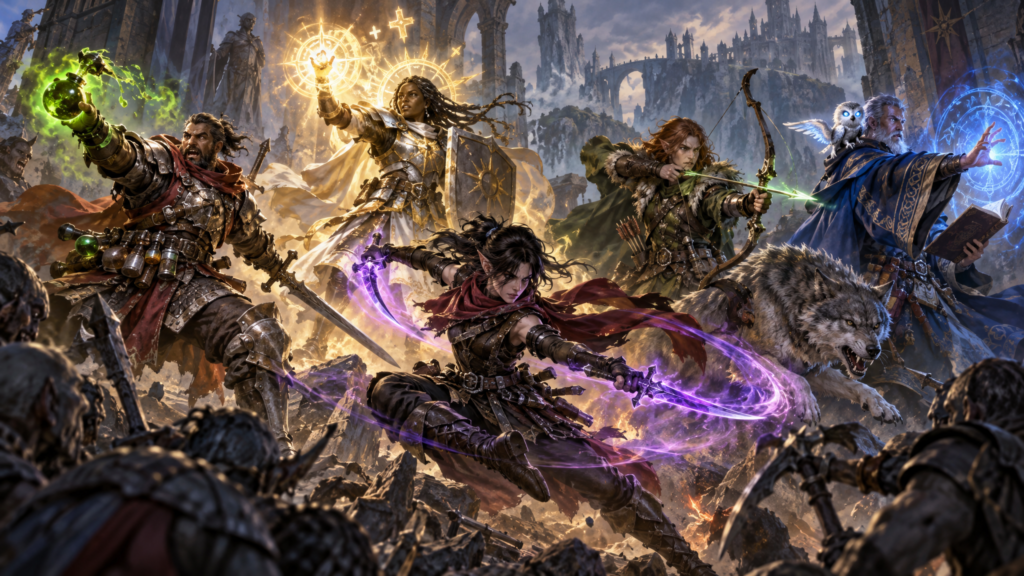
Pathfinder 2e offers an enormous amount of character customization. Choosing an ancestry, background, and class is only the beginning: archetypes allow players to expand their characters’ abilities, explore new combat styles, and fill important gaps in their party’s composition.
Whether you want to turn your Fighter into an unstoppable grappler, give your Cleric additional healing options, or let your Ranger command an entire team of animal companions, the right archetype can significantly improve your character.
But which archetypes are actually worth investing in?
In this guide, we’ll explore 10 of the best Pathfinder 2e archetypes for character optimization, focusing on their strongest features, ideal character combinations, and the situations in which they offer the greatest benefits.
The selection includes both combat-focused and utility-oriented options. Not every archetype is equally effective for every class, so we’ll also explain which characters benefit most from each choice.
How Do Archetypes Work in Pathfinder 2e?
Before looking at individual options, it’s important to understand how archetypes work.
Unlike traditional multiclassing systems, Pathfinder 2e allows characters to expand their abilities through Dedication Feats and additional archetype feats.
To enter an archetype, a character usually needs to meet its prerequisites and select its Dedication Feat using a class feat slot. Once the dedication is acquired, the character can choose additional feats from that archetype instead of their normal class feats, provided they meet the relevant requirements.
There is an important restriction: after taking a Dedication Feat, you generally need to acquire two additional feats from that archetype before you can select another Dedication Feat. This prevents characters from collecting too many powerful abilities from unrelated archetypes without making meaningful investments.
Archetypes can provide:
- New combat abilities and fighting styles.
- Additional spellcasting options.
- Improved defenses and survivability.
- Healing and support abilities.
- Animal companions and other special allies.
- New exploration, social, and skill-based capabilities.
Some campaigns also use the optional Free Archetype variant rule. Under this system, characters receive additional feat slots specifically for archetype feats, allowing for considerably more customization without sacrificing as many class feats.
This distinction matters when evaluating optimization: an archetype that requires several feats might be an excellent investment in a Free Archetype campaign but a more expensive choice in a standard game.
10 Best Pathfinder 2e Archetypes for Character Optimization
1. Beastmaster – Best for Animal Companions
Best for: Rangers, Druids, Champions, and characters who want additional battlefield support.
The Beastmaster archetype is one of the most interesting choices for players who want to incorporate animal companions into their characters.
Although Rangers and Druids already have access to animal companion options, Beastmaster allows characters from other classes to develop this aspect of their build.
Its main advantage is flexibility. As you invest in the archetype, you can gain additional animal companions and access abilities that improve how you command and use them.
Some of its most interesting features include:
- Beastmaster Dedication: Gives you access to an animal companion.
- Additional Companion: Allows you to acquire another companion.
- Call Companion: Helps you switch which companion is active.
- Beastmaster’s Trance: Provides a way to perceive through your companion’s senses.
- Lead the Pack: Supports characters who want to develop a stronger animal companion team.
The archetype is particularly interesting because it can give a character additional options during encounters and exploration.
Best combinations:
- Ranger + Beastmaster: A natural combination for characters focused on hunting, tracking, and fighting alongside animals.
- Druid + Beastmaster: Excellent for wilderness-themed characters who want to make animal companions central to their identity.
- Fighter + Beastmaster: Adds an animal companion to a character who otherwise specializes in direct physical combat.
Optimization verdict: Beastmaster is a strong thematic and tactical investment, especially in campaigns where animal companions can contribute consistently. However, remember that multiple companions do not automatically mean multiple companions fighting simultaneously. The archetype has specific rules governing active companions and switching between them.
2. Medic – Best for Healing and Party Survivability
Best for: Investigators, Rogues, Fighters, Rangers, and almost any character with a suitable Medicine investment.
The Medic archetype is one of the most practical options in Pathfinder 2e.
Healing is essential in many campaigns, and having a character who can restore Hit Points without constantly relying on magical resources can make a significant difference.
Medic specializes in improving the Medicine skill and providing additional ways to treat injured allies.
Its most valuable features include:
- Medic Dedication: Improves your Medicine proficiency and establishes your character as a dedicated healer.
- Doctor’s Visitation: Allows you to combine movement with Battle Medicine, helping you reach injured allies more efficiently.
- Treat Condition: Provides additional medical support for certain conditions.
- Resuscitate: Offers an emergency option for characters who are dying.
- Holistic Care: Expands the archetype’s medical utility.
One of the biggest advantages of Medic is that it doesn’t require your character to become a spellcaster.
A Fighter or Rogue can invest in Medicine and become a valuable source of healing without sacrificing their primary combat identity.
Best combinations:
- Investigator + Medic: An excellent combination for a character who already emphasizes Intelligence, Medicine, and problem-solving.
- Rogue + Medic: Combines skill versatility with valuable party support.
- Fighter + Medic: Gives a frontline character a useful secondary role outside dealing damage.
Optimization verdict: Medic is arguably one of the safest archetype investments for a party that needs reliable healing. It is particularly valuable when the group doesn’t have a dedicated Cleric or another character capable of providing consistent healing.
3. Marshal – Best for Team-Based Combat
Best for: Fighters, Champions, Barbarians, and other martial characters.
The Marshal archetype is designed for characters who want to lead their allies and improve the group’s effectiveness in combat.
Rather than focusing exclusively on personal damage, Marshal abilities help create a stronger team through auras, tactical positioning, and leadership.
Its most recognizable feature is Inspiring Marshal Stance, which can provide allies with a bonus to attack rolls while they remain within the stance’s aura.
The archetype also offers options for characters who prefer a more intimidating leadership style, including abilities associated with Dread Marshal.
Other useful features include:
- Marshal Dedication: Establishes your character as a battlefield leader.
- Inspiring Marshal Stance: Supports allies with an offensive bonus.
- Dread Marshal Stance: Provides a more aggressive, fear-oriented approach.
- Tactical Cadence: Expands your ability to coordinate allies.
- Cadence Call: Offers additional tactical support.
Marshal is particularly interesting in groups where several characters fight together in close proximity.
For example, a Fighter using Marshal abilities can improve the effectiveness of nearby melee allies, potentially making the entire party more dangerous.
Best combinations:
- Fighter + Marshal: An excellent frontline leader who combines personal combat ability with party support.
- Champion + Marshal: A defensive character who can protect allies while improving their offensive potential.
- Barbarian + Marshal: A powerful combination for characters who want to combine aggression with battlefield leadership.
Optimization verdict: Marshal is especially valuable in coordinated parties. Its effectiveness depends on positioning, party composition, and the actions required to maintain its abilities. It is less attractive for characters who frequently operate far away from their allies.
4. Wrestler – Best for Grappling and Battlefield Control
Best for: Fighters, Monks, Barbarians, and characters who specialize in Athletics.
The Wrestler archetype transforms grappling into a major component of your character’s combat strategy.
Instead of simply attacking opponents with weapons, Wrestlers specialize in controlling enemies through throws, holds, and other physical techniques.
This makes the archetype particularly interesting for players who want to disable dangerous opponents and control the battlefield.
Its abilities can support several combat maneuvers, including:
- Grappling.
- Throwing enemies.
- Restricting enemy movement.
- Controlling opponents through wrestling techniques.
- Combining Athletics with offensive actions.
The archetype works particularly well with characters who already have high Strength and proficiency in Athletics.
A Fighter with Wrestler Dedication, for example, can combine strong weapon attacks with grappling options. A Monk can use the archetype to develop an even more specialized unarmed fighting style.
Best combinations:
- Fighter + Wrestler: Excellent for characters who want reliable combat control and strong offensive options.
- Monk + Wrestler: A natural combination for unarmed combat specialists.
- Barbarian + Wrestler: Combines high physical strength with aggressive grappling techniques.
Optimization verdict: Wrestler is one of the best choices for characters who want to control enemies rather than simply maximize damage. Its value increases considerably when the campaign features dangerous melee opponents and your party can exploit the conditions and positioning you create.
5. Bastion – Best for Shield-Based Defense
Best for: Fighters, Champions, and other characters who regularly use shields.
Bastion is an excellent archetype for characters who want to specialize in defensive combat.
Shields are already important in Pathfinder 2e, but Bastion provides additional abilities that make shield use more versatile and effective.
Its features focus on improving defensive reactions, protecting allies, and making shields a more central part of your combat strategy.
Some of its notable abilities include:
- Bastion Dedication: Establishes your character as a specialist in shield defense.
- Disarming Block: Allows you to use a shield defensively while creating opportunities to disarm an opponent.
- Nimble Shield Hand: Provides greater flexibility when using a shield.
- Quick Shield Block: Improves access to shield-based defensive reactions.
- Reflexive Shield: Offers additional protection against certain incoming threats.
The main advantage of Bastion is that it reinforces an already useful combat tool.
A character who regularly raises a shield can benefit from additional defensive options without having to completely change their playstyle.
Best combinations:
- Fighter + Bastion: One of the strongest combinations for a dedicated shield specialist.
- Champion + Bastion: Excellent for characters focused on protecting allies and surviving dangerous encounters.
- Guardian + Bastion: A natural defensive combination for campaigns using the Guardian class.
Optimization verdict: Bastion is a strong choice for defensive martial characters. It is less attractive for builds that rarely use shields, since much of its value depends on making shield-related actions part of your regular combat routine.
6. Sentinel – Best for Armor-Focused Characters
Best for: Rogues, Rangers, Druids, and other characters who want improved armor options.
Sentinel is a defensive archetype focused on armor training and survivability.
It is particularly interesting for characters whose original class does not provide the armor proficiencies they would ideally like to have.
For example, a Rogue may want additional protection without changing their class, while another character might want to build a heavily armored warrior with a different primary specialization.
Sentinel provides access to armor-related abilities and can improve your character’s proficiency with certain types of armor.
Its main benefits include:
- Sentinel Dedication: Provides additional armor training.
- Armor Specialist: Improves your defensive capabilities when wearing suitable armor.
- Mighty Bulwark: Offers an important defensive improvement against certain effects.
- Additional armor-focused feats that support characters who want to specialize in heavy protection.
The archetype is particularly useful when armor proficiency is a meaningful limitation for your build.
However, it is important to remember that armor proficiency alone does not automatically make a character exceptionally durable. You still need to consider Dexterity, armor requirements, movement penalties, and the rest of your defensive statistics.
Best combinations:
- Rogue + Sentinel: Helps create a more heavily protected Rogue.
- Ranger + Sentinel: Supports a durable martial character.
- Druid + Sentinel: Can be interesting for certain armor-focused concepts, although you must carefully check the interaction with your class features and any restrictions.
Optimization verdict: Sentinel is a specialized defensive option. It can be extremely useful when it solves a specific armor-proficiency problem, but it isn’t automatically a better investment than improving your class’s existing defensive abilities.
7. Blessed One – Best for Additional Divine Healing
Best for: Fighters, Champions, Barbarians, and characters who want magical healing without becoming full spellcasters.
Blessed One is an excellent archetype for characters who want access to divine healing abilities.
Its main attraction is Lay on Hands, a powerful focus spell that allows the character to restore Hit Points and provide additional defensive benefits.
This makes Blessed One particularly useful for martial characters who don’t normally have access to reliable magical healing.
Unlike a full spellcasting dedication, Blessed One offers a more focused investment. You don’t need to develop an extensive spellcasting progression to gain a useful healing ability.
Important features include:
- Blessed One Dedication: Grants access to Lay on Hands.
- Blessed Sacrifice: Provides an option for characters who want to protect others through self-sacrifice.
- Blessed Spell: Expands the archetype’s divine capabilities.
- Greater Mercy: Offers additional benefits when using the archetype’s healing abilities.
Blessed One can be particularly valuable in parties that already have strong damage dealers but need additional ways to recover between encounters or survive dangerous fights.
Best combinations:
- Fighter + Blessed One: Adds healing to a character who already performs well in frontline combat.
- Barbarian + Blessed One: Provides a useful defensive and recovery option for an aggressive character.
- Rogue + Blessed One: Combines mobility and skill versatility with additional healing support.
Optimization verdict: Blessed One is a very practical archetype for characters who want healing without committing to a full spellcasting dedication. It is particularly useful when the party needs additional support but doesn’t want to sacrifice its primary combat roles.
8. Psychic – Best for Expanding Magical Abilities
Best for: Sorcerers, Wizards, Bards, and characters who want access to occult magic.
The Psychic archetype is an interesting option for characters who want to expand their magical capabilities.
It provides access to psychic-themed abilities and spellcasting options, allowing characters from other classes to incorporate elements of the Psychic class into their builds.
One of its most interesting features is the ability to access Amped Cantrips, which can enhance certain psychic cantrips through the use of Focus Points.
This can provide additional tactical options, particularly for characters who want to expand their offensive or utility magic.
Other relevant features include:
- Psychic Dedication: Opens access to psychic abilities.
- Basic Psychic Spellcasting: Expands your spellcasting options.
- Psi Development: Provides access to additional psychic abilities.
- Further spellcasting feats that improve your capabilities as you advance.
Psychic can be particularly interesting for characters who already have spellcasting abilities and want additional magical flexibility.
However, it is important to consider the action economy and the compatibility of the psychic abilities with your existing class features.
Best combinations:
- Sorcerer + Psychic: A natural combination for characters who want to expand their magical options.
- Wizard + Psychic: Offers additional magical flexibility and access to psychic-themed abilities.
- Bard + Psychic: Can create an interesting support-oriented spellcaster with a broader range of magical tools.
Optimization verdict: Psychic is a potentially powerful choice for magical characters, but it requires careful planning. The best results come from selecting abilities that complement your existing spellcasting rather than simply duplicating effects you already have.
9. Rogue – Best for Skill Versatility
Best for: Investigators, Rangers, Fighters, and characters who want additional skills and mobility.
The Rogue archetype is one of the most flexible multiclass options in Pathfinder 2e.
It allows characters to incorporate some of the Rogue’s defining abilities without abandoning their original class.
One of its biggest advantages is its focus on skills. Rogues are exceptionally versatile characters, and their archetype can help other classes become more effective outside combat.
Depending on your choices, you can gain access to abilities associated with:
- Additional skill training and expertise.
- Sneak Attack.
- Rogue-oriented skill feats.
- Mobility and stealth.
- Additional ways to approach combat encounters.
For example, a Fighter with Rogue Dedication can develop into a more versatile character who combines strong weapon proficiency with additional skill-based options.
An Investigator can also benefit from Rogue abilities, creating a character who is particularly effective in exploration and investigative campaigns.
Best combinations:
- Fighter + Rogue: Adds skill versatility and additional offensive options.
- Investigator + Rogue: An excellent combination for a character focused on investigation, stealth, and precision.
- Ranger + Rogue: Supports characters who specialize in stealth, tracking, and tactical combat.
Optimization verdict: Rogue is an excellent general-purpose archetype. Its greatest strength is versatility rather than a single spectacular ability. It is particularly attractive when your character would benefit from additional skills and a broader range of options.
10. Archer – Best for Ranged Combat Specialists
Best for: Fighters, Rangers, Rogues, and characters who want to specialize in bows.
Archer is a strong option for characters who want to focus on ranged combat without necessarily choosing the Ranger class.
It provides access to additional bow-related combat feats, helping characters develop a more specialized ranged fighting style.
The archetype is especially interesting for martial classes that already have strong weapon proficiency.
Its benefits can include:
- Archer Dedication: Opens access to specialized archery abilities.
- Double Shot: Allows you to make two ranged attacks with a bow under specific conditions.
- Triple Shot: Expands this approach for characters who meet the requirements.
- Point-Blank Shot: Improves certain close-range archery options.
- Additional feats that support different ranged combat strategies.
One of Archer’s biggest advantages is that it allows characters to specialize in bows while retaining their original class identity.
A Fighter can become an extremely capable archer, while a Rogue can combine ranged attacks with stealth and precision-based tactics.
Best combinations:
- Fighter + Archer: An excellent choice for a character who wants to maximize the effectiveness of bow attacks.
- Ranger + Archer: Supports a highly specialized ranged combat build.
- Rogue + Archer: Creates a versatile ranged character with strong skill and stealth capabilities.
Optimization verdict: Archer is a strong specialist archetype for characters who want to build around bows. It is less useful for characters who frequently switch between melee and ranged weapons or whose class already provides all the archery feats they need.
Pathfinder 2e Archetypes Compared: Which One Should You Choose?
The best archetype depends on your character’s role, your party composition, and the type of campaign you’re playing.
The following table summarizes the ten options discussed in this guide.
| Archetype | Main Strength | Best For |
|---|---|---|
| Beastmaster | Animal companions | Rangers, Druids |
| Medic | Healing and Medicine | Investigators, Rogues |
| Marshal | Party-wide combat support | Fighters, Champions |
| Wrestler | Grappling and control | Fighters, Monks |
| Bastion | Shield-based defense | Fighters, Champions |
| Sentinel | Armor proficiency | Rogues, Rangers |
| Blessed One | Divine healing | Fighters, Barbarians |
| Psychic | Magical versatility | Wizards, Sorcerers |
| Rogue | Skill versatility | Investigators, Fighters |
| Archer | Ranged combat | Fighters, Rangers |
Best Archetypes by Character Role
If you are primarily interested in optimizing a specific role, these are the options worth considering:
- Best for damage and offensive combat: Archer or Wrestler, depending on your weapon and fighting style.
- Best for battlefield control: Wrestler.
- Best for party support: Marshal.
- Best for healing: Medic.
- Best for additional magical abilities: Psychic.
- Best for defense: Bastion.
- Best for armor-focused builds: Sentinel.
- Best for animal companions: Beastmaster.
- Best for skill versatility: Rogue.
- Best for additional divine healing: Blessed One.
Remember that these are broad recommendations, not universal rankings. A character’s class feats, ability scores, party composition, and campaign environment can significantly change the value of an archetype.
Free Archetype: How Does It Change Character Optimization?
If your GM allows the optional Free Archetype rule, character optimization becomes considerably more flexible.
Under the standard rules, archetype feats compete with your normal class feats. This means that choosing an archetype can involve sacrificing an ability that might otherwise improve your character’s primary role.
Free Archetype provides additional feat slots that can be used for archetype feats, allowing characters to explore more options without giving up as many class abilities.
For example:
Fighter + Wrestler + Marshal
A Fighter could use Wrestler to control opponents through grappling while investing in Marshal to support nearby allies.
Ranger + Beastmaster + Medic
A Ranger could fight alongside an animal companion while also providing valuable healing support.
Champion + Bastion + Blessed One
A Champion could become an exceptionally defensive character with additional healing and protection options.
These combinations can be very effective, but they still require planning. Some abilities compete for actions, reactions, or positioning, and taking more archetypes does not automatically make a character stronger.
The best builds combine abilities that support one another rather than simply collecting as many feats as possible.
Common Mistakes When Choosing an Archetype
Even experienced players can make mistakes when planning an archetype-focused character.
Here are some common problems to avoid.
1. Choosing an archetype without considering your class
An archetype should complement your existing abilities. Choosing one that duplicates features you already have can waste valuable feat slots.
2. Ignoring prerequisites
Some archetypes require specific ability scores, skill proficiencies, or other conditions. Check these requirements before planning your build.
3. Forgetting the Dedication restrictions
You generally need two additional feats from an archetype before taking another Dedication Feat. Plan your progression accordingly.
4. Overlooking action economy
Some archetype abilities require actions or reactions that compete with your normal combat options. An ability can look excellent on paper but be difficult to use consistently.
5. Ignoring your party composition
A Medic might be extremely valuable in a party without reliable healing, while a second dedicated healer might provide less benefit to a group that already has several support characters.
6. Choosing abilities that don’t support your main strategy
A character specializing in ranged combat might not benefit much from an archetype built around close-range grappling. Always consider how an ability fits into your intended playstyle.
Final Thoughts
Archetypes are among the most important character customization tools in Pathfinder 2e.
They allow players to develop characters that go beyond the traditional limitations of their classes, creating unusual combinations and highly specialized builds.
For players interested in optimization, Medic, Marshal, Wrestler, Bastion, and Beastmaster are particularly interesting starting points. They offer clear benefits and can complement a wide variety of party compositions.
However, the strongest character isn’t necessarily the one with the most archetypes or the highest number of powerful-looking abilities. Good optimization means choosing feats that work together, complement your class, and help your party succeed.
Ultimately, the best archetype is the one that makes your character more effective at doing what you want them to do.
Which Pathfinder 2e archetype do you think offers the best optimization potential? Let us know in the comments!
Frequently Asked Questions
What is the best archetype in Pathfinder 2e?
There is no universally best archetype. Medic is one of the most practical options for party support, Wrestler is excellent for battlefield control, Marshal improves team-based combat, and Beastmaster offers additional tactical flexibility through animal companions.
Can you have multiple archetypes in Pathfinder 2e?
Yes. You can select multiple archetypes, but you generally need to acquire two additional feats from your current archetype after its Dedication Feat before selecting another Dedication Feat.
Is Free Archetype an official Pathfinder 2e rule?
Yes. Free Archetype is an optional variant rule presented in the Game Master’s Guide (GM Core). It gives characters additional opportunities to select archetype feats. However, the GM decides whether to use it in a campaign.
What is the best archetype for a Fighter in Pathfinder 2e?
Wrestler, Marshal, Bastion, and Archer are all interesting options for Fighters. Wrestler is particularly useful for battlefield control, Marshal provides team support, Bastion improves shield-based defense, and Archer supports ranged combat builds.
What is the best archetype for a healer?
Medic is one of the strongest dedicated healing options, especially for characters who invest in Medicine. Blessed One is another excellent choice for characters who want access to magical healing through Lay on Hands.
Are archetypes better than multiclassing?
Pathfinder 2e uses archetypes as its main system for expanding a character’s abilities beyond their original class. Multiclass archetypes are one category within this broader system. Whether an archetype is better than another depends on the character’s goals and the abilities being selected.