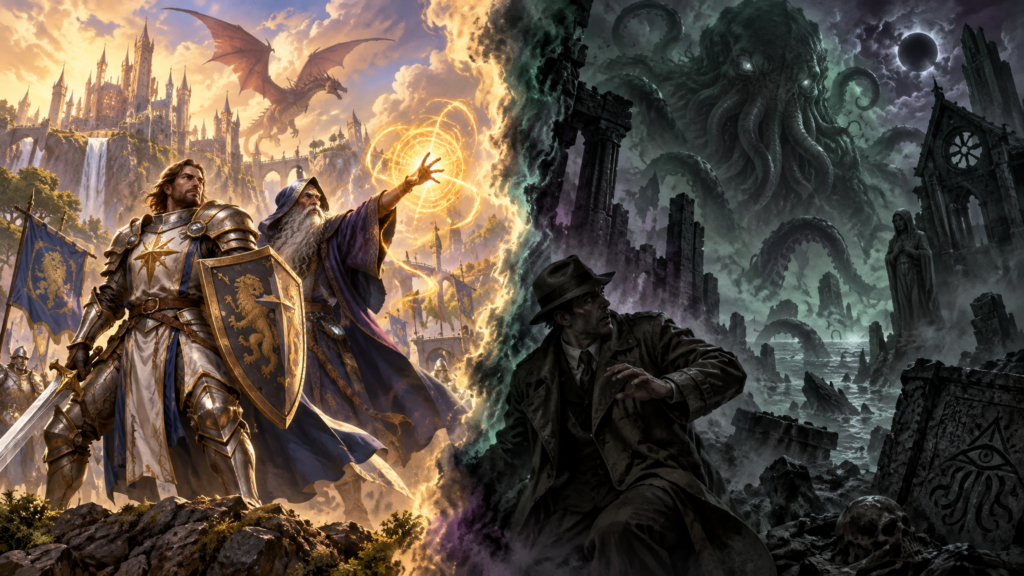
Dungeons & Dragons and Call of Cthulhu are two of the most recognizable tabletop roleplaying games in the world. Both invite players to create characters, explore fictional worlds, solve problems, and experience stories together. However, the two games offer very different experiences.
Dungeons & Dragons (D&D) is best known for fantasy adventures, powerful heroes, dangerous monsters, magical abilities, and epic quests. Call of Cthulhu, on the other hand, focuses on investigation, psychological horror, forbidden knowledge, and the terrifying possibility that humanity is insignificant in a universe it cannot understand.
So, which game should you choose?
In this guide, we compare Call of Cthulhu and D&D across their settings, rules, character creation, combat, progression, difficulty, and suitability for beginners. By the end, you should have a clearer idea of which tabletop RPG best matches your group’s interests.
Call of Cthulhu vs D&D: Quick Comparison
| Feature | Dungeons & Dragons | Call of Cthulhu |
|---|---|---|
| Main genre | Fantasy adventure | Investigative horror |
| Typical setting | Magical worlds and kingdoms | Often 1920s or modern-day settings |
| Main characters | Adventurers, heroes, spellcasters | Investigators, professionals, ordinary people |
| Core dice mechanics | Primarily a d20 system | Primarily a percentile D100 system |
| Combat | Often a central activity | Usually dangerous and best avoided when possible |
| Character progression | Levels, abilities, spells, and equipment | Skill improvement through experience |
| Character survival | Characters can become increasingly powerful | Characters can remain vulnerable throughout a campaign |
| Main challenge | Overcoming enemies and obstacles | Solving mysteries and surviving the unknown |
| Best for | Epic adventures and tactical combat | Investigation, suspense, and cosmic horror |
| Typical campaign style | Dungeon crawling, quests, exploration | Mysteries, investigations, conspiracies, survival |
1. Setting and Atmosphere
The most obvious difference between D&D and Call of Cthulhu is the world in which the stories take place.
Dungeons & Dragons: Fantasy and Adventure
D&D is primarily a fantasy roleplaying game. Depending on the setting, characters might explore ancient ruins, visit enchanted forests, investigate underground cities, fight dragons, or travel between different planes of existence.
Magic is a fundamental part of many D&D worlds. Wizards study spells, clerics receive divine powers, and other characters may possess supernatural abilities of their own.
The atmosphere can range from light-hearted fantasy to grimdark horror, but the game is particularly well suited to stories about heroes facing increasingly dangerous challenges.
A typical D&D adventure might involve:
- Exploring a forgotten dungeon.
- Defeating a powerful monster.
- Rescuing a kidnapped noble.
- Recovering an ancient magical artefact.
- Preventing a villain from destroying a kingdom.
The characters are usually capable adventurers who can grow stronger and take on greater challenges over time.
Call of Cthulhu: Mystery and Cosmic Horror
Call of Cthulhu is inspired by the horror fiction of H. P. Lovecraft and other writers associated with cosmic horror.
Many adventures take place during the 1920s, although the game also supports modern-day settings and other historical periods. Characters investigate disappearances, strange cults, mysterious deaths, forbidden books, and events that seem to contradict the laws of nature.
The horror often comes from discovering that the world is far stranger and more dangerous than the characters imagined.
A typical Call of Cthulhu adventure might involve:
- Investigating a suspicious death.
- Searching an abandoned mansion for evidence.
- Uncovering a secret society.
- Deciphering an ancient manuscript.
- Discovering a creature that humans were never meant to encounter.
Unlike many fantasy adventures, these stories do not necessarily end with the heroes defeating the ultimate threat. Escaping with crucial information, protecting innocent people, or preventing a catastrophe can be a significant victory.
Winner: D&D for epic fantasy and magical exploration. Call of Cthulhu for suspense, mysteries, and unsettling discoveries.
2. Character Creation
Creating a character is one of the most enjoyable parts of a tabletop RPG. However, D&D and Call of Cthulhu approach character creation differently.
Creating a D&D Character
D&D characters are built around their species, background, class, abilities, and personal history, with the precise options depending on the rules edition being used.
Your class defines many of your character’s capabilities. A fighter specializes in martial combat, a wizard uses learned magic, and a rogue excels at skills such as stealth and infiltration.
Character creation also encourages players to think about the role their characters will play within the party.
For example, a group might include:
- A fighter who protects allies and deals damage.
- A cleric who combines divine magic with support abilities.
- A rogue who specializes in stealth and skill-based challenges.
- A wizard who uses spells to control situations and overcome obstacles.
These roles can overlap, but party composition often matters, especially when preparing for combat encounters.
Creating a Call of Cthulhu Investigator
Call of Cthulhu uses investigators rather than the traditional heroic archetypes associated with D&D.
An investigator might be a journalist, private detective, doctor, professor, police officer, or antiquarian. Their occupation helps determine their professional skills and suggests how they might approach a mystery.
Instead of choosing a class that determines a character’s main abilities, players distribute points among characteristics and skills according to the rules of the chosen edition.
Skills such as Psychology, Library Use, Spot Hidden, Persuade, and Stealth can be important during investigations.
The character’s personal history also matters. Family relationships, important possessions, beliefs, and meaningful locations can provide opportunities for roleplaying and give the Keeper material to incorporate into the story.
Winner: D&D for players who enjoy defined character archetypes and fantasy abilities. Call of Cthulhu for those who prefer playing believable people with professional skills and personal connections.
3. Rules and Dice Mechanics
Although both games use dice to determine uncertain outcomes, their core systems work differently.
How D&D Uses Dice
D&D primarily uses a twenty-sided die, known as a d20, for ability checks, attack rolls, and saving throws.
A character generally rolls a d20, adds relevant modifiers, and compares the result with a target number or an opposing roll.
For example, a rogue attempting to climb a difficult wall might make an ability check. The Dungeon Master determines the relevant ability and difficulty, and the player rolls to see whether the attempt succeeds.
Combat also uses initiative to determine the order of turns. Characters can move, attack, cast spells, and use other abilities according to the rules of their edition.
The system includes many special rules for spells, conditions, character abilities, and combat situations. This provides tactical depth, although learning everything can take time.
How Call of Cthulhu Uses Dice
Call of Cthulhu 7th Edition primarily uses a percentile system based on a D100 roll.
An investigator has skills expressed as percentages. If an investigator has a 60% score in Library Use, for example, they generally succeed at a regular skill check by rolling 60 or lower on a D100.
The system also includes different difficulty levels, such as Hard and Extreme success, as well as bonus and penalty dice in appropriate circumstances.
This makes the basic probability relatively easy to understand: a higher skill percentage generally means a better chance of success.
However, the rules are not limited to simple skill checks. Investigators must also contend with combat, injuries, chases, and Sanity loss, and the Keeper needs to understand how these mechanics interact.
Winner: Call of Cthulhu has a particularly intuitive core skill mechanic. D&D offers more structured tactical options, but both games have rules that take practice to master.
4. Combat: Tactical Battles vs Dangerous Encounters
Combat is one of the most significant differences between the two systems.
Combat in D&D
D&D is designed to support tactical encounters against monsters, villains, and other opponents.
Characters often gain new combat abilities as they advance. They may acquire stronger spells, better equipment, additional attacks, or features that allow them to survive increasingly dangerous encounters.
Positioning, movement, resource management, teamwork, and the use of terrain can all influence the outcome of a battle.
A well-designed encounter can challenge a party without making combat feel hopeless. Players often have several ways to approach a threat, depending on their characters and the situation.
Combat is not mandatory in every D&D adventure, but it is an important part of the game’s design.
Combat in Call of Cthulhu
In Call of Cthulhu, combat can be extremely dangerous.
Investigators are generally much more vulnerable than high-level fantasy adventurers. A confrontation with armed criminals can be serious, while certain Mythos creatures may be difficult or impossible to defeat through ordinary violence.
This changes the way players approach danger.
Instead of immediately attacking an enemy, investigators might hide, negotiate, distract their opponents, gather evidence, or look for a way to escape.
Weapons are still relevant, and some adventures contain substantial combat. However, fighting is often a risk that needs to be weighed against the possible rewards.
Winner: D&D for tactical combat and character abilities. Call of Cthulhu for tense encounters in which avoiding a fight may be the smartest decision.
5. Character Progression and Power
Another major difference concerns how characters develop over time.
Progression in D&D
D&D uses a level-based progression system. As characters gain experience or reach story milestones, they advance through levels and unlock new abilities.
Depending on the class and edition, they might gain more hit points, improved spells, new class features, additional attacks, or other advantages.
This progression creates a strong sense of growth. A character who begins as a relatively inexperienced adventurer can eventually become capable of confronting powerful dragons, legendary villains, and threats to entire worlds.
Equipment and magical items can further expand a character’s capabilities.
Progression in Call of Cthulhu
Call of Cthulhu does not use the same class-and-level structure.
Investigators can improve their skills through experience. In the seventh edition, successful use of a skill can create an opportunity to improve it during the development phase, subject to the game’s rules.
However, becoming more experienced does not necessarily mean becoming dramatically more powerful.
A skilled investigator may become better at finding evidence, researching ancient texts, treating injuries, or persuading people. They can still be vulnerable to violence and the psychological consequences of encountering the Mythos.
This progression supports the genre: knowledge can help investigators solve mysteries, but it can also expose them to truths they would rather never have discovered.
Winner: D&D for a strong sense of heroic progression. Call of Cthulhu for grounded character development in which greater knowledge does not guarantee greater safety.
6. Sanity and Horror
Sanity is one of the defining mechanics of Call of Cthulhu and one of the clearest distinctions between the two games.
Sanity in Call of Cthulhu
Investigators have a Sanity score, commonly abbreviated as SAN. When they encounter certain horrifying or unnatural events, the Keeper may call for a Sanity roll.
Depending on the result and the event, the investigator may lose Sanity points and experience consequences such as temporary psychological disruption or bouts of madness, as defined by the rules.
The mechanic represents the psychological impact of confronting horrors that challenge an investigator’s understanding of reality. It is a fictional game mechanic, not a clinical measure of real-world mental health.
Sanity also creates interesting decisions. An investigator may need to uncover the truth to solve a mystery, but discovering more about the Mythos can come at a psychological cost.
The result is a tension between knowledge and safety.
Does D&D Have a Sanity System?
D&D does not use Sanity as a central, universal mechanic in the same way.
The game has rules for fear, charm, madness, and other psychological or supernatural effects, and some editions and supplements provide optional Sanity rules. A Dungeon Master can also create a horror-focused campaign using the existing rules.
However, these elements are not the defining foundation of ordinary D&D play.
Winner: Call of Cthulhu for psychological and cosmic horror. D&D can support horror, but it usually requires more deliberate choices about tone and mechanics.
7. Which Game Is Easier for Beginners?
There is no universal answer. The easier game depends on what the players find intuitive and what the Game Master is comfortable running.
Is D&D Easier to Learn?
D&D has a huge community, many beginner guides, character-building resources, actual-play videos, and published adventures.
Its core gameplay loop is also easy to understand: explore a location, interact with characters, overcome obstacles, and fight enemies when necessary.
However, character creation and tactical combat can introduce a considerable number of rules. Spellcasters in particular may need time to understand their available spells and abilities.
Pre-generated characters and a beginner-friendly adventure can make the first session much easier.
Is Call of Cthulhu Easier to Learn?
Call of Cthulhu has a straightforward core percentile mechanic, and investigators do not need to learn a class progression system.
However, a mystery-based game places particular demands on the Keeper. They must present clues, manage information, portray suspicious characters, and help the investigation continue without revealing every secret immediately.
New players may also need to adjust to the fact that their investigators are not designed to defeat every threat in direct combat.
For a first session, Chaosium’s free Quick-Start Rules and its introductory scenario, The Haunting, provide a useful starting point.
Verdict: D&D is a natural choice for players who want fantasy adventures and tactical encounters. Call of Cthulhu can be a great starting point for people who prefer mysteries and horror. Neither game is automatically easier for every group.
8. Which Game Is Better for Roleplaying?
Both systems encourage roleplaying, but they often reward different kinds of decisions.
In D&D, roleplaying can involve negotiating with kings, building relationships with companions, resolving moral dilemmas, investigating ruins, or deciding what kind of heroes the characters want to become.
Players may also enjoy acting out their characters’ personalities, developing rivalries, and making decisions that affect the wider campaign.
Call of Cthulhu places a particularly strong emphasis on interpreting clues, interviewing witnesses, researching historical records, and deciding how much risk to take in pursuit of the truth.
Investigators often have ordinary professions and personal lives, making it natural to explore their relationships, fears, loyalties, and reasons for continuing to investigate.
Neither system requires players to be expert actors. Clear communication, curiosity, and a willingness to make decisions from the character’s perspective are usually more important.
Winner: It depends on the story you want to tell. D&D is especially flexible for heroic character development, while Call of Cthulhu is particularly suited to investigative roleplaying and suspense.
9. Which Game Is Better for a Long Campaign?
Both D&D and Call of Cthulhu can support long campaigns, but they use different approaches to maintaining momentum.
Long Campaigns in D&D
D&D is particularly well suited to campaigns in which characters grow stronger, explore new regions, build relationships, and gradually confront greater threats.
A campaign can follow a published storyline or a homebrew setting created by the Dungeon Master.
The party’s growing abilities make it possible to introduce increasingly dangerous opponents and challenges, creating a clear sense of progression.
Long Campaigns in Call of Cthulhu
Call of Cthulhu campaigns often build toward a larger mystery, conspiracy, or confrontation with the Mythos.
The investigators might follow clues across different locations, discover connections between seemingly unrelated events, and gradually understand the scale of the threat.
Campaigns such as Masks of Nyarlathotep demonstrate how investigations can span multiple locations and develop into an extensive story.
However, the investigators’ vulnerability can affect long-term play. Players may need to create replacement characters, and the Keeper must manage the consequences of injuries, psychological strain, and dangerous discoveries.
Winner: D&D for long-term heroic progression. Call of Cthulhu for campaigns built around interconnected mysteries and gradually revealed cosmic horror.
10. Call of Cthulhu vs D&D: Which Should You Choose?
The best choice depends on what you want from your gaming sessions.
Choose D&D If You…
- Enjoy fantasy worlds, magic, dragons, and legendary heroes.
- Want tactical combat and a wide range of character abilities.
- Like seeing characters grow stronger through levels.
- Enjoy dungeon exploration, quests, and treasure hunting.
- Want a game with extensive community resources and published campaigns.
Choose Call of Cthulhu If You…
- Prefer mysteries, investigations, and uncovering secrets.
- Enjoy psychological horror and cosmic horror.
- Want to play ordinary people facing extraordinary threats.
- Prefer a game where combat can be dangerous and avoidance is often sensible.
- Like stories in which knowledge can have frightening consequences.
What If You Enjoy Both?
There is no reason to limit yourself to one system.
D&D and Call of Cthulhu can complement each other because they provide different types of experiences. A group might enjoy a long fantasy campaign on one occasion and switch to a short horror investigation for a special evening.
Trying both games can also help players discover what they value most in tabletop roleplaying: tactical combat, character progression, mystery-solving, atmosphere, or collaborative storytelling.
Final Verdict
Dungeons & Dragons and Call of Cthulhu are excellent tabletop RPGs, but they excel at different kinds of storytelling.
D&D is the stronger choice for players who want to become fantasy heroes, develop powerful abilities, explore magical worlds, and overcome tactical challenges. Call of Cthulhu is ideal for groups who want to investigate disturbing mysteries, experience cosmic horror, and confront the limits of human understanding.
If you enjoy both genres, try both systems. You might discover that D&D is your favourite game for an epic campaign, while Call of Cthulhu becomes your choice for a tense, unforgettable horror session.
Ultimately, the best tabletop RPG is the one that inspires your group to gather around the table, create memorable characters, and tell stories together.
Looking for your next tabletop RPG? Explore our other guides to Dungeons & Dragons, Pathfinder, horror roleplaying games, and the best campaigns and one-shot adventures for your next game night.
Frequently Asked Questions
Is Call of Cthulhu better than D&D?
Neither game is objectively better. D&D is generally a better fit for fantasy adventures, tactical combat, and heroic progression. Call of Cthulhu is better suited to investigative horror, suspense, and stories in which characters face threats they may not be able to defeat.
Is Call of Cthulhu harder than D&D?
Both games have rules that take time to learn. Call of Cthulhu’s percentile skill system is relatively intuitive, but running investigations can be challenging for a new Keeper. D&D offers a clear adventure structure but includes more character abilities and tactical combat options to manage.
Can beginners play Call of Cthulhu?
Yes. The game has introductory resources and beginner-friendly scenarios. New players can use pregenerated investigators and learn the rules gradually. The Quick-Start Rules are a practical way to try the game before investing in the full rulebooks.
Can you play Call of Cthulhu without knowing Lovecraft’s stories?
Absolutely. Familiarity with Lovecraft’s fiction can add context, but it is not required. The Keeper can introduce the setting and the Mythos through the adventure itself.
Is Call of Cthulhu more realistic than D&D?
Call of Cthulhu often begins with more realistic characters and familiar environments, particularly in historical or modern settings. However, the game also includes supernatural phenomena and cosmic horrors. D&D deliberately embraces fantasy, magic, and heroic abilities, so realism is not its primary goal.
Can you use D&D rules to run a Call of Cthulhu adventure?
You can adapt a horror story to D&D, but the experience may change significantly. D&D characters can possess magical abilities and become very powerful, potentially reducing the vulnerability that makes investigative horror effective. For a game focused on the Mythos, the dedicated Call of Cthulhu system is usually the more natural choice.
Which game is better for a one-shot?
Both can work well for a single session. D&D one-shots often focus on a dungeon, mission, or combat encounter, while Call of Cthulhu one-shots frequently revolve around a contained mystery or unsettling discovery. Choose according to the atmosphere you want.