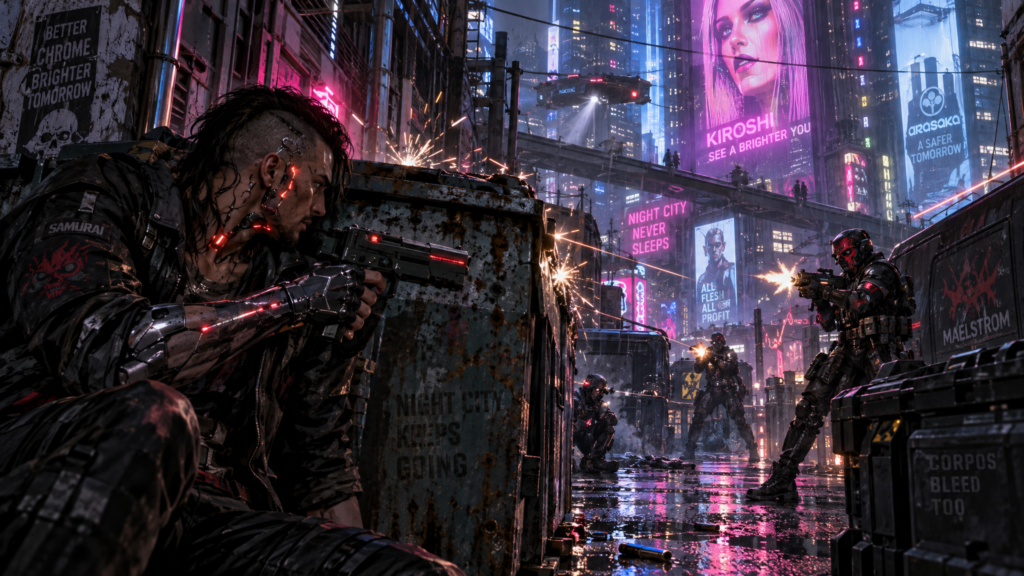
Combat in Cyberpunk RED is fast, dangerous, and unforgiving. A character can have impressive cyberware, powerful weapons, and years of combat experience, but a single mistake can still lead to serious consequences.
Understanding how a combat turn works is essential for new players. Fortunately, the basic structure is straightforward: determine who acts first, move your character, choose an action, and resolve its consequences.
In this guide, we will explain the initiative system, movement, available actions, attack rolls, damage, and the basic structure of a combat encounter in Cyberpunk RED.
What Is a Turn in Cyberpunk RED?
In Cyberpunk RED, combat is divided into turns and rounds.
A turn is the opportunity for one character or enemy to act. A round is completed when every participant in the initiative order has taken their turn.
Each round represents approximately three seconds in the game world. Since everyone’s actions happen within this short period, combat feels fast and chaotic.
The basic rule is:
One Turn = One Move Action + One Other Action
This means that, during a typical turn, your character can move and perform one additional action, such as shooting a gun, attacking with a melee weapon, reloading, or using a skill.
You do not necessarily have to move before acting. Depending on the situation, you can perform your action first, move afterward, or split your movement around certain actions.
Step 1: Roll Initiative
When combat begins, everyone involved rolls initiative to determine the order in which they act.
The initiative formula is:
Initiative = REF + 1d10
- REF: Your character’s Reflexes statistic.
- 1d10: Roll one ten-sided die.
For example, imagine that your character has REF 7 and rolls a 6 on the die.
Your initiative result is 13.
If an enemy has REF 6 and rolls a 4, their result is 10. Your character acts first because 13 is higher than 10.
Once everyone has rolled, the Game Master (GM) arranges the participants in descending order, from the highest initiative result to the lowest.
This order remains the same throughout the combat unless a rule specifically changes it. When the last participant has acted, a new round begins and the sequence repeats.
Step 2: Take Your Move Action
During your turn, you can move a distance based on your character’s MOVE statistic.
Your standard movement distance is:
Movement Distance = MOVE × 2 metres
For example, if your character has MOVE 5, you can move up to 10 metres with a standard Move Action.
You can use this movement to:
- Move closer to an enemy.
- Retreat from a dangerous opponent.
- Reach a better firing position.
- Move behind suitable cover.
- Get closer to a teammate who needs help.
Positioning is extremely important in Cyberpunk RED. Standing in the open while several enemies have clear shots at you is rarely a good idea.
Can You Move and Then Shoot?
Yes. You can generally move before performing your other action.
You can also split your movement around an action when the rules permit it. For example, you might move a few metres, fire a weapon, and then continue moving with the remainder of your movement allowance.
However, your total movement cannot exceed the amount available to you, and certain actions and weapon rules impose additional restrictions.
What If You Want to Move Further?
You can use the Run Action to gain an additional Move Action, provided that you have already taken a Move Action during that turn.
For example, a character with MOVE 5 could use one Move Action to travel 10 metres and then use Run for another Move Action of up to 10 metres.
Running uses your other action for the turn, so you generally cannot both run and perform a separate attack during that same turn.
Step 3: Choose Your Action
After accounting for movement, you can perform one other action. The right choice depends on your position, equipment, and immediate objective.
Here are some of the most important options.
Attack
You can attack an enemy with a ranged weapon, melee weapon, or unarmed combat, following the relevant rules.
Attacking is often the most direct option, but it is not always the best one. Shooting from a poor position, ignoring nearby threats, or attacking a heavily protected opponent can put you at a disadvantage.
Reload
If your weapon has run out of ammunition, you may need to spend your action reloading it.
This is particularly important when fighting several opponents. A character who forgets to account for ammunition might find themselves unable to attack at a critical moment.
Aim and Other Combat Options
Depending on the rules and circumstances, you may be able to use actions that improve your chances of hitting, manipulate equipment, or prepare for a later opportunity.
For example, you can use a Hold Action to specify an action that you will perform later in the initiative order when a chosen condition or position in the order is reached.
Get Up
If your character is prone, you must use the Get Up Action to stand before you can use a Move Action again.
Being knocked to the ground can therefore cost you valuable time, especially if enemies are nearby.
Grab, Choke, or Throw
Combat is not limited to firearms.
You can grapple an opponent, attempt to take an object from them, choke someone you have grabbed, or throw a grappled opponent to the ground. These options use their own rules and can be particularly useful in close quarters.
Use a Skill or an Object
You can also use an appropriate skill to perform a task or interact with an object.
Some tasks take longer than a single action, so the GM determines how much time is required. Drawing an easily accessible weapon into a free hand, for instance, does not normally require an action, while stowing a held weapon does.
Step 4: Resolve an Attack
When you choose to attack, you need to determine whether the attack hits and, if it does, how much damage it causes.
The procedure depends on the type of attack.
Ranged Attacks
For a typical ranged attack, you roll:
REF + Relevant Ranged Weapon Skill + 1d10
The result is compared against a Difficulty Value (DV) determined by the weapon’s range.
Different weapons perform differently at different distances. A pistol, shotgun, and assault rifle do not necessarily have the same difficulty values at a given range.
For example, suppose your character fires a pistol at an enemy 10 metres away. You consult the pistol’s range table, calculate your attack result, and compare it with the appropriate DV.
If your result exceeds the DV, the attack hits. If the results are tied, the defender wins.
Melee Attacks
Melee combat uses a different comparison.
The attacker rolls:
DEX + Melee Weapon Skill + 1d10
The defender rolls:
DEX + Evasion Skill + 1d10
The higher result wins, with the defender winning ties.
If the attacker wins, the attack hits and damage is resolved according to the weapon and the applicable rules.
What About Critical Successes and Failures?
The ten-sided die can produce particularly important results.
- A natural 10 produces a Critical Success, allowing an additional die to be rolled and added to the original result.
- A natural 1 produces a Critical Failure, requiring an additional die to be rolled and subtracted from the statistic, skill, and original die result.
These rules can make a seemingly ordinary attack surprisingly effective—or cause a character to make a costly mistake.
Step 5: Calculate Damage and Armor
Hitting an opponent does not necessarily mean that you will inflict damage to their Hit Points.
When an attack hits, the attacker rolls the weapon’s damage dice. The defender’s armor can absorb some or all of that damage.
The basic procedure is:
- Roll the weapon’s damage.
- Subtract the relevant armor’s Stopping Power (SP).
- Apply any remaining damage to the defender’s Hit Points.
- If the attack causes damage to Hit Points, the armor’s SP is reduced by 1 until repaired.
For example, suppose a weapon deals 12 damage and the target has armor with SP 7.
The armor absorbs 7 points, leaving 5 damage to be applied to the target’s Hit Points.
If the attack penetrates the armor and causes damage, the armor’s SP is reduced by 1.
This mechanic means that armor is valuable, but it is not an unlimited source of protection. As a fight continues, repeated hits can gradually make a character more vulnerable.
Critical Injuries
Some attacks can cause Critical Injuries, which introduce additional consequences beyond ordinary damage.
For example, a serious injury might impair movement or make certain actions more difficult. Critical Injuries can turn a manageable encounter into a desperate struggle to survive.
This is one of the reasons combat in Cyberpunk RED rewards careful positioning and tactical decisions rather than simply exchanging attacks until one side runs out of Hit Points.
Step 6: End Your Turn
Once you have completed your movement and other action, your turn ends.
The next participant in the initiative order takes their turn, following the same general procedure.
You do not automatically receive another action simply because you have finished your turn quickly. You must wait until the initiative order returns to you in the next round.
When every participant has acted, the next round begins.
Combat continues until the situation is resolved: one side might be defeated, the characters might escape, the opponents might surrender, or the GM might determine that the conflict has ended for another reason.
A Practical Example of a Cyberpunk RED Turn
Imagine that your character is a Solo caught in a firefight inside a ruined shopping centre.
An enemy is 12 metres away, firing from behind a counter. Your character has MOVE 5 and carries a pistol.
Here is how your turn might unfold.
1. Check your initiative.
Your character rolled higher than the enemy, so you act first.
2. Move toward cover.
You use your Move Action to travel 6 metres toward a concrete pillar, staying within your 10-metre movement allowance.
3. Fire your pistol.
You use your other action to shoot at the enemy. You calculate your attack using REF, your relevant weapon skill, and a d10, then compare the result against the pistol’s DV for the target’s distance.
4. Resolve the damage.
If you hit, you roll the pistol’s damage and apply the enemy’s armor rules.
5. End your turn.
Your opponent takes their turn according to the initiative order. They might return fire, reposition themselves, or choose another action.
The fight then continues into the next round.
This example is deliberately simple. Real encounters can involve multiple enemies, different weapons, cover, critical injuries, special abilities, and other tactical considerations.
Tactical Tips for New Cyberpunk RED Players
Understanding the turn structure is only the beginning. To survive in Night City, you should also learn how to make your actions count.
1. Use Cover
Cover can protect you from enemy fire. Look for objects that can genuinely stop bullets, and remember that merely being near an object does not necessarily mean you are protected by it.
2. Pay Attention to Range
Your weapon’s effectiveness depends on distance. Check its range table before choosing a target, particularly if you are using a weapon that performs poorly at long range.
3. Think Beyond Attacking
Reloading, moving to safety, helping a wounded teammate, or preparing an action can be more useful than firing another shot.
4. Keep Track of Your Ammunition
A weapon with an empty magazine is not much use in the middle of a firefight. Consider your ammunition before committing to a prolonged fight.
5. Remember That Combat Is Dangerous
Cyberpunk RED characters are not invulnerable action heroes. Armor, cyberware, and powerful weapons can help, but poor decisions can still have serious consequences.
Sometimes, avoiding a fight is the smartest tactical choice.
Cyberpunk RED Turn vs. Round: What Is the Difference?
These terms are easy to confuse when you are learning the game.
| Term | Meaning |
|---|---|
| Turn | One participant’s opportunity to move and take an action. |
| Round | The period in which every participant in the initiative order gets a turn. |
| Initiative | The roll that determines the order of turns. |
| Move Action | Allows a character to move according to their MOVE statistic. |
| Action | The character’s other main opportunity to do something, such as attack or reload. |
The most important distinction is that a round is not an additional turn for each character. It is the complete cycle of everyone’s turns.
Is Cyberpunk RED Combat Difficult to Learn?
The basic turn structure is relatively easy to understand: roll initiative, move, take an action, and resolve the result.
The more complex parts are learning the weapon range tables, understanding different attack types, managing armor and ammunition, and remembering the special rules for particular situations.
New players should start by mastering the basic sequence before worrying about every advanced combat option. After a few encounters, the procedure becomes much more familiar.
Final Thoughts
A combat turn in Cyberpunk RED gives every character an opportunity to reposition themselves and perform an important action. The system is simple at its core, but the combination of initiative, movement, weapon ranges, armor, and dangerous injuries makes each decision matter.
The essential rule to remember is:
One Move Action + One Action per turn.
Learn how initiative works, make good use of cover, understand your weapon’s range, and think carefully before committing to a fight. Those fundamentals will give you a much stronger foundation for surviving the streets of Night City.
Cyberpunk RED Combat FAQ
How long is a turn in Cyberpunk RED?
A turn represents approximately three seconds of in-game time. A complete round, in which every participant takes their turn, also represents approximately three seconds.
How many actions can you take in a Cyberpunk RED turn?
Normally, a character receives one Move Action and one other action per turn. Using Run can grant an additional Move Action, but it consumes the other action for that turn.
Can you move before attacking in Cyberpunk RED?
Yes. You can generally move before taking your other action, and certain actions can be performed during a split movement. Your movement must remain within the permitted distance and follow any relevant restrictions.
How does initiative work in Cyberpunk RED?
Each participant rolls 1d10 and adds their REF statistic. Participants then act in descending order, from the highest initiative result to the lowest.
How do you attack in Cyberpunk RED?
A typical ranged attack uses REF, the relevant ranged weapon skill, and a d10, compared against a DV based on weapon range. Melee attacks use DEX and the Melee Weapon skill against the defender’s DEX, Evasion skill, and d10.
Does armor prevent all damage in Cyberpunk RED?
No. Armor’s Stopping Power reduces incoming damage. If damage penetrates the armor and reduces Hit Points, the armor’s SP is reduced by 1 until repaired.
Is Cyberpunk RED combat similar to Dungeons & Dragons?
Both games use initiative and structured turns, but their combat mechanics differ. Cyberpunk RED places particular emphasis on weapon range, firearms, armor degradation, and the consequences of serious injuries.