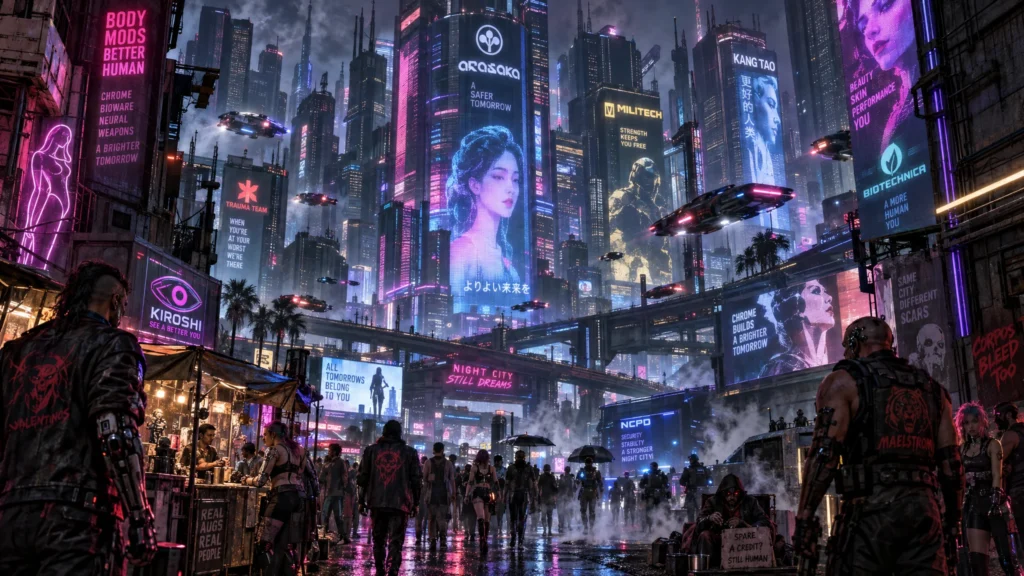
Welcome to Night City, choomba. A place where corporations control essential services, gangs fight for territory, technology can replace almost any part of your body, and survival is often more important than the law.
In Cyberpunk RED, Night City is more than just the setting where your Edgerunners live and work. It is a character in its own right: dangerous, unpredictable, divided, and constantly changing.
Set in 2045, during the period known as the Time of the Red, Cyberpunk RED presents a city still recovering from the devastating Fourth Corporate War. The nuclear explosion that destroyed much of the old Corporate Center, the collapse of infrastructure, and the struggle for power have transformed Night City into a fragmented metropolis where local authorities, corporations, gangs, and criminal organizations compete for influence.
Whether you’re a new player trying to understand the setting or a Game Master looking for inspiration for your next campaign, this guide will help you explore Night City’s districts, major gangs, corporations, and the conflicts that make the city one of the most memorable settings in tabletop roleplaying.
What Is Night City in Cyberpunk RED?
Night City was originally envisioned by Richard Night as a model of modern urban development: an efficient, prosperous city free from the problems affecting other American metropolitan areas.
That dream didn’t survive its founder.
Following his assassination, Coronado City was renamed Night City. Over the following decades, criminal organizations, megacorporations, political interests, and violent gangs gradually transformed it into a battleground for economic and territorial control.
The Fourth Corporate War brought even greater devastation. In 2023, a nuclear device detonated at Arasaka’s headquarters, destroying much of the Corporate Center and killing hundreds of thousands of people.
By 2045, Night City is rebuilding, but the recovery is far from complete.
The city is characterized by:
- Corporate influence: Companies control important infrastructure, technology, employment, and private security.
- Gang territories: Different gangs dominate neighborhoods, businesses, and criminal activities.
- Social inequality: Wealthy executives live behind protected walls while poorer communities struggle with inadequate housing and services.
- Unstable infrastructure: Power outages, damaged buildings, and unreliable public services remain part of everyday life.
- Political fragmentation: Districts have their own local interests, and city-wide authority is often limited.
Unlike the Night City of Cyberpunk 2077, which takes place in 2077, Cyberpunk RED shows a city still dealing with the consequences of the Fourth Corporate War.
It is a period of reconstruction, opportunity, and extreme danger.
Night City’s Districts Explained
Night City is divided into numerous districts, each with its own atmosphere, population, political interests, and security arrangements.
The official Night City 2045 sourcebook expands the setting into 24 districts, providing detailed information about their history, locations, local authorities, factions, and important characters.
For a general introduction, it is useful to understand the city’s four broad geographical areas: the Island, Northside, Mainland, and Southside.
1. The Island
The Island contains some of Night City’s most recognizable urban areas, including wealthy neighborhoods, corporate locations, entertainment districts, and places still marked by the destruction of the Fourth Corporate War.
Important districts include:
- Little Europe: A diverse urban district with European cultural influences, businesses, entertainment, and residential areas.
- Upper Marina: A coastal area associated with more affluent residents, commercial activity, and access to the waterfront.
- Downtown: A redeveloped urban center with businesses, offices, and the ambitions of a city trying to rebuild its economic importance.
The Island offers a useful contrast between Night City’s wealthy population and the people trying to survive in its less prosperous neighborhoods.
For Game Masters, it is an excellent location for corporate negotiations, high-end social events, espionage, and missions involving wealthy clients.
2. Northside
Northside includes developing neighborhoods, residential areas, and locations where reconstruction and corporate investment are particularly visible.
Important districts include:
- Watson Development: A major development area associated with megabuildings and housing projects. Kabuki, known for its distinctive local culture and crowded streets, is one of its most recognizable areas.
- New Westbrook: A district shaped by the aftermath of the war and the displacement of residents from other parts of the city.
- Charter Hill: A more comfortable residential area associated with people aspiring to enter Night City’s corporate elite.
- Executive Zone: A heavily protected area where the wealthiest and most influential residents can live behind security barriers.
Northside is particularly interesting because it demonstrates how differently people experience the same city.
A corporate employee living in Charter Hill may enjoy a relatively comfortable lifestyle, while someone in a less developed neighborhood may struggle to access reliable electricity, medical care, and secure housing.
For campaigns, Northside works well for corporate investigations, neighborhood disputes, infiltration missions, and stories involving social inequality.
3. The Mainland
The Mainland contains a mixture of residential districts, industrial areas, commercial locations, and neighborhoods shaped by the city’s complicated history.
Important districts include:
- North Heywood: A residential area with a mixture of established communities and people trying to improve their circumstances.
- Santo Domingo: An important industrial and residential district associated with manufacturing, infrastructure, and working-class communities.
- Heywood Industrial Zone: A major concentration of warehouses, factories, and industrial facilities.
- Heywood Docks: A port-related district important to shipping, logistics, and the movement of goods.
- The Glen: A district with its own local identity and a mixture of residential and commercial activity.
- Rancho Coronado: A suburban area whose traditional residential character has been heavily affected by the city’s housing problems and the arrival of displaced populations.
The Mainland is ideal for stories involving industrial espionage, smuggling, labor disputes, corporate sabotage, and conflicts between local communities and powerful organizations.
A simple mission involving stolen industrial equipment can quickly become a much larger conflict involving a corporation, a gang, and a group of workers.
4. The Southside
Southside contains some of the most dangerous and heavily damaged areas of Night City.
Important districts include:
- South Night City: An industrial sprawl where abandoned warehouses, factories, and gang-controlled locations are common.
- Old Japantown: An area severely affected by the nuclear explosion and its aftermath, with a complicated relationship between local communities and competing gangs.
- Little China: A district where local communities struggle to preserve their homes and businesses despite economic pressure and criminal activity.
- Old Combat Zone: One of the most dangerous areas of Night City, associated with gang violence and abandoned urban infrastructure.
- Hot Zone: The area closest to the site of the nuclear explosion. Radiation, damaged buildings, scavengers, and dangerous creatures make it particularly hazardous.
- Pacifica Playground: An entertainment and leisure area with its own distinctive atmosphere.
Southside is particularly important for Cyberpunk RED campaigns because it represents the consequences of corporate warfare and social collapse.
It is also an excellent setting for scavenging missions, dangerous expeditions, gang conflicts, rescue operations, and stories about people trying to rebuild their lives.
Other Areas Worth Knowing
Night City also extends beyond its central urban districts.
The Reclamation Zone and the Outskirts are particularly interesting for adventures involving communities outside the main urban environment.
Beyond the city, the Badlands offer a very different experience: open roads, nomad packs, abandoned settlements, remote facilities, and the constant threat of people who prefer to live outside the control of urban institutions.
These locations are especially useful for campaigns involving Nomads, transportation, smuggling, and long-distance missions.
The Most Important Gangs in Night City
Gangs are an essential part of everyday life in Night City.
Some control entire neighborhoods, others specialize in particular criminal activities, and some operate more like ideological movements or community organizations.
The official Night City Atlas and the Night City 2045 setting material provide numerous examples of the gangs that operate in the city.
Here are some particularly interesting groups to know.
1. Maelstrom
Maelstrom is one of Night City’s most recognizable combat gangs.
Its members are famous for their extensive cyberware, intimidating appearance, and violent philosophy. For Maelstrom, power is closely connected to physical and technological modification.
The gang is particularly dangerous because its members often embrace extreme cybernetic transformations and have little interest in conventional social rules.
Typical activities:
- Violent territorial expansion.
- Illegal cyberware activities.
- Criminal operations.
- Armed intimidation.
Campaign potential: Maelstrom can be used as a dangerous enemy, an unpredictable source of information, or a powerful organization that hires Edgerunners for particularly violent jobs.
2. Tyger Claws
The Tyger Claws are a powerful gang with a history connected to Arasaka.
In the 2045 setting, they are an important presence in Kabuki and Old Japantown, where they have influence over both criminal activities and local security.
Their organization, discipline, and territorial ambitions make them particularly dangerous opponents.
Typical activities:
- Protection operations.
- Criminal enterprises.
- Territorial control.
- Connections with other criminal organizations.
Campaign potential: A mission involving the Tyger Claws can quickly become complicated when a corporation, a rival gang, or a local business becomes involved.
3. Inquisitors
The Inquisitors have an unusual ideology: they believe cyberware is evil and that removing it from people is a way of saving their souls.
Their beliefs make them especially dangerous in a world where cybernetic implants are part of everyday life.
Unlike gangs motivated primarily by money or territory, the Inquisitors are driven by an extremist worldview.
Typical activities:
- Anti-cyberware violence.
- Attacks against cybernetic users.
- Recruitment and ideological propaganda.
- Organized intimidation.
Campaign potential: They can create interesting moral conflicts, especially when a character depends on cyberware to survive or perform their job.
4. Iron Sights
The Iron Sights are a brutal combat gang that has become increasingly influential through new sponsorship and organization.
They are particularly useful for campaigns involving territorial disputes and conflicts between heavily armed groups.
Typical activities:
- Armed violence.
- Gang warfare.
- Territorial control.
- Contracted criminal operations.
Campaign potential: The Iron Sights can serve as hired muscle, a rival faction, or the first visible part of a much larger conflict.
5. Red Chrome Legion
The Red Chrome Legion is an extremist neo-Nazi gang.
Its ideology makes it one of the most disturbing factions in Night City, and its members are involved in a violent conflict with the Iron Sights.
Typical activities:
- Extremist recruitment.
- Organized violence.
- Hate-driven attacks.
- Gang warfare.
Campaign potential: The Red Chrome Legion can be used as an antagonistic organization in stories involving community protection, political extremism, and the consequences of hate-driven violence.
6. Gold Dragons
The Gold Dragons are a gang associated with Little China and operate under the leadership of David Ling Po.
They are connected to the local protection business and provide an interesting example of how gangs can become part of a neighborhood’s everyday power structure.
Typical activities:
- Protection operations.
- Local criminal activity.
- Territorial influence.
- Connections with other organizations.
Campaign potential: The Gold Dragons can be useful when a mission involves local businesses, neighborhood politics, or criminal negotiations.
7. The Zoners
The Zoners are different from many of Night City’s traditional boostergangs.
They are a movement focused on improving living conditions in South Night City through community organization and protest.
Their existence demonstrates that not every organized street faction needs to be motivated by criminal profit.
Typical activities:
- Community organization.
- Local activism.
- Neighborhood improvement.
- Protests and political pressure.
Campaign potential: The Zoners can become allies for Edgerunners who want to help local communities, but their activities may bring them into conflict with corporations and criminal organizations.
8. Scavvers
Scavvers are not a single unified gang but rather a collection of groups that survive by recovering valuable technology and equipment from abandoned locations.
In a city filled with damaged buildings, discarded cyberware, and remnants of corporate warfare, scavenging can be extremely profitable.
However, their activities often involve violence, exploitation, and dangerous encounters.
Typical activities:
- Recovering abandoned technology.
- Illegal cyberware operations.
- Theft and trafficking.
- Searching dangerous locations.
Campaign potential: Scavvers are excellent antagonists for missions involving missing people, stolen implants, abandoned facilities, and the recovery of valuable equipment.
Corporations in Night City
If gangs control parts of the streets, corporations influence the systems that keep Night City functioning.
In Cyberpunk RED, corporate power is particularly interesting because the city is still recovering from the Fourth Corporate War.
The destruction of Arasaka’s headquarters and the damage caused by the conflict have changed the balance of power.
Corporations remain extremely influential, but they cannot simply control every aspect of Night City without facing competition from other organizations, local authorities, and criminal factions.
Here are some important corporate names and organizations to understand.
1. Arasaka
Arasaka is one of the most powerful corporations in the Cyberpunk universe.
Known for its military capabilities, security services, and corporate influence, Arasaka played a central role in the Fourth Corporate War.
Its Night City headquarters was destroyed by the nuclear explosion in 2023.
By 2045, the corporation’s influence in the city is not the same as it was before the war. Its history, interests, and connections nevertheless remain important to the setting.
Areas of influence:
- Corporate security.
- Military technology.
- Intelligence and espionage.
- Corporate influence and political maneuvering.
Campaign potential: Arasaka is an excellent source of missions involving corporate secrets, stolen data, former employees, and the consequences of the Fourth Corporate War.
2. Militech
Militech is a major military technology and weapons corporation.
Its business includes firearms, military equipment, security technology, and other products connected to armed conflict.
The company was one of the central players in the Fourth Corporate War, making its history closely connected to the destruction that shaped Night City.
Areas of influence:
- Weapons manufacturing.
- Military technology.
- Security contracts.
- Corporate intelligence and military operations.
Campaign potential: Militech can provide missions involving stolen weapons, prototype equipment, corporate security, and military research.
3. Petrochem
Petrochem is one of the major energy corporations in the Cyberpunk universe.
Although its historical roots are connected to oil, it has become a major producer and distributor of CHOOH2, an important fuel in the Cyberpunk setting, as well as plastics and other products.
It is also involved in Night City’s infrastructure through subsidiaries and commercial contracts.
Areas of influence:
- Energy production.
- Fuel distribution.
- Industrial materials.
- Logistics and infrastructure.
Campaign potential: A mission involving stolen fuel, damaged pipelines, industrial sabotage, or corporate competition can easily bring Petrochem into the story.
4. SovOil
SovOil is a major energy corporation and one of Petrochem’s most important rivals.
The competition between the two companies is part of the wider corporate struggle over energy resources and distribution.
In Night City, this rivalry can create opportunities for industrial espionage, sabotage, and covert operations.
Areas of influence:
- Energy production.
- Fuel distribution.
- Industrial operations.
- Corporate competition.
Campaign potential: Edgerunners might be hired to steal information, sabotage a shipment, protect a facility, or investigate an attack blamed on a rival company.
5. Ziggurat
Ziggurat is particularly important because of its connection to Night City’s digital infrastructure.
Founded in 2030, the corporation rapidly installed the city’s modern CitiNet system.
Its influence extends into communication, information distribution, and digital services.
In a setting where reliable information can be difficult to obtain, control over digital infrastructure is an enormous source of power.
Areas of influence:
- CitiNet infrastructure.
- Digital communication.
- Information distribution.
- Network services.
Campaign potential: Ziggurat is an excellent choice for missions involving data theft, digital surveillance, network sabotage, and information manipulation.
6. Night Corp
Night Corp is closely associated with Night City’s development and long-term interests.
Its activities can be connected to the city’s infrastructure, reconstruction, and powerful local interests.
For Game Masters, it is an interesting organization because its objectives can be difficult to distinguish from the interests of the city itself.
Areas of influence:
- Urban development.
- Infrastructure projects.
- Local political interests.
- Long-term corporate planning.
Campaign potential: A Night Corp mission might involve investigating a construction project, recovering confidential plans, or uncovering the true purpose of a supposedly beneficial urban development initiative.
How Corporations, Gangs and Local Authorities Interact
One of the most interesting aspects of Cyberpunk RED is that Night City does not have a simple hierarchy of power.
Corporations, gangs, local authorities, criminal organizations, and private security providers often compete for influence.
The NCPD has city-wide jurisdiction, but districts can also rely on their own security arrangements. Some local authorities hire private security organizations with police powers, while other areas may depend heavily on community groups, corporations, or gangs.
This creates a complicated environment in which the same action can have very different consequences depending on where it happens.
Consider the following example:
An Edgerunner crew steals a shipment of experimental cyberware from a corporate warehouse.
The shipment belongs to a corporation, but it was transported through territory controlled by a local gang. The gang wants payment for allowing the shipment to pass through its neighborhood, while a private security provider has been hired to recover the stolen equipment.
Meanwhile, a local community organization wants to prevent the cyberware from being used in an illegal medical operation.
Suddenly, a simple theft becomes a conflict involving several competing interests.
This is exactly the kind of situation that makes Night City such an effective setting for Cyberpunk RED.
How to Use Night City in Your Cyberpunk RED Campaign
Night City provides almost unlimited opportunities for Game Masters.
The key is to make locations, factions, and corporations feel connected rather than treating them as isolated elements.
Here are five ways to use the city in your campaign.
1. Create District-Based Adventures
Give every mission a specific location and make that location important to the story.
A mission in the Executive Zone should feel very different from one in the Old Combat Zone.
For example:
- Executive Zone: Infiltrate a corporate residence and steal confidential information.
- Watson Development: Investigate suspicious activity inside a megabuilding.
- South Night City: Recover stolen equipment from an abandoned factory.
- Little China: Protect a local business from a gang demanding payment.
- Hot Zone: Explore the ruins of a destroyed corporate facility.
The district should influence the atmosphere, the NPCs, and the risks involved.
2. Give Every Gang Its Own Objectives
Avoid using gangs simply as enemies waiting to be defeated.
Give each faction its own motivations, resources, relationships, and weaknesses.
A gang might want to control a particular street because it provides access to an important transportation route. Another might be trying to protect a neighborhood from corporate exploitation.
This creates opportunities for negotiation, alliances, betrayals, and moral decisions.
3. Make Corporations More Than Employers
Corporations are often presented as organizations that hire Edgerunners for dangerous missions.
However, they can also be long-term antagonists, political actors, and sources of information.
A corporation might hire the Crew to recover stolen data while secretly using the mission to eliminate a rival executive.
The characters may complete the job successfully without ever discovering the real objective.
4. Make the City React to the Players
Night City should feel alive.
If the Crew helps a local community, people might begin providing information or hiding them from enemies.
If they destroy a gang’s headquarters, another faction might move into the area.
If they expose a corporation’s illegal activities, the company might respond with surveillance, intimidation, or legal pressure.
Every important decision should have the potential to change the city’s relationship with the characters.
5. Use Everyday Life to Make the Setting Believable
Not every session needs to involve gunfights and corporate conspiracies.
Show the characters the ordinary side of Night City:
- Buying food from a street vendor.
- Waiting for public transportation.
- Looking for affordable medical treatment.
- Visiting a Fixer to obtain information.
- Dealing with unreliable utilities.
- Trying to find a safe place to sleep.
These small details make the city feel more realistic and make dangerous missions more meaningful.
Final Thoughts
Night City is one of the strongest settings in tabletop roleplaying because it offers much more than a futuristic city filled with neon lights and cybernetic implants.
Its districts have different identities, its gangs have competing motivations, and its corporations influence almost every aspect of everyday life.
For players, this means that every mission can lead to unexpected consequences. For Game Masters, it provides an enormous collection of locations, factions, and conflicts that can be used to create memorable stories.
The most important thing to remember is that Night City is not simply a place where Edgerunners complete jobs.
It is a city where every decision has a price, every alliance can become a liability, and even the smallest action can attract the attention of someone much more powerful.
Welcome to Night City, choomba. Try to make it out alive.
Frequently Asked Questions
What year does Cyberpunk RED take place?
Cyberpunk RED is primarily set in 2045, during a period known as the Time of the Red. The setting takes place after the Fourth Corporate War and before the events of Cyberpunk 2077.
How many districts does Night City have in Cyberpunk RED?
The Night City 2045 sourcebook details 24 districts, expanding on the city’s geography and organization. The exact district breakdown has developed across different Cyberpunk RED publications.
Is Night City controlled by corporations?
Not entirely. Corporations have enormous economic and political influence, but Night City also has local authorities, the City Council, gangs, criminal organizations, and private security providers. Power is fragmented and constantly contested.
What are the most dangerous gangs in Night City?
Maelstrom, the Tyger Claws, the Inquisitors, the Iron Sights, and the Red Chrome Legion are among the notable factions. Their influence and activities vary depending on the district and the events of the campaign.
What is the Combat Zone in Cyberpunk RED?
The Combat Zone refers to areas of Night City where public safety and infrastructure have deteriorated dramatically and gangs exercise considerable influence. The city contains several dangerous areas, including the Old Combat Zone and the Hot Zone, which have very different histories and conditions.
What is the difference between Cyberpunk RED and Cyberpunk 2077?
Cyberpunk RED takes place in 2045, while Cyberpunk 2077 takes place in 2077. RED focuses on the aftermath of the Fourth Corporate War and Night City’s reconstruction, whereas 2077 depicts a later version of the city with a different political, technological, and corporate landscape.