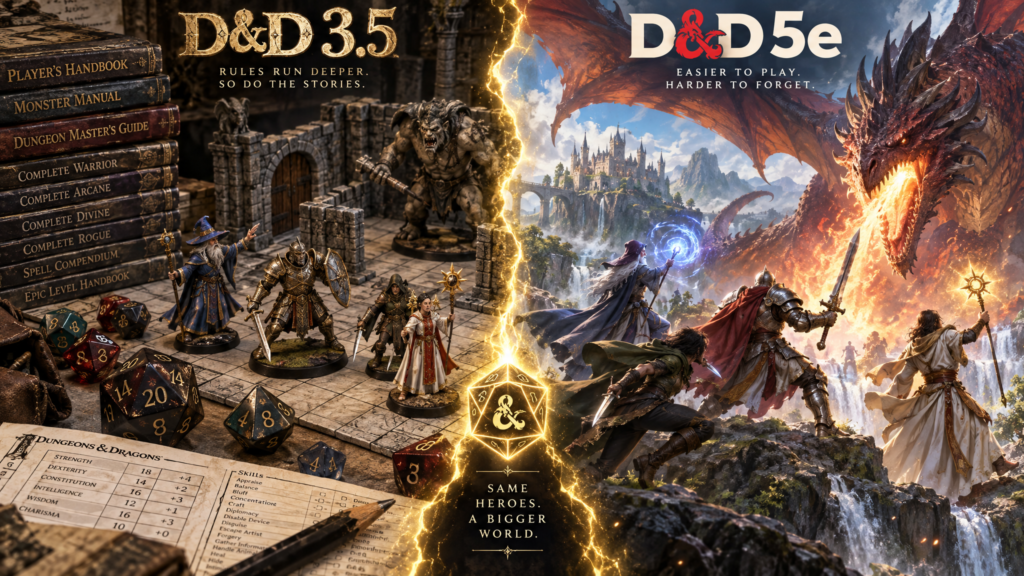
Dungeons & Dragons (D&D) has evolved significantly over the years, and few comparisons are as interesting as D&D 3.5 Edition vs. D&D 5th Edition. Both editions offer fantasy adventures, powerful spells, dangerous monsters, and endless opportunities for roleplaying. However, they approach character creation, combat, skills, and game balance in very different ways.
D&D 3.5 is famous for its deep character customization, extensive rules, and complex character-building options. D&D 5e, particularly the original 2014 rules, focuses on accessibility, streamlined mechanics, and faster gameplay.
But which edition is better? Is D&D 5e simply an improved version of 3.5, or does the older edition offer advantages that modern players should not overlook?
In this guide, we will explore the main differences between D&D 3.5 and 5e, comparing their rules, classes, combat systems, magic, feats, multiclassing, and overall gameplay experience.
1. D&D 3.5 vs. 5e: An Overview
Before examining individual mechanics, it helps to understand what each edition is designed to offer.
D&D 3.5 Edition was released in 2003 as a revised version of Dungeons & Dragons 3rd Edition. It refined the existing rules while retaining the d20-based system, detailed character customization, and extensive mechanical options.
D&D 5th Edition was released in 2014. Its designers aimed to make the game more accessible to newcomers while preserving the tactical combat, character progression, and imaginative freedom that long-time players enjoyed.
The original 2014 fifth edition rules were subsequently revised in 2024. These revised rules are often informally called D&D 5.5e, although they remain part of the fifth edition family.
For clarity, this article primarily compares D&D 3.5 with the original 2014 version of D&D 5e, mentioning the 2024 revision where relevant.
| Feature | D&D 3.5 Edition | D&D 5e (2014) |
|---|---|---|
| Complexity | High | More streamlined |
| Character customization | Extensive | More structured |
| Skill system | Individual skill ranks | Proficiency-based |
| Ability checks | d20 plus modifiers | d20 plus modifiers, with advantage and disadvantage |
| Combat | Detailed tactical rules | Simplified core mechanics |
| Feats | Numerous feat choices | Fewer choices, generally tied to progression |
| Multiclassing | Class-based progression with prerequisites and penalties in some cases | Flexible class combinations with prerequisites |
| Prestige classes | Major customization option | Generally replaced by subclasses and other features |
| Magic | Extensive spell and effect interactions | Streamlined spellcasting rules |
| Best suited to | Players who enjoy mechanical depth | Players who prefer accessible, flexible gameplay |
Both editions support tactical combat, roleplaying, dungeon exploration, and character development. The biggest difference is how much mechanical detail the rules provide.
2. Character Creation: Flexibility vs. Simplicity
Character creation is one of the most noticeable differences between D&D 3.5 and 5e.
In both editions, players choose a character concept, determine ability scores, select a class, and develop their character as they gain experience. However, the number and structure of their mechanical choices differ considerably.
Character Creation in D&D 3.5
D&D 3.5 offers a huge range of character-building possibilities.
Players can combine classes, select feats, invest skill points, choose equipment, and plan their character’s progression over multiple levels. Multiclassing and prestige classes create additional opportunities to develop specialized builds.
For example, a player might create a warrior who combines fighter levels with levels in another martial class, eventually qualifying for a prestige class that rewards a particular combat style.
This level of customization is one of 3.5’s greatest strengths.
However, it also creates challenges. Players need to understand prerequisites, skill requirements, feat chains, class features, and the consequences of their choices.
A poorly planned character can become significantly less effective than a carefully optimized one.
Character Creation in D&D 5e
The original 2014 version of D&D 5e simplifies many of these decisions.
Players choose a class and eventually select a subclass, which defines a particular specialization. A fighter, for example, can develop into a Champion, Battle Master, or Eldritch Knight.
Characters also gain class features at predetermined levels, reducing the need to plan complicated combinations of feats and prestige classes.
This makes character creation easier for beginners while still allowing experienced players to build specialized characters.
The verdict: D&D 3.5 is generally better for players who enjoy planning intricate character builds. D&D 5e is more accessible and makes it easier to create an effective character without extensive system knowledge.
3. The Skill System: Skill Points vs. Proficiency
Skills determine how effectively characters perform activities such as sneaking, climbing, investigating, persuading, and identifying magical phenomena.
Although both editions use ability checks, they handle character training differently.
Skills in D&D 3.5
In D&D 3.5, characters receive skill points that they can invest in individual skills.
The number of skill points available depends on factors such as class and Intelligence. Some skills are class skills, making them cheaper to develop, while cross-class skills generally cost more.
A rogue might invest heavily in Hide, Move Silently, Search, Disable Device, and Open Lock, developing a specialist who excels at stealth and infiltration.
The system allows players to distinguish characters with considerable precision.
However, tracking skill ranks and costs adds complexity to character creation and level advancement.
Skills in D&D 5e
The original 2014 fifth edition rules use a proficiency system.
Instead of buying individual skill ranks, characters become proficient in selected skills. When proficiency applies, they add a proficiency bonus to the relevant ability check.
For example, a character proficient in Stealth adds their proficiency bonus to appropriate Dexterity (Stealth) checks.
Characters can also gain Expertise, which doubles their proficiency bonus for selected checks.
This system reduces bookkeeping while preserving meaningful differences between trained and untrained characters.
The verdict: D&D 3.5 offers more granular control over skill development, while D&D 5e makes skills easier to manage during both character creation and gameplay.
4. Combat: Detailed Mechanics vs. Streamlined Rules
Combat is central to many D&D campaigns, and the two editions approach tactical encounters differently.
Both editions use initiative, attack rolls, armor, saving throws, and character abilities. However, D&D 3.5 generally requires players to manage more modifiers and specialized rules.
Combat in D&D 3.5
D&D 3.5 features a detailed combat system with mechanics such as:
- Base attack bonus and iterative attacks.
- Attacks of opportunity.
- Numerous combat maneuvers and modifiers.
- Specific rules for grappling, tripping, disarming, and other tactical actions.
- Detailed interactions between feats, weapons, armor, and combat conditions.
A high-level martial character can make multiple attacks during a full attack action, with additional attacks generally receiving progressively lower attack bonuses.
Positioning, reach, threatened areas, and the exact action a character takes can have substantial tactical consequences.
The result is a combat system that rewards players who understand its mechanical details.
However, combat can become slow when players frequently need to consult rules or calculate several modifiers.
Combat in D&D 5e
The original 2014 version of D&D 5e streamlines many of these mechanics.
Characters generally have movement, an action, and potentially a bonus action on their turn. They can also use a reaction when an appropriate trigger occurs.
Advantage and disadvantage replace many combinations of small situational bonuses and penalties.
For example, instead of tracking several separate modifiers, a character might roll two d20s and use the higher result when they have advantage.
The system retains tactical choices without requiring players to calculate as many modifiers.
The verdict: D&D 3.5 is an excellent choice for players who enjoy detailed tactical combat. D&D 5e generally offers faster encounters and is easier to run for groups with mixed experience levels.
5. Ability Scores and Dice Rolls
Both editions use six ability scores:
- Strength
- Dexterity
- Constitution
- Intelligence
- Wisdom
- Charisma
They also share the basic d20 principle: roll a twenty-sided die, apply the appropriate modifiers, and compare the result against a target number or an opposing roll.
However, the systems differ in how they organize and simplify those modifiers.
D&D 3.5: A More Detailed Modifier System
D&D 3.5 uses ability modifiers, skill ranks, base attack bonuses, saving throw bonuses, and numerous situational modifiers.
Bonuses and penalties can come from spells, equipment, feats, class features, and environmental circumstances.
Understanding how different modifier types interact can be essential when optimizing a character.
D&D 5e: Proficiency and Advantage
The original 2014 version of D&D 5e uses a proficiency bonus that increases with character level.
This bonus applies to relevant attack rolls, saving throws, and ability checks when a character is proficient.
The advantage and disadvantage system also simplifies many situational adjustments.
With advantage, a player rolls two d20s and uses the higher result. With disadvantage, they roll two d20s and use the lower result.
These mechanics make common rolls easier to resolve without removing every tactical consideration.
The verdict: D&D 3.5 provides more detailed mechanical differentiation, while D&D 5e prioritizes consistency and ease of use.
6. Feats: Extensive Customization vs. Fewer Choices
Feats are special abilities that allow characters to develop specific strengths beyond their standard class features.
They are important in both editions, but their role differs.
Feats in D&D 3.5
Feats are a central part of character optimization in D&D 3.5.
Characters receive feats as they advance, and some classes grant additional bonus feats. Many feats have prerequisites involving ability scores, base attack bonuses, other feats, or class features.
This creates chains of choices that can support highly specialized builds.
For example, a character pursuing a particular combat technique might need to select several prerequisite feats before accessing a more powerful option.
The system provides considerable freedom, but players must plan ahead to get the most from their choices.
Feats in D&D 5e
In the original 2014 rules, feats are generally optional. They can be selected instead of an Ability Score Improvement when a character’s class reaches a level that offers that choice.
Many feats provide a combination of benefits, such as new combat options, defensive bonuses, or improved skills.
Because there are fewer mandatory prerequisites and less emphasis on long feat chains, character progression is generally easier to manage.
The verdict: D&D 3.5 is ideal for players who enjoy building characters around intricate feat combinations. D&D 5e makes feats easier to understand and incorporate into a character’s development.
7. Multiclassing and Prestige Classes
Multiclassing allows characters to gain levels in more than one class.
It can create unusual combinations, but the two editions handle this type of character development differently.
Multiclassing in D&D 3.5
D&D 3.5 allows characters to combine classes as they advance.
A character might begin as a fighter, gain levels as a rogue, and eventually qualify for a prestige class.
Prestige classes provide specialized features and usually require characters to meet specific prerequisites.
For example, a character might need certain skills, feats, ability scores, or class features before entering a particular prestige class.
The system offers tremendous flexibility, but multiclassing can also introduce complications.
In some cases, taking levels in multiple base classes can result in experience penalties, depending on the character’s race and class-level distribution.
Multiclassing in D&D 5e
The original 2014 fifth edition rules also allow multiclassing, subject to ability score prerequisites and other restrictions.
However, the system generally uses a simpler progression structure.
Characters gain features from each class according to their levels in that class, while some resources, such as spell slots for certain spellcasting combinations, use special multiclassing rules.
Prestige classes are not part of the standard 2014 fifth edition framework. Instead, subclasses and other character options provide many forms of specialization.
The verdict: D&D 3.5 is especially attractive to players who enjoy elaborate multiclass builds and prestige classes. D&D 5e offers multiclassing with fewer layers of character-building complexity.
8. Magic and Spellcasting
Magic is one of the most important parts of Dungeons & Dragons, and both editions offer extensive spell lists for wizards, clerics, druids, sorcerers, and other spellcasting classes.
The difference lies primarily in how spells interact with the rest of the rules.
Magic in D&D 3.5
D&D 3.5 is known for its extensive spell system and the powerful combinations that experienced players can discover.
Spells can interact with feats, prestige classes, magic items, ability scores, and other effects in complex ways.
The edition also features different spellcasting progression systems, including prepared spellcasting and spontaneous casting.
High-level spellcasters can gain access to exceptionally powerful effects, and optimizing these abilities can dramatically influence the balance of an encounter.
The sheer number of possible interactions is one of the system’s biggest attractions for players who enjoy mechanical experimentation.
Magic in D&D 5e
The original 2014 fifth edition rules retain prepared and spontaneous spellcasting, although the details depend on the class.
Spellcasting is generally easier to manage because the core rules use a more standardized structure.
Concentration is particularly important. Many powerful ongoing spells require concentration, preventing a character from maintaining multiple concentration spells simultaneously.
This places limits on certain combinations that could otherwise become extremely powerful.
Spell slots remain an important resource, and choosing when to spend them is a central part of playing a spellcaster.
The verdict: D&D 3.5 offers a particularly deep environment for spell optimization, while D&D 5e makes spellcasting easier to manage and places clearer limits on some combinations of ongoing effects.
9. Character Balance and Class Power
Character balance is another important difference between the editions.
Neither system guarantees that every character will contribute equally in every situation. However, they approach character progression and class abilities differently.
Balance in D&D 3.5
D&D 3.5 offers considerable freedom, but its many mechanical options can produce large differences in character effectiveness.
An optimized character can become significantly more powerful than a character built without understanding the system’s interactions.
Spellcasters can also gain access to abilities that reshape encounters, bypass obstacles, or solve problems without relying on conventional combat.
This can make encounter design challenging for Dungeon Masters, particularly at higher levels.
Balance in D&D 5e
The original 2014 fifth edition rules aim for a more standardized progression system.
Classes receive their core features at defined levels, proficiency bonuses follow a common progression, and advantage and disadvantage simplify many situational effects.
However, D&D 5e is not perfectly balanced. Class performance can vary according to level, party composition, player experience, spell selection, and campaign style.
The 2024 revision further updates class features and other mechanics, but it does not eliminate every possible balance issue.
The verdict: D&D 5e is generally easier for Dungeon Masters to manage, especially with new players. D&D 3.5 can reward deep system knowledge, but it requires more attention to character optimization and party balance.
10. Equipment, Magic Items, and Character Progression
Both editions feature extensive equipment lists, magical weapons, enchanted armor, wondrous items, and powerful artifacts.
However, their broader approaches to character advancement differ.
D&D 3.5 integrates many mechanical bonuses into equipment and character-building choices. Players often pay close attention to how magic items improve armor class, attack rolls, saving throws, and other statistics.
D&D 5e also features magic items, but its bounded accuracy design limits how quickly many attack bonuses and defensive values increase.
Bounded accuracy means that the system generally keeps bonuses and target numbers within a more controlled range, allowing lower-level creatures and challenges to remain relevant in certain circumstances.
This does not mean that high-level characters are weak. They gain powerful abilities, more hit points, and other advantages, but numerical bonuses are generally more constrained than in D&D 3.5.
For Dungeon Masters, this can make it easier to design encounters without relying on constantly increasing armor classes and attack bonuses.
The verdict: D&D 3.5 offers more opportunities for intricate numerical optimization through character options and equipment. D&D 5e makes it easier to manage progression and keep many encounters within a more predictable mathematical framework.
11. Which Edition Is Easier for Beginners?
For most newcomers, the original 2014 version of D&D 5e is the easier starting point.
Its proficiency system, streamlined combat rules, and structured class progression reduce the amount of information players need to learn before participating in an adventure.
New players can focus on what their characters want to do instead of constantly checking how multiple mechanical modifiers interact.
D&D 3.5, on the other hand, can be rewarding for players who enjoy learning complex systems.
It provides many options for developing a distinctive character, but understanding the full range of possibilities takes time.
Here is a quick comparison:
| Player preference | Recommended edition |
|---|---|
| New to tabletop RPGs | D&D 5e |
| Wants straightforward combat | D&D 5e |
| Enjoys detailed character optimization | D&D 3.5 |
| Loves prestige classes and feat chains | D&D 3.5 |
| Prefers faster rules resolution | D&D 5e |
| Enjoys extensive mechanical customization | D&D 3.5 |
| Wants a large range of tactical character builds | Either edition, depending on the desired complexity |
Ultimately, the best edition is the one that suits your group’s preferred style of play.
12. Can You Use D&D 3.5 Content in D&D 5e?
Not directly in most cases.
Although both editions share familiar concepts, including ability scores, classes, monsters, spells, and the d20 system, their mechanics are different enough that content usually requires conversion.
A monster from a 3.5 sourcebook might have statistics, abilities, or special attacks that do not work the same way in 5e.
Similarly, a 3.5 prestige class cannot simply be added to a 5e character without adapting its prerequisites, progression, and features.
Spells and magic items may also need adjustments to account for differences in spellcasting, bounded accuracy, and character progression.
Experienced Dungeon Masters can convert older material, but they should review both the numerical values and the intended gameplay effects.
If you want to use an old adventure, its story, setting, characters, and narrative ideas may be easier to reuse than its mechanics.
13. D&D 3.5 vs. 5e: What About the 2024 Rules?
The original 2014 fifth edition rules are not the same as the revised 2024 rules.
The 2024 Player’s Handbook updates character creation, class features, feats, spells, and other aspects of the game. It is designed to remain compatible with much of the existing fifth edition material, although individual rules and character options may need to be handled according to the chosen version.
For example, the 2024 rules revise class features and the way character origins are structured. They also update numerous spells and gameplay procedures.
However, these revisions do not turn fifth edition into D&D 3.5.
The fundamental design philosophy remains different: 3.5 emphasizes extensive mechanical customization, while fifth edition generally aims for more streamlined play.
If you are comparing the editions before choosing a campaign, make sure your group agrees on which core rulebooks it will use. This is particularly important when combining character options from different publication years.
14. Final Verdict: Is D&D 3.5 Better Than D&D 5e?
There is no universal winner in the D&D 3.5 vs. 5e debate.
Both editions have strengths, and the best choice depends on what you want from a tabletop roleplaying game.
Choose D&D 3.5 if you love:
- Deep character customization.
- Extensive feat and multiclass combinations.
- Prestige classes and specialized builds.
- Detailed tactical combat.
- Exploring complex mechanical interactions.
Choose D&D 5e if you prefer:
- More accessible rules.
- Faster combat.
- A straightforward proficiency system.
- Easier character creation and progression.
- A system that allows beginners to participate without extensive preparation.
For many groups, D&D 5e provides the best balance between accessibility and tactical depth. It is easier to introduce to new players and generally requires less rules management during a session.
However, D&D 3.5 remains an appealing choice for players who enjoy system mastery and the freedom to construct highly specialized characters.
Neither edition makes the other obsolete. They simply offer different approaches to fantasy roleplaying.
The bottom line: If you want a streamlined game that is easy to learn, start with D&D 5e. If you enjoy complex mechanics and extensive character optimization, D&D 3.5 may be the better fit.
Whichever edition you choose, the most important part of Dungeons & Dragons remains the same: creating memorable adventures with your friends.