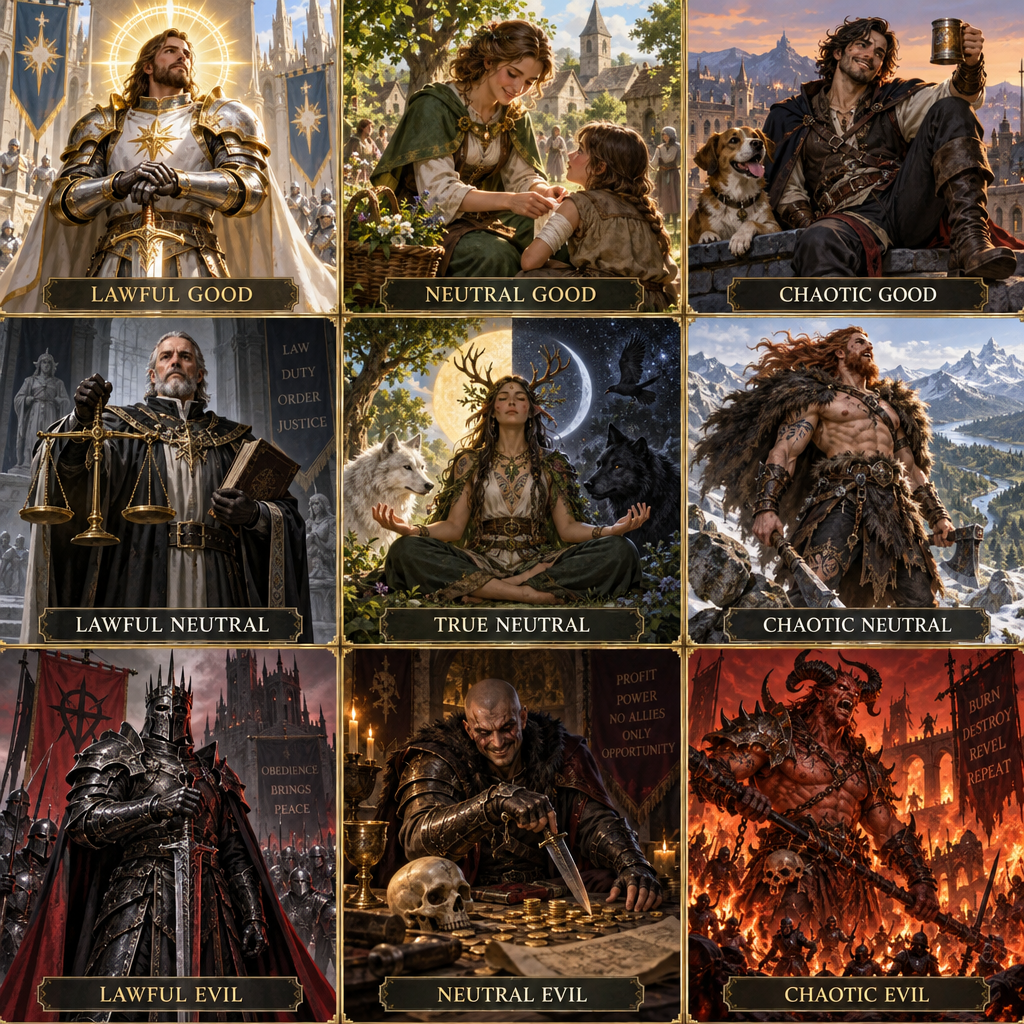
When creating a character in Dungeons & Dragons, players must make several important decisions. They choose a species, a class, their abilities, and their character’s background. But there is another element that can help define who their character really is: alignment.
D&D alignment is a simple system used to describe a character’s moral beliefs, ethical principles, and general attitude toward rules and freedom. It can help players decide how their characters react to difficult situations, interact with other adventurers, and make important decisions.
The traditional Dungeons & Dragons alignment system contains nine different alignments, ranging from Lawful Good to Chaotic Evil. Each one represents a different combination of morality and attitude toward order.
In this guide, we will explain all nine D&D alignments, explore their differences, and provide practical examples to help you choose the right alignment for your character.
What Is Alignment in D&D?
Alignment is a roleplaying tool that summarizes a character’s ethical and moral outlook.
It does not necessarily determine whether a character is a hero or a villain. Instead, it describes the principles that guide their decisions and the way they approach the world.
For example, two characters might both want to protect an innocent village from an invading army. However, they could have very different reasons for doing so.
One character might believe that protecting innocent people is a moral duty that must always be respected. Another might help because they personally care about the villagers and refuse to let anyone tell them what to do.
Both characters could be good, but their attitudes toward rules and authority would be different.
Alignment combines two separate dimensions:
- Morality: Good, Neutral, or Evil.
- Attitude toward order: Lawful, Neutral, or Chaotic.
Combining these two dimensions creates the nine traditional alignments.
The Two Dimensions of D&D Alignment
Before examining each alignment individually, it is important to understand the two principles behind the system.
Good, Neutral, and Evil
The first dimension describes a character’s moral outlook.
Good characters generally care about the well-being of others. They are willing to help people in need, protect the innocent, and make sacrifices for the greater good.
Neutral characters, in this context, do not consistently prioritize either altruism or deliberate harm. They might focus on survival, personal responsibilities, balance, or their own interests. Neutrality does not automatically mean indifference or selfishness.
Evil characters tend to prioritize their own interests at the expense of others. They might exploit, manipulate, or harm people to achieve their objectives. An evil character does not necessarily have to be cruel all the time, but their willingness to disregard others’ well-being is an important part of their outlook.
Lawful, Neutral, and Chaotic
The second dimension describes a character’s relationship with rules, traditions, authority, and personal freedom.
Lawful characters value order, structure, traditions, institutions, or personal codes. A lawful character does not necessarily obey every law. They might follow a strict personal code even when the law contradicts it.
Neutral characters do not consistently favor order over freedom. They might respect rules when they are useful, challenge them when necessary, or avoid taking a strong position on the issue.
Chaotic characters prioritize freedom, independence, and personal judgment. They tend to distrust rigid systems and are more willing to break rules when those rules conflict with their principles.
Chaos does not automatically mean recklessness, madness, or a desire to destroy everything. A chaotic character can be thoughtful, disciplined, and deeply committed to a cause.
The D&D Alignment Chart
The traditional alignment chart combines the two dimensions into a grid of nine possibilities.
| Alignment | General Description |
|---|---|
| Lawful Good | Follows principles and seeks to do what is right. |
| Neutral Good | Prioritizes helping others without rigidly following rules. |
| Chaotic Good | Defends others and values freedom over authority. |
| Lawful Neutral | Follows rules, traditions, or a personal code. |
| True Neutral | Avoids strong commitments to either extreme or prioritizes balance. |
| Chaotic Neutral | Values independence and personal freedom. |
| Lawful Evil | Uses rules, hierarchies, or codes to pursue selfish goals. |
| Neutral Evil | Pursues personal interests without significant concern for others. |
| Chaotic Evil | Pursues destructive or selfish goals with little regard for rules or other people’s safety. |
Let’s explore each alignment in more detail.
1. Lawful Good
Lawful Good characters believe that doing the right thing and respecting a meaningful code of conduct can work together.
They often value justice, responsibility, honesty, and the protection of innocent people. They may respect established laws, religious teachings, or a personal code that guides their actions.
However, being Lawful Good does not mean blindly obeying every authority figure. If a corrupt ruler abuses their power, a Lawful Good character might oppose them because their actions violate the principles that the character considers important.
Typical Characteristics
- Respects justice and responsibility.
- Protects people who cannot protect themselves.
- Believes that rules and institutions can help society.
- Accepts personal sacrifices to uphold their principles.
- Tries to resolve conflicts fairly.
Example
A knight discovers that a local noble is imprisoning innocent villagers to maintain control over a region.
The knight investigates the situation, gathers evidence, and attempts to bring the noble to justice. If necessary, they are willing to risk their position to protect the villagers.
The knight is not defending the law simply because it exists. They are defending justice and the principles that the law should represent.
Who Should Play Lawful Good?
Lawful Good is a natural choice for players who enjoy heroic characters with strong principles. It can work particularly well for knights, idealistic paladins, devoted clerics, and characters who want to make the world a better place through responsibility and courage.
2. Neutral Good
Neutral Good characters prioritize doing what is right, but they do not believe that rules must always be followed to achieve a positive outcome.
They are generally compassionate, helpful, and willing to adapt to circumstances. They care more about the people affected by a decision than about whether that decision follows an established procedure.
A Neutral Good character might obey the law when it protects people and break it when it causes unnecessary suffering.
Typical Characteristics
- Prioritizes helping others.
- Adapts their methods to the situation.
- Respects rules when they serve a useful purpose.
- Values compassion over rigid procedures.
- Tries to achieve positive outcomes without unnecessary conflict.
Example
A healer discovers that a city has banned a particular medicine because of a political dispute.
The medicine could save a group of seriously ill children. The healer decides to distribute it secretly, accepting the risk of punishment because saving lives is more important than obeying an unjust restriction.
Who Should Play Neutral Good?
Neutral Good is a good choice for players who want a compassionate hero without the rigidity sometimes associated with lawful characters. It suits healers, charitable adventurers, practical heroes, and characters who believe that the outcome matters more than strict adherence to rules.
3. Chaotic Good
Chaotic Good characters believe in helping others and protecting freedom, even when doing so means challenging authority.
They tend to distrust oppressive institutions, resist unjust traditions, and make decisions according to their conscience rather than established rules.
They are not necessarily criminals or troublemakers. A Chaotic Good character can be reliable, brave, and deeply loyal to their friends. Their defining trait is that they are unwilling to let authority automatically determine what is right.
Typical Characteristics
- Values personal freedom and independence.
- Opposes oppression and unjust authority.
- Follows personal convictions.
- Is willing to break rules to protect others.
- Dislikes unnecessary restrictions.
Example
A tyrannical ruler has ordered the arrest of anyone who criticizes the government.
A rebel decides to organize an escape for political prisoners and distribute evidence of the ruler’s crimes. They know that their actions are illegal, but they believe that freedom and justice are more important than obedience.
Who Should Play Chaotic Good?
Chaotic Good is ideal for players who enjoy rebels, freedom fighters, independent heroes, and characters who challenge corrupt institutions. It can be particularly entertaining in campaigns involving oppressive governments, unjust laws, or powerful enemies who abuse their authority.
4. Lawful Neutral
Lawful Neutral characters value order, consistency, and established principles. Unlike Lawful Good characters, however, they do not necessarily prioritize compassion or the greater good when making decisions.
Their defining characteristic is their commitment to a system of rules, traditions, duties, or personal principles.
A Lawful Neutral character might be a loyal soldier, a meticulous judge, a disciplined monk, or a professional who believes that society depends on everyone fulfilling their responsibilities.
This does not automatically make them cruel. They might be fair, dependable, and respectful, but they are less willing to abandon their code simply because a situation becomes emotionally difficult.
Typical Characteristics
- Values order and predictability.
- Follows a personal or institutional code.
- Respects hierarchy and established procedures.
- Believes that consistency is important.
- Avoids making decisions based purely on emotion.
Example
A city guard discovers that their closest friend has stolen a valuable artifact from a temple.
The guard investigates the incident and reports the theft, even though doing so will damage their friendship. They believe that their duty requires them to enforce the law consistently.
Who Should Play Lawful Neutral?
Lawful Neutral works well for disciplined soldiers, judges, investigators, monks, and characters whose identity revolves around duty or a strict code. It is particularly interesting when a character’s obligations conflict with their personal relationships.
5. True Neutral
True Neutral characters occupy the center of the traditional alignment chart.
The term can describe characters who avoid taking strong positions on the conflict between good and evil or law and chaos. It can also describe characters who prioritize balance, survival, or a practical understanding of the world.
True Neutral does not necessarily mean that a character has no beliefs. A druid might protect nature because they believe that maintaining the balance of an ecosystem is more important than helping one particular faction.
Similarly, an ordinary adventurer might help their companions, avoid unnecessary cruelty, and respect useful laws without feeling committed to a particular moral philosophy.
Typical Characteristics
- Prefers balance or practical solutions.
- Does not consistently favor law or chaos.
- Can help others without being motivated by idealism.
- Values survival, independence, or a specific responsibility.
- Avoids unnecessary commitments to ideological extremes.
Example
A druid discovers that two neighboring kingdoms are preparing for war. One kingdom wants to expand its territory, while the other is destroying an ancient forest to build defensive fortifications.
The druid tries to prevent both sides from damaging the natural environment. They are not automatically loyal to either kingdom and will oppose whichever side threatens the balance they are trying to preserve.
Who Should Play True Neutral?
True Neutral suits practical adventurers, nature-focused characters, independent wanderers, and people who prioritize balance or survival. It can also work for a character whose moral outlook develops throughout the campaign.
6. Chaotic Neutral
Chaotic Neutral characters value personal freedom and independence above conformity.
They dislike being controlled and often prefer to make their own decisions without submitting to laws, traditions, or external expectations.
However, Chaotic Neutral does not mean that a character must be unpredictable, selfish, or disruptive. A Chaotic Neutral character can be loyal to their friends, keep promises, and follow a personal code. They simply do not necessarily accept that established rules deserve obedience.
Typical Characteristics
- Values independence and personal freedom.
- Dislikes unnecessary restrictions.
- Makes decisions according to personal judgment.
- Resists authority when it interferes with individual choice.
- Can be spontaneous without being deliberately destructive.
Example
A mercenary joins a group of adventurers because they believe in the mission and enjoy working with the team.
When the group’s leader begins imposing unnecessary restrictions, the mercenary challenges those decisions. They remain committed to the mission but refuse to follow orders that they consider unreasonable.
Who Should Play Chaotic Neutral?
Chaotic Neutral is suitable for independent adventurers, free spirits, unconventional rogues, and characters who dislike being controlled. It works best when the character has clear motivations rather than simply acting randomly.
7. Lawful Evil
Lawful Evil characters pursue their own interests while relying on order, hierarchy, rules, traditions, or personal codes.
They understand that institutions can provide power and stability. Instead of necessarily destroying those institutions, they may exploit them to control others and achieve their goals.
A Lawful Evil character can be polite, professional, and even dependable when it benefits them. Their defining feature is not constant cruelty, but their willingness to use people or systems in pursuit of selfish objectives.
Typical Characteristics
- Values power, control, and hierarchy.
- Uses rules and institutions to gain advantages.
- Keeps agreements when doing so serves their interests or code.
- Can be calculating and patient.
- Prioritizes personal ambition over other people’s welfare.
Example
A powerful magistrate wants to control a prosperous city.
Rather than openly overthrowing the government, the magistrate manipulates legal procedures, purchases influence, and creates new regulations that gradually weaken political opponents. Every action appears legitimate, but the ultimate goal is personal power.
Who Should Play Lawful Evil?
Lawful Evil is particularly interesting for calculated villains, ambitious nobles, corrupt officials, ruthless commanders, and characters who believe that power and order matter more than compassion.
Players should discuss an evil character with their Dungeon Master and the rest of the group before introducing one into a campaign. A character who constantly undermines their allies can damage the experience for everyone.
8. Neutral Evil
Neutral Evil characters prioritize their own interests without being particularly committed to either order or chaos.
They may cooperate with institutions, break laws, manipulate individuals, or form alliances depending on what benefits them most.
Unlike Lawful Evil characters, they are not necessarily guided by a strict code. Unlike Chaotic Evil characters, they do not necessarily enjoy destruction or disorder for its own sake.
Their central motivation is often personal advantage, whether that means wealth, security, influence, revenge, or power.
Typical Characteristics
- Prioritizes personal interests.
- Uses other people when it is advantageous.
- Cooperates when cooperation is useful.
- Breaks rules when doing so provides a benefit.
- Avoids unnecessary risks that do not serve their goals.
Example
A merchant discovers that a rival has been selling dangerous counterfeit potions.
The merchant does not report the rival out of concern for the victims. Instead, they secretly buy the rival’s remaining stock, eliminate the competition, and increase their own profits.
They might behave generously toward customers when doing so improves their reputation, but their primary motivation remains personal gain.
Who Should Play Neutral Evil?
Neutral Evil is a good fit for calculating antagonists, opportunists, corrupt merchants, ruthless spies, and characters who put their own interests first. It can be compelling when the character has understandable goals but pursues them through morally questionable methods.
9. Chaotic Evil
Chaotic Evil characters reject constraints and show little regard for the safety, freedom, or well-being of others.
They might be motivated by hatred, greed, revenge, cruelty, or the desire to dominate through fear. Unlike Lawful Evil characters, they are not necessarily interested in preserving institutions or following a strict personal code.
Unlike Neutral Evil characters, they may be willing to embrace destructive or reckless behavior even when it provides little practical benefit.
However, Chaotic Evil does not require a character to attack everyone they meet without reason. Even a dangerous villain can plan carefully, form temporary alliances, and recognize when violence would be counterproductive.
Typical Characteristics
- Disregards other people’s safety and rights.
- Rejects rules and restrictions.
- Can be violent, destructive, or cruel.
- Uses fear and intimidation to achieve objectives.
- Prioritizes selfish desires over cooperation and responsibility.
Example
A bandit leader wants to control a remote village.
Instead of negotiating with the villagers or establishing a system of tribute, the bandit leader uses violence and intimidation to force them into submission. They destroy homes belonging to those who resist, even when doing so damages the resources they intend to control.
Who Should Play Chaotic Evil?
Chaotic Evil is often associated with destructive villains, violent warlords, sadistic antagonists, and dangerous monsters. It can work for a player character in a suitable campaign, but it requires careful cooperation with the Dungeon Master and the rest of the group.
An evil alignment should not be treated as permission to ruin other players’ plans or attack allies without discussion.
How to Choose an Alignment for Your D&D Character
Choosing an alignment can seem difficult when creating your first character. The easiest approach is to consider how your character would respond to moral dilemmas.
Ask yourself three questions:
- What matters most to my character? Helping others, personal ambition, freedom, survival, justice, or something else?
- How does my character view rules? Do they follow them, treat them as useful guidelines, or resist them?
- What would my character refuse to do? Would they betray a friend, abandon an innocent person, break an oath, or sacrifice their freedom?
Your answers should help you identify the alignment that best describes your character’s current outlook.
Remember that you do not need to fit perfectly into one category. Alignment is a broad description, not a complete personality profile.
A Lawful Good character can make mistakes. A Chaotic Neutral character can be loyal. A Neutral Evil character can genuinely care about a family member. What matters is the character’s overall pattern of choices and motivations.
Can a D&D Character Change Alignment?
Yes. A character’s outlook can change during an adventure.
Imagine a Lawful Good paladin who discovers that the religious institution they serve has become corrupt. They might initially try to reform it from within, but gradually abandon its authority as they realize that its leaders have betrayed their principles.
Depending on their decisions, the character might move toward Neutral Good or Chaotic Good.
Similarly, a Neutral Good adventurer who becomes obsessed with revenge might gradually adopt a more selfish or destructive outlook.
These changes should emerge naturally from the story rather than being treated as a punishment or an arbitrary mechanical event.
In the 2024 fifth-edition rules, alignment is primarily a roleplaying tool. It helps describe a character’s ethical outlook, but it does not automatically force the character to perform particular actions. The choices a character repeatedly makes are often the clearest indication of their alignment.
Does Alignment Affect D&D Game Mechanics?
In many D&D campaigns, alignment has little or no direct effect on a character’s everyday mechanical abilities.
It generally does not determine attack bonuses, ability scores, hit points, or the spells a character can learn. Those elements are primarily governed by the character’s class, level, abilities, features, and the rules being used.
However, alignment can still matter in particular circumstances.
Some spells, magic items, monsters, supernatural effects, or campaign settings may interact with alignment, depending on the edition and the specific rules involved.
Alignment can also help a Dungeon Master portray non-player characters, determine how factions behave, and create conflicts between characters with different values.
It is important to distinguish between general alignment descriptions and specific mechanical rules. Always check the relevant rulebook when a particular spell, feature, or item refers to alignment.
Can You Play an Evil Character in D&D?
Yes, evil player characters can be possible, depending on the campaign and the Dungeon Master’s rules.
However, an evil character needs a motivation that allows them to cooperate with the rest of the party.
For example, a Lawful Evil character might join the group because they want to defeat a common enemy, fulfill a contract, or acquire influence. A Neutral Evil character might cooperate because the group’s success also benefits them.
The key is to create a character who can participate in a shared adventure without constantly sabotaging the other players.
Before choosing an evil alignment, discuss the idea with your Dungeon Master. Some campaigns explicitly prohibit evil characters, and even when they are allowed, the group should agree on the kind of story they want to play.
D&D Alignments and Character Personality
Alignment is useful, but it should not replace a fully developed personality.
Two Lawful Good characters might behave very differently because one is a compassionate healer while the other is a strict military commander.
Likewise, two Chaotic Evil characters might have completely different motivations. One might seek revenge against a rival, while another might want to dominate a kingdom through fear.
To create a more interesting character, combine alignment with other details:
- Motivations: What does the character want?
- Ideals: What principles do they believe in?
- Bonds: Which people, places, or causes matter to them?
- Flaws: What weaknesses could lead them to make mistakes?
- Background: What experiences shaped their worldview?
These details give you a much richer foundation for roleplaying than alignment alone.
Final Thoughts
The nine D&D alignments provide a simple way to describe how characters approach morality, rules, and personal freedom.
Lawful Good characters try to do what is right while respecting meaningful principles. Chaotic Good characters defend others without automatically accepting authority. Lawful Evil characters exploit systems to pursue their ambitions, while Chaotic Evil characters disregard restrictions and other people’s well-being.
The remaining alignments represent different combinations of these attitudes, offering players plenty of possibilities for creating distinctive personalities.
Ultimately, alignment should help you roleplay your character, not restrict your creativity. Choose the alignment that best reflects your character’s current values, allow their experiences to shape their decisions, and focus on creating a memorable story with the rest of your party.
D&D Alignment FAQ
What are the nine alignments in D&D?
The nine traditional alignments are Lawful Good, Neutral Good, Chaotic Good, Lawful Neutral, True Neutral, Chaotic Neutral, Lawful Evil, Neutral Evil, and Chaotic Evil.
What is the difference between Lawful Good and Chaotic Good?
Both alignments generally prioritize helping others, but they approach rules differently. Lawful Good characters value justice, responsibility, and meaningful codes, while Chaotic Good characters prioritize freedom and personal conscience over authority.
What is the difference between Lawful Evil and Chaotic Evil?
Lawful Evil characters often use rules, hierarchies, and institutions to pursue selfish goals. Chaotic Evil characters tend to reject restrictions and show little concern for the harm they cause to others.
Is True Neutral the same as being selfish?
No. True Neutral characters might prioritize balance, survival, practicality, or a specific responsibility. They can still be compassionate and help others without consistently identifying with a particular moral extreme.
Can a Lawful Good character break the law?
Yes. A Lawful Good character can oppose an unjust law if they believe that doing so is necessary to uphold justice and protect innocent people. Lawfulness is not simply blind obedience.
Can a character change alignment in D&D?
Yes. A character’s beliefs and behavior can evolve as a result of their experiences and decisions. Alignment is a broad description of their outlook, not an unchangeable identity.
Does alignment affect gameplay in D&D 5e?
Alignment is primarily a roleplaying tool in fifth edition. Specific spells, magic items, monsters, or campaign rules may interact with it, but it does not generally determine a character’s basic combat abilities.
Which D&D alignment is best for beginners?
There is no universally best alignment. Lawful Good, Neutral Good, and Chaotic Good can be accessible starting points for players who want to create heroic characters, but beginners can choose any alignment that fits the campaign and their character concept.
Can you play a Chaotic Neutral character without being disruptive?
Yes. Chaotic Neutral characters can be independent, loyal, and responsible. Their defining trait is a preference for personal freedom rather than a desire to disrupt the party or ignore every rule.