If you are new to Dungeons & Dragons, choosing your first rulebook can be confusing. You may have heard of the Player’s Handbook, the Dungeon Master’s Guide, and the Monster Manual, but what does each book actually do? Do you need all of them to start playing? And which one should you buy first?
The good news is that you do not need to purchase every D&D book to enjoy your first adventure. However, understanding the purpose of the core rulebooks will help you spend your money wisely and get the most out of the game.
In this guide, we will explore the two main books that teach you how to play and run Dungeons & Dragons 5th Edition: the Player’s Handbook (PHB) and the Dungeon Master’s Guide (DMG). We will also explain the role of the Monster Manual, the third core rulebook, and clarify the differences between the original 2014 rules and the revised 2024 books.
What Are the D&D 5e Core Rulebooks?
Dungeons & Dragons is a tabletop roleplaying game in which players create fictional characters, explore imaginary worlds, overcome challenges, and tell stories together. The rules determine how characters perform actions, cast spells, fight enemies, and interact with the world.
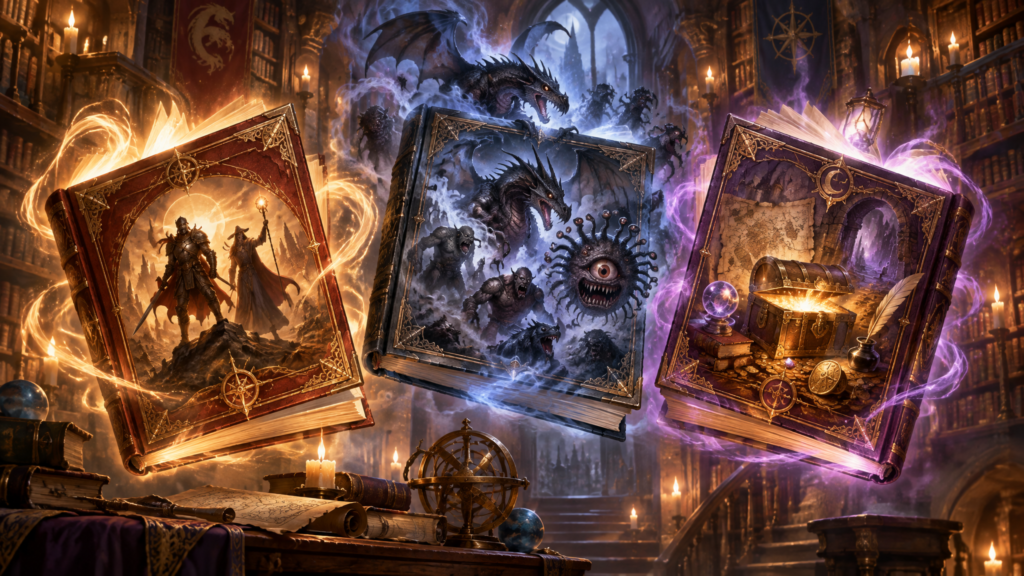
The three core rulebooks form the foundation of D&D 5e.
| Rulebook | Main purpose | Who needs it most? |
|---|---|---|
| Player’s Handbook | Explains how to play and create characters | All players and Dungeon Masters |
| Dungeon Master’s Guide | Helps organize and run adventures and campaigns | Dungeon Masters |
| Monster Manual | Provides monsters and their game statistics | Primarily Dungeon Masters |
These books have different purposes, but they complement one another. The Player’s Handbook teaches the rules used by the group, the Dungeon Master’s Guide helps the person running the game, and the Monster Manual supplies creatures for adventures.
An Important Note About D&D 5e: 2014 vs. 2024
Before purchasing anything, check which version you are buying.
The original fifth edition rules were published in 2014. Wizards of the Coast subsequently released revised core rulebooks in 2024. These are commonly described as the 2024 revision of 5e, and you may also see the term “5.5e” used by players and retailers.
The revised books update and reorganize parts of the game, including character options, rules, spells, equipment, and Dungeon Master tools. They are not simply identical reprints of the original books.
If you are joining a group, ask which rules it uses before buying your books. The original and revised versions share much of the same foundation, but some character options and rules differ.
1. The Player’s Handbook: The Essential Guide for Players
The Player’s Handbook is the most important D&D book for most people who want to start playing. It explains the core rules and gives players the information they need to create, develop, and control their characters.
You can think of it as your character’s instruction manual and your main reference during a game.
You do not need to memorize the entire book before your first session. Instead, you can learn the basic rules and look up specific information when you need it.
Who Is the Player’s Handbook For?
The Player’s Handbook is designed primarily for players, but Dungeon Masters also need to understand it.
It is especially useful if you:
- Have never played a tabletop roleplaying game.
- Want to create your first D&D character.
- Need to understand combat, skills, and dice rolls.
- Want to play a wizard, fighter, rogue, cleric, or another character class.
- Need to look up spells, equipment, abilities, and character progression.
- Want to understand how your character becomes more powerful over time.
If you are joining a group as a player, this is generally the first rulebook to consider purchasing.
What Does the Player’s Handbook Contain?
The exact organization and available options depend on whether you have the 2014 or 2024 version. However, the main areas of information are similar.
1. The Basic Rules of D&D
The book explains how the game works, including the relationship between players, characters, the Dungeon Master, and the fictional world.
You will learn about the different types of dice, the six ability scores, proficiency, ability checks, saving throws, and attack rolls.
The six traditional ability scores are:
- Strength: Physical power and force.
- Dexterity: Agility, coordination, and reflexes.
- Constitution: Physical endurance and resilience.
- Intelligence: Reasoning, knowledge, and memory.
- Wisdom: Awareness, perception, and intuition.
- Charisma: Personal presence and social influence.
These abilities help determine what your character is good at.
For example, a character trying to lift a heavy stone might make a Strength check, while someone attempting to notice a hidden door might make a Wisdom (Perception) check.
Most familiar D&D actions use the twenty-sided die, or d20. You roll it, add the relevant modifiers, and compare the result with a target number or another roll.
The book also explains advantage and disadvantage, which allow certain rolls to be made with two d20s, keeping the higher or lower result respectively.
For beginners, these rules are the foundation of almost everything that happens at the table.
2. Character Creation
One of the most enjoyable parts of D&D is creating a character with a distinctive personality, background, and set of abilities.
The Player’s Handbook walks you through the process of building an adventurer.
Depending on the version and the options permitted by your group, you will choose elements such as:
- Class: Your character’s main adventuring role and abilities.
- Species: Your character’s fantasy ancestry or type.
- Background: Your character’s history and previous experiences.
- Ability scores: The attributes that influence your character’s strengths.
- Skills and proficiencies: Areas in which your character has training.
- Equipment: Weapons, armor, tools, and other starting items.
- Spells: Magical abilities available to spellcasting characters.
- Personality and backstory: Details that help you decide who your character is.
For example, you might create a dwarf fighter who once served in a royal army, an elf wizard searching for forbidden knowledge, or a halfling rogue who dreams of becoming a legendary explorer.
The rules provide the mechanical framework, but your imagination determines the character’s personality, ambitions, relationships, and decisions.
3. Character Classes
Your class is one of the most important decisions you make during character creation. It determines many of your character’s abilities and helps establish how they contribute to an adventuring party.
The familiar twelve classes in the 2014 and 2024 versions are:
- Barbarian: A powerful warrior who can enter a state of rage.
- Bard: A versatile character combining magic, performance, and support.
- Cleric: A divine spellcaster who can heal, protect, and fight.
- Druid: A nature-focused spellcaster with distinctive magical abilities.
- Fighter: A versatile combat specialist.
- Monk: A mobile martial artist who uses disciplined techniques.
- Paladin: A warrior who combines martial skill with sacred magic.
- Ranger: An explorer and hunter with combat and nature-related abilities.
- Rogue: A specialist in stealth, precision, and skills.
- Sorcerer: A spellcaster whose magic comes from an innate or unusual source.
- Warlock: A spellcaster whose power comes through a pact with a mysterious patron.
- Wizard: A scholar of magic who learns and prepares spells.
Each class offers a different playstyle. Some are straightforward to learn, while others require more attention to spell selection, resources, or tactical decisions.
A fighter can be a good starting point for someone who wants to concentrate on weapons and combat. A wizard may appeal to someone who enjoys planning spells and solving problems creatively. However, the best class is ultimately the one that matches your interests.
Remember that the subclasses, available options, and individual mechanics differ between the 2014 and 2024 books.
4. Character Advancement
D&D characters generally become more capable as they gain experience and advance in level.
The Player’s Handbook explains how leveling works and which new abilities a character receives.
Depending on the class and version, advancement can provide benefits such as:
- More hit points.
- Improved combat abilities.
- New class features.
- More powerful spells.
- Additional proficiencies or other character options.
- Subclass features that give your character a more specialized identity.
This progression is an important part of long-term campaigns. A character who begins as an inexperienced adventurer may eventually face legendary monsters and threats capable of endangering entire kingdoms.
The book also contains rules for character options such as feats and multiclassing, although some options require more experience to use effectively.
5. Skills, Exploration, and Social Interaction
D&D is not just a game about fighting monsters.
Characters can investigate crimes, negotiate with nobles, search ancient ruins, navigate dangerous wilderness, solve puzzles, sneak past guards, and uncover hidden secrets.
The Player’s Handbook explains how ability checks and skills resolve many of these situations.
For example, a character might use Stealth to avoid detection, Persuasion to negotiate with a guard, or Investigation to search a room for clues.
These mechanics provide a consistent way to resolve uncertain outcomes without preventing players from trying creative solutions.
A successful D&D session can involve very little combat. The rules support exploration, social encounters, investigation, and roleplaying as well as battles.
6. Combat Rules
Combat is an important part of D&D, and the Player’s Handbook explains how encounters work.
The rules cover initiative, movement, attacks, damage, armor, hit points, healing, conditions, and the actions characters can take during a fight.
The turn-based structure helps everyone understand when they can act and what their characters are capable of doing.
For example, if your party encounters a group of goblins, the Dungeon Master determines initiative, everyone takes turns, and players decide whether to attack, cast spells, move to safety, or attempt another action permitted by the rules.
The book also explains what happens when characters are injured, incapacitated, or reduced to zero hit points.
These rules can look complicated at first, but most players learn them gradually through actual play.
7. Equipment, Weapons, Armor, and Adventuring Gear
Characters need more than abilities to survive their adventures.
The Player’s Handbook contains equipment information, including weapons, armor, shields, tools, adventuring gear, and the costs of many common items.
This section helps you understand what your character can buy, carry, and use.
A rogue might invest in tools useful for dealing with locks and traps, while a fighter might prioritize armor and weapons. An explorer could carry rope, torches, a backpack, and other practical equipment.
Equipment also contributes to character identity. A weapon, instrument, holy symbol, or unusual item can become part of your character’s story.
8. Spells and Spellcasting
Magic is one of D&D’s defining features, and the Player’s Handbook contains extensive spellcasting rules and spell descriptions.
It explains how characters learn or prepare spells, how spell slots work for relevant classes, what casting times mean, and how spells affect targets and areas.
Spells can serve many purposes. Some deal damage, some heal injuries, others protect allies, manipulate enemies, reveal information, or change the environment.
For example, a spellcaster might use a defensive spell to protect the party, a utility spell to overcome an obstacle, or a powerful attack spell against a dangerous enemy.
If you play a spellcasting class, you will probably consult this section frequently. Beginners may find it helpful to choose a small number of familiar spells first rather than trying to learn every available option at once.
The spell lists and rules are not identical across the 2014 and 2024 editions, so make sure you use the version that matches your character.
Is the Player’s Handbook Enough to Play D&D?
For many groups, the Player’s Handbook contains the core rules needed to play. It is possible to begin without owning every other core rulebook, particularly if your Dungeon Master already has access to the necessary materials.
However, the book does not provide a complete prewritten campaign or a full bestiary of monsters.
If you are a new player, the Player’s Handbook is usually the best first purchase. If you are the Dungeon Master, you may also want access to the Dungeon Master’s Guide and Monster Manual, depending on how you plan to run your game.
2. The Dungeon Master’s Guide: How to Run a D&D Game
The Dungeon Master’s Guide serves a different purpose. Rather than primarily teaching players how to control their characters, it helps the Dungeon Master prepare adventures, manage the game, and build memorable experiences for the group.
The Dungeon Master, often abbreviated to DM, is the person who describes the world, portrays most of its inhabitants, presents challenges, and adjudicates situations using the rules.
The DM is not an opponent who must defeat the players. Their job is to help create an engaging adventure in which the players’ decisions matter.
Who Is the Dungeon Master’s Guide For?
The Dungeon Master’s Guide is intended primarily for people who want to run D&D sessions.
It is especially useful if you:
- Want to become a Dungeon Master for the first time.
- Need help preparing your first adventure.
- Want to design your own campaign or fantasy world.
- Need advice on balancing encounters and managing difficulty.
- Want to create villains, non-player characters, locations, and mysteries.
- Need information about magic items and rewards.
- Want to adapt rules or introduce optional mechanics.
You do not have to read the entire book before becoming a DM. Many Dungeon Masters learn by preparing a small adventure, running it, and consulting the relevant sections as questions arise.
What Does the Dungeon Master’s Guide Contain?
The exact contents vary by version. The following sections describe the main purposes of the guide, particularly the structure of the original 2014 book.
1. Creating a Campaign and a Fantasy World
One of the guide’s major functions is helping the DM create a setting for the characters’ adventures.
You might want to run a classic fantasy campaign with castles, dragons, and ancient ruins. Alternatively, you could create a world dominated by political intrigue, magical academies, dangerous wilderness, or mysterious ancient civilizations.
The guide offers ideas and tools for developing elements such as:
- Geography and maps.
- Kingdoms, settlements, and important locations.
- Gods, religions, and magical traditions.
- Factions, organizations, and political conflicts.
- Historical events and ongoing threats.
- Campaign themes and styles of play.
You do not have to invent everything yourself. D&D has established settings, including the Forgotten Realms, that you can use as the foundation for an adventure.
The important point is that the DM can decide how much of the world to create. You can start with a village, a nearby dungeon, and one immediate problem, then expand the setting as the campaign develops.
2. Designing Adventures
A campaign is often made up of several connected adventures, while an individual adventure may consist of a single session or multiple sessions.
The Dungeon Master’s Guide provides advice on structuring adventures, introducing complications, creating encounters, and building a sequence of challenges.
Imagine that your players arrive in a village where several people have disappeared.
The adventure might involve interviewing residents, following tracks, exploring a forest, discovering a hidden entrance, and confronting the creature responsible.
The DM decides how the world responds to the characters’ actions and prepares enough material to make the situation interesting. The players, however, remain free to choose how they approach the problem.
The guide can help you organize these elements without requiring you to write a complete novel or predict every possible decision.
3. Creating Encounters and Managing Difficulty
An encounter is a situation in which characters face a meaningful challenge. It might involve combat, a dangerous environment, a social confrontation, or another obstacle.
The DM needs to consider how difficult an encounter should be and how it fits into the wider adventure.
The original Dungeon Master’s Guide includes guidance for creating encounters and assessing their difficulty. It also provides optional rules and advice for handling situations that are not covered in detail by the basic rules.
For beginners, one important lesson is that a challenging encounter should not necessarily mean a fight to the death. Players may negotiate, flee, hide, use the environment, or discover another solution.
The guide provides useful tools, but encounter balancing is not an exact science. The number of characters, their abilities, available resources, and the decisions they make can all influence how a fight unfolds.
4. Non-Player Characters and Villains
The DM controls the people and creatures the players meet, except for the player characters themselves.
These characters are called non-player characters, or NPCs.
An NPC might be a friendly merchant, a suspicious guard, a wise scholar, a rival adventurer, a king, or the villain behind the campaign’s central conflict.
The guide offers advice on designing NPCs, creating villains, and using supporting characters to make a world feel alive.
You do not need to develop a detailed biography for every person the party encounters. Often, a name, a motivation, a distinctive mannerism, and one useful piece of information are enough to make an NPC memorable.
A good villain also needs more than high combat statistics. Goals, resources, weaknesses, relationships, and a believable reason for acting can make an antagonist much more interesting.
5. Dungeons, Wilderness, Settlements, and Traps
Adventures take place in many different environments, each with its own opportunities and dangers.
The Dungeon Master’s Guide includes advice on designing and running locations such as:
- Dungeons and underground complexes.
- Forests, mountains, and other wilderness areas.
- Towns, cities, and settlements.
- Unusual environments and dangerous locations.
- Traps and environmental obstacles.
For example, a dungeon can be more than a series of rooms containing monsters. It might include locked doors, clues, hazards, secret passages, rival explorers, and choices with lasting consequences.
A wilderness journey can involve navigation, resource management, weather, and unexpected encounters. A city adventure might revolve around factions, investigations, social relationships, or political conflict.
These tools help the DM create variety and make exploration meaningful.
6. Magic Items, Treasure, and Rewards
Finding treasure is a familiar part of fantasy adventures, but rewards do not have to consist only of gold.
The guide includes information on magic items, treasure, unusual rewards, artifacts, and other ways to recognize the characters’ achievements.
Magic items can provide new capabilities or make a character more distinctive. A magical sword, a ring with unusual powers, or a mysterious artifact can become a memorable part of the campaign.
The DM decides what rewards appear, when they become available, and how they affect the story.
The guide is particularly valuable for understanding how to use powerful items thoughtfully. Giving characters equipment that is too strong too early can change the difficulty of encounters, while rewards that connect to the campaign can make exploration feel more meaningful.
7. Rules for Running the Game
Even experienced DMs sometimes encounter situations that require a quick ruling.
The Dungeon Master’s Guide includes advice on running the game, handling exploration and social interaction, resolving chases, using optional rules, and dealing with unusual situations.
It can also help a DM decide how to approach subjects such as diseases, poisons, madness, and other specialized mechanics in the original 2014 rules.
The book is not a replacement for the Player’s Handbook. The PHB remains the main reference for the core rules used by players, while the DMG offers additional guidance and tools for the person running the session.
8. Optional Rules and Customization
Not every D&D group wants the same experience.
Some groups prefer straightforward heroic fantasy. Others want a grittier campaign, more complicated exploration, additional tactical choices, or unusual magical technology.
The Dungeon Master’s Guide includes optional rules and advice for customizing the game. It also provides guidance for creating new monsters, spells, magic items, and character options.
These tools are useful once you understand the basic rules, but beginners do not need to modify everything immediately.
A sensible approach is to start with the standard rules, identify what your group enjoys, and introduce optional mechanics only when they solve a specific problem or improve the experience.
Does a New Dungeon Master Need the Dungeon Master’s Guide?
The guide is valuable, but it is not a requirement for every person who wants to try running a session.
A beginner can start with the core rules, a suitable introductory adventure, and a group willing to learn together. Published adventures can reduce preparation time by providing locations, encounters, characters, and a central storyline.
The Dungeon Master’s Guide becomes particularly useful when you want to understand why adventures are structured in certain ways, create your own content, or gain more confidence in managing a campaign.
If you already know you want to become the group’s regular DM, it is a strong addition to your collection.
3. The Third Core Book: The Monster Manual
Although this guide focuses on the Player’s Handbook and Dungeon Master’s Guide, it is important not to overlook the Monster Manual.
The Monster Manual is the core bestiary. It contains creatures that the DM can use to populate adventures and provides the game statistics needed to run them.
Depending on the version, you will find creatures such as goblins, dragons, giants, mind flayers, beholders, undead, and many other fantasy monsters.
A monster entry generally includes information such as its defensive and offensive capabilities, movement, special traits, and other rules needed during an encounter.
This makes it much easier for the DM to run a creature without inventing all of its abilities from scratch.
The Monster Manual is especially useful if you want to create your own adventures, but it is not usually the first book a new player needs. Players generally do not need to consult the monster statistics during an encounter; the DM handles that information.
4. Player’s Handbook vs. Dungeon Master’s Guide: What Is the Difference?
The simplest distinction is that the Player’s Handbook explains how to play a character, while the Dungeon Master’s Guide helps you run the world and organize the adventure.
Here is a practical comparison.
| Feature | Player’s Handbook | Dungeon Master’s Guide |
|---|---|---|
| Main audience | Players and DMs | Primarily DMs |
| Character creation | Core resource | Supporting advice and options |
| Classes and character abilities | Main reference | Additional tools in some areas |
| Combat rules | Core rules | Advice and optional mechanics |
| Spell descriptions | Main reference | Guidance for creating or customizing spells |
| Campaign creation | Limited to player-facing context | Major focus |
| Adventure design | Not its main purpose | Major focus |
| NPCs and villains | Player-facing rules where relevant | Design and management tools |
| Magic items | Equipment and relevant rules | Extensive treasure and magic-item resources |
| Monsters | Some creature-related rules, depending on version | DM guidance, but the Monster Manual is the main bestiary |
| Creating custom content | Not the main purpose | Includes tools and advice |
Which Book Should You Buy First?
For most beginners, the answer is the Player’s Handbook.
It gives you the core information you need to understand the game and create a character. If you are a player joining an existing group, the DM may already own the other books or have access to the material needed to run the campaign.
If you are planning to run your own games, the Dungeon Master’s Guide is a logical next purchase. The Monster Manual completes the traditional set of three core books and is especially helpful when you want to design encounters or use a wide range of creatures.
You do not necessarily need to purchase all three at once.
5. Can You Play D&D Without Buying All Three Core Rulebooks?
Yes. You can begin playing D&D without owning all three physical books.
There are several practical options.
If you are a player: Start with access to the Player’s Handbook or the relevant basic rules. Your DM may be able to help you create a character and explain the rules you need.
If you are a new DM: Consider using an introductory adventure and available basic rules. You can learn how to run a small session before investing in a larger collection.
If your group already owns the books: You may be able to share access to the relevant rules, subject to the group’s preferences and the format of the materials.
If you prefer digital tools: D&D Beyond provides digital rulebooks and character tools. Check the current contents and access terms before purchasing, since availability depends on the product and your account.
You should also distinguish between the full rulebooks and free introductory rules. A free rules resource can help you learn the game, but it does not necessarily include every option or piece of content found in the paid books.
The goal is to get enough information to start playing, not to collect every possible resource before your first adventure.
6. Are the 2014 and 2024 D&D 5e Books Compatible?
The 2024 books revise the fifth edition rules rather than replacing the game with an entirely unrelated system.
Many familiar concepts remain, including the six ability scores, d20-based checks, classes, spells, combat, and character advancement. However, the revised rules change or reorganize certain mechanics and options.
This means that you should not assume every rule, character option, spell, subclass, or piece of equipment works exactly the same way across both versions.
If you are a beginner, the easiest route is usually to choose the version your group uses and follow it consistently.
If you are joining a group that uses the 2014 rules, the original books may be the most straightforward choice. If the group has moved to the revised 2024 rules, use the revised books and confirm which older options, if any, the DM allows.
You can also discuss mixing material from different versions with your DM. Some groups enjoy doing so, but it may require checking how particular options interact.
The most important thing is not which version is universally “best.” It is choosing the rules that fit your group and ensuring everyone understands which rules are being used.
7. Tips for Beginners: How to Use the Books Without Feeling Overwhelmed
D&D rulebooks can look intimidating because they contain hundreds of pages, tables, spell descriptions, and special cases. You do not need to master everything at once.
Here are some practical tips for getting started.
Start With the Basics
Learn the purpose of the d20, your character’s ability scores, proficiency, hit points, and the difference between an ability check, an attack roll, and a saving throw.
These concepts will help you understand many other rules.
Learn Your Character Before the Entire Game
You do not need to know every class or spell in the book. Focus on your character’s abilities, equipment, and the actions you are likely to use.
A fighter and a wizard have different rules to learn, so concentrating on your own character makes the first few sessions more manageable.
Keep the Relevant Pages Easy to Find
Use the table of contents and index to locate rules quickly. You can also keep notes about commonly used abilities or spells, as long as you do not replace important rules with inaccurate summaries.
Digital search functions can be useful when you need to find a rule during a session.
Ask Your Dungeon Master Questions
It is normal to need help during your first games. Ask the DM to explain a rule when you do not understand what your character can do.
The DM may make a quick ruling so that play can continue and then check the exact rule afterward.
Do Not Try to Memorize Every Spell or Monster
D&D contains a huge amount of information, and most of it will not be relevant to your character’s next decision.
Learn what you need for the current session. As you gain experience, the rules and terminology will become more familiar.
Remember That Roleplaying Is More Than Following Rules
The books provide structure, but the game is built around imagination and shared decisions.
You can describe how your character approaches a problem, negotiate with an NPC, investigate a strange sound, or propose an unexpected solution. The rules help determine the outcome when it is uncertain, but they do not dictate every action you can imagine.
8. Frequently Asked Questions About D&D 5e Core Rulebooks
Is the Player’s Handbook enough for a beginner?
For a player, it is generally the most important book because it contains the core rules and character options. You can often begin playing with access to the Player’s Handbook or the applicable basic rules, without owning every core book.
Do I need the Dungeon Master’s Guide to become a DM?
No, not necessarily. You can run an introductory adventure with basic rules and suitable adventure material. The Dungeon Master’s Guide becomes increasingly useful when you want advice, additional tools, and help designing your own campaigns.
Do players need the Monster Manual?
Usually not. The Monster Manual is primarily a resource for the DM, who uses it to run creatures and prepare encounters. Players generally do not need to look up monster statistics during play.
Which D&D 5e book should I buy first?
If you want to play a character, start with the Player’s Handbook. If you intend to run games, the Player’s Handbook is still important, but you should also consider the Dungeon Master’s Guide. The Monster Manual is the third core book and provides a large collection of creatures.
Are D&D 5e books suitable for complete beginners?
Yes. They are designed to support learning and play, although some sections are easier to understand after you have experienced a session. Beginners should focus on the rules relevant to their immediate role rather than attempting to read every book from cover to cover.
Are the 2014 D&D 5e books still useful?
Yes. They remain useful for groups playing the original fifth edition rules. However, the revised 2024 books contain updated rules and options, so you should check which version your group uses before purchasing.
What is the difference between the Dungeon Master’s Guide and the Monster Manual?
The Dungeon Master’s Guide provides advice and tools for preparing and running adventures, building worlds, managing treasure, and customizing the game. The Monster Manual is primarily a bestiary containing creatures and the statistics needed to run them.
Do I need miniatures, maps, or expensive accessories?
No. D&D can be played with character sheets, dice, and a way to communicate the action. Miniatures, battle maps, and other accessories can be useful, but they are optional and should not be a barrier to getting started.
Final Verdict: Which D&D 5e Core Rulebook Is Best for You?
The Player’s Handbook and Dungeon Master’s Guide serve different but complementary purposes.
The Player’s Handbook is the essential starting point for players. It explains the rules, provides character creation options, and serves as a reference for abilities, equipment, spells, and combat.
The Dungeon Master’s Guide is primarily for people who want to run the game. It provides tools and advice for creating worlds, designing adventures, managing encounters, and rewarding players.
The Monster Manual completes the traditional set of three core rulebooks by providing a large collection of creatures for the DM to use.
If you are completely new to Dungeons & Dragons, do not feel pressured to buy everything immediately. Start with the book that matches your role, check which version your group uses, and learn the rules as you play.
D&D is ultimately about collaborative storytelling, exploration, and memorable adventures. The rulebooks are there to help you enjoy that experience—not to make getting started more complicated than it needs to be.