One of the first—and most exciting—decisions you’ll make in Dungeons & Dragons is choosing your class. Your class defines your character’s abilities, combat style, strengths, and role within the adventuring party.
Whether you dream of wielding powerful magic, sneaking through the shadows, healing your allies, or charging into battle with a massive sword, there’s a class that matches your playstyle.
In this guide, we’ll explain how Dungeons & Dragons classes work, explore every core class, and help you choose the perfect one for your first adventure.
What Are Classes in Dungeons & Dragons?
In Dungeons & Dragons (D&D), a class represents your character’s profession, training, and primary abilities.
While your species, background, and ability scores influence your character, your class determines:
- Your combat style
- The weapons and armor you can use
- Your magical abilities
- Your unique class features
- Your progression as you level up
Think of your class as the foundation of your character.
How Do Classes Work?
When creating a character, you choose one class at Level 1.
As you gain experience and level up, your class grants new abilities, stronger features, and sometimes access to powerful subclass options that further customize your character.
Every class develops differently, meaning no two adventures feel exactly the same.
The 12 Core Classes in Dungeons & Dragons
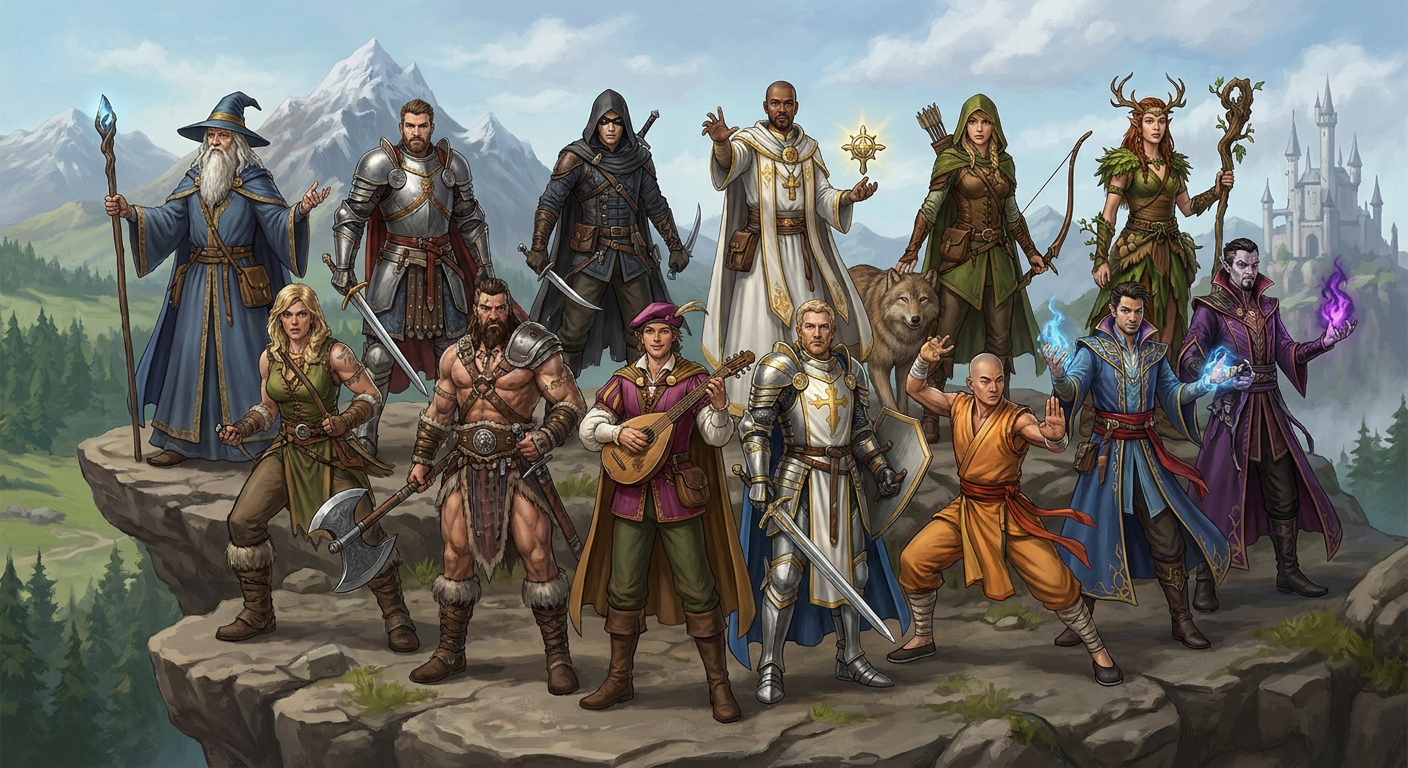
Below is an overview of the twelve core classes found in the Fifth Edition of Dungeons & Dragons.
Barbarian
The Barbarian is the ultimate frontline warrior.
Barbarians rely on raw strength, resilience, and their signature Rage, allowing them to deal increased damage while resisting many attacks.
Best For
- Melee combat
- High durability
- Simple gameplay
Ideal Players
Beginners who enjoy straightforward, aggressive combat.
Do you want to learn more about the Barbarin class? check out our article here: Barbarian Class Guide: Everything You Need to Know About the Dungeons & Dragons Barbarian
Bard
The Bard is a versatile spellcaster who combines music, performance, and magic.
Bards excel at supporting allies, influencing conversations, and solving problems creatively.
Best For
- Social interactions
- Buffing teammates
- Versatile spellcasting
Ideal Players
Creative role-players who enjoy flexibility.
Cleric
The Cleric channels divine power granted by a deity.
Although famous for healing, Clerics are also capable warriors and powerful spellcasters.
Best For
- Healing
- Defensive magic
- Divine spells
Ideal Players
Players who enjoy supporting the party while remaining effective in combat.
Do you want to learn more about the Cleric class? check out our article here: Dungeons & Dragons Cleric Guide: Everything You Need to Know About the Cleric Class
Druid
The Druid protects the natural world and commands the forces of nature.
Its iconic Wild Shape ability allows transformation into various animals.
Best For
- Nature magic
- Utility spells
- Shape-shifting
Ideal Players
Fans of nature, versatility, and creative problem-solving.
Fighter
The Fighter is one of the most flexible classes in D&D.
Whether specializing in swords, bows, shields, or magical combat techniques, Fighters excel in nearly every combat style.
Best For
- Weapon mastery
- Consistent damage
- Flexible builds
Ideal Players
Both beginners and experienced players.
Monk
The Monk is a disciplined martial artist who uses speed, precision, and inner energy known as Ki.
Monks are highly mobile and capable of stunning enemies with rapid attacks.
Best For
- Mobility
- Martial arts
- Tactical combat
Ideal Players
Players who enjoy fast-paced gameplay.
Paladin
The Paladin combines martial combat with divine magic.
Known for powerful Divine Smite attacks, Paladins also protect allies and inspire hope.
Best For
- Tanking
- Burst damage
- Healing
Ideal Players
Those who enjoy heroic characters and leadership.
Do you want to learn more about the Paladin class? check out our article here: Paladin Class Guide: Everything You Need to Know About the Dungeons & Dragons Paladin
Ranger
The Ranger is a skilled hunter and explorer.
Rangers specialize in ranged combat, survival, and tracking dangerous creatures.
Modern versions of the class also feature useful spellcasting abilities.
Best For
- Exploration
- Archery
- Survival
Ideal Players
Fans of wilderness adventures.
Rogue
The Rogue excels in stealth, precision, and skill-based gameplay.
Their signature Sneak Attack ability rewards careful positioning during combat.
Best For
- Stealth
- Lockpicking
- High damage
Ideal Players
Players who enjoy strategy and clever tactics.
Do you want to learn more about the Rogue class? check out our article here: Dungeons & Dragons Rogue Guide: Everything You Need to Know About the Rogue Class
Sorcerer
Unlike Wizards, Sorcerers are born with magical power.
Their magic comes from supernatural bloodlines, mysterious events, or innate abilities.
The class offers fewer spells but exceptional flexibility through Metamagic.
Best For
- Offensive spellcasting
- Magical specialization
- High burst damage
Ideal Players
Players who enjoy powerful magic without excessive complexity.
Do you want to learn more about the Sorcerer class? check out our article here: Dungeons & Dragons Sorcerer Guide: Everything You Need to Know About the Sorcerer Class
Warlock
The Warlock gains magical abilities through a pact with a powerful supernatural being.
Its unique mechanics make it one of D&D’s most distinctive spellcasting classes.
Best For
- Unique abilities
- Role-playing opportunities
- Consistent magical attacks
Ideal Players
Fans of mysterious and morally complex characters.
Wizard
The Wizard is the ultimate master of arcane magic.
With access to the largest spell list in the game, Wizards can solve almost any problem with the right preparation.
Best For
- Spell variety
- Utility magic
- Battlefield control
Ideal Players
Players who enjoy planning and mastering complex magic.
Do you want to learn more about the Wizard class? check out our article here: Dungeons & Dragons Wizard Guide: Everything You Need to Know About the Wizard Class
Choosing the Right Class
The best class depends entirely on your preferred playstyle.
Ask yourself:
- Do I want to fight in melee?
- Do I enjoy casting spells?
- Would I rather support my teammates?
- Do I like stealth?
- Do I prefer simple or complex mechanics?
There’s no universally “best” class—only the one that’s most enjoyable for you.
Which Class Is Best for Beginners?
Several classes are especially beginner-friendly.
Fighter
Easy to understand while remaining powerful throughout the game.
Barbarian
Simple mechanics with impressive durability.
Cleric
Introduces spellcasting while remaining forgiving in combat.
Rogue
Easy to learn but rewarding as players gain experience.
Spellcasters vs Martial Classes
One of the biggest choices is whether to play a spellcaster or a martial class.
Martial Classes
Examples include:
- Fighter
- Barbarian
- Rogue
- Monk
Advantages:
- Easier to learn
- Reliable in combat
- Fewer rules to memorize
Spellcasting Classes
Examples include:
- Wizard
- Cleric
- Druid
- Sorcerer
- Bard
- Warlock
Advantages:
- Incredible versatility
- Powerful utility
- Creative problem-solving
Multiclassing
Experienced players can choose multiclassing, allowing one character to advance in multiple classes.
For example:
- Fighter + Wizard
- Rogue + Bard
- Paladin + Sorcerer
- Warlock + Bard
Multiclassing offers greater customization but also increases complexity.
Beginners are usually encouraged to remain with a single class during their first campaign.
Which Class Fits Your Playstyle?
| If You Like… | Choose… |
|---|---|
| Heavy weapons | Barbarian |
| Tactical combat | Fighter |
| Healing allies | Cleric |
| Nature | Druid |
| Stealth | Rogue |
| Martial arts | Monk |
| Divine heroes | Paladin |
| Archery | Ranger |
| Music and diplomacy | Bard |
| Innate magic | Sorcerer |
| Forbidden magic | Warlock |
| Powerful spells | Wizard |
Final Thoughts
Dungeons & Dragons offers one of the most diverse class systems in tabletop gaming.
Each class provides a unique way to experience the game, whether you’re smashing monsters as a Barbarian, unraveling ancient mysteries as a Wizard, or inspiring allies as a Bard.
The best class isn’t necessarily the strongest—it’s the one that makes you excited to sit down at the table and tell unforgettable stories with your friends.
If you’re new to D&D, don’t worry about choosing the “perfect” class. Every class has something unique to offer, and discovering your favorite is part of the adventure.
Frequently Asked Questions (FAQ)
What are classes in Dungeons & Dragons?
Classes define your character’s abilities, combat style, magical powers, and progression throughout the game. They are one of the most important choices during character creation.
How many classes are there in D&D?
The core Fifth Edition includes 12 main classes: Barbarian, Bard, Cleric, Druid, Fighter, Monk, Paladin, Ranger, Rogue, Sorcerer, Warlock, and Wizard.
What is the easiest D&D class for beginners?
Many new players start with the Fighter or Barbarian because they have straightforward mechanics and are effective in combat. The Rogue and Cleric are also excellent beginner-friendly choices.
Which D&D class is the strongest?
There is no single strongest class. Each excels in different situations. Wizards are known for unmatched magical versatility, Fighters for consistent combat performance, and Clerics for their balance of healing, defense, and offense.
Can you combine multiple classes in D&D?
Yes. Through multiclassing, experienced players can level up in more than one class, creating unique combinations and playstyles.
What’s the difference between martial and spellcasting classes?
Martial classes focus on physical combat using weapons and armor, while spellcasting classes rely on magic to deal damage, heal allies, or control the battlefield.
Can two players choose the same class?
Absolutely. Even if two players choose the same class, different subclasses, backgrounds, equipment, and role-playing choices can make their characters feel completely unique.