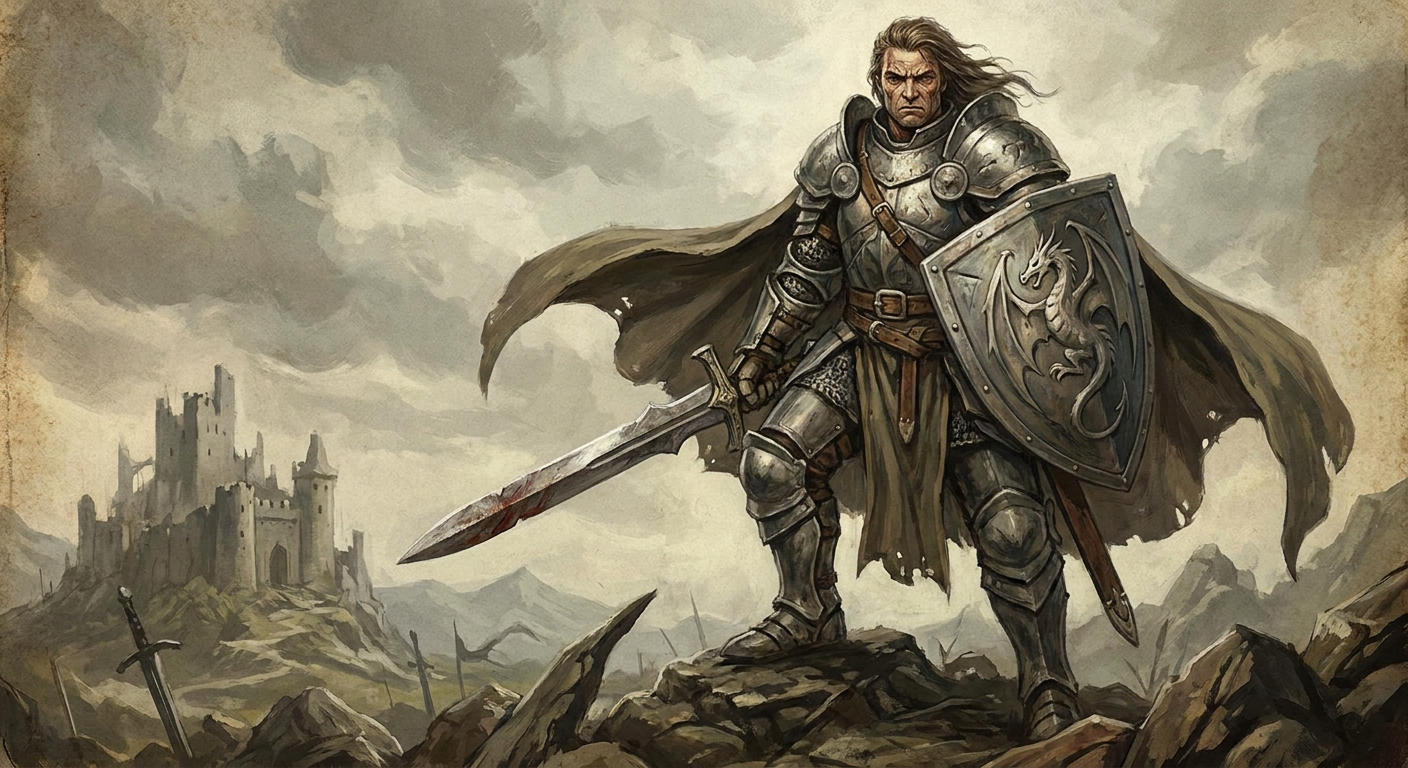
The Fighter is a martial class that specializes in weapon combat.
Unlike spellcasters who rely on magic, Fighters master physical combat through training, discipline, and battlefield experience.
One Fighter may become a heavily armored guardian defending allies, while another specializes in ranged combat or agile swordplay.
No other martial class offers the same level of flexibility.
The Fighter’s Role in the Party
Fighters can fulfill several different roles.
Depending on your build, you might become:
- Frontline Tank
- Damage Dealer (DPS)
- Defender
- Archer
- Duelist
- Battlefield Controller
Because of this versatility, Fighters fit into almost every party composition.
Fighter Class Overview
| Feature | Details |
|---|---|
| Primary Ability | Strength or Dexterity |
| Hit Die | d10 |
| Armor | All armor and shields |
| Weapons | Simple and Martial Weapons |
| Saving Throws | Strength & Constitution |
| Primary Role | Frontline Combat |
| Spellcasting | Only certain subclasses |
| Difficulty | Easy to Learn |
Hit Dice and Hit Points
One of the Fighter’s greatest strengths is durability.
Hit Die
The Fighter uses a d10 Hit Die, giving it one of the highest health pools in the game.
Only the Barbarian surpasses it with a d12.
Hit Points at Level 1
At first level, your hit points equal:
10 + your Constitution modifier
Example:
- Constitution 16 (+3)
- Hit Points = 13
Hit Points at Higher Levels
Whenever you gain a Fighter level, you gain:
- 1d10 + Constitution modifier, or
- 6 + Constitution modifier (average value, depending on your table’s rules)
A high Constitution greatly increases survivability over the course of a campaign.
Armor Proficiencies
Fighters are proficient with:
- Light Armor
- Medium Armor
- Heavy Armor
- Shields
This allows them to achieve some of the highest Armor Class (AC) values in D&D.
A Fighter wearing plate armor and carrying a shield can become extremely difficult to hit.
Weapon Proficiencies
The Fighter is proficient with:
- Every Simple Weapon
- Every Martial Weapon
This includes:
Melee Weapons
- Longsword
- Greatsword
- Greataxe
- Warhammer
- Halberd
- Glaive
- Rapier
- Morningstar
- Spear
- Mace
Ranged Weapons
- Longbow
- Shortbow
- Heavy Crossbow
- Hand Crossbow
- Light Crossbow
- Javelins
- Throwing Axes
No other class starts with such broad weapon proficiency.
Weapon Damage Examples
Some of the Fighter’s most popular weapons include:
| Weapon | Damage Die | Damage Type | Properties |
|---|---|---|---|
| Longsword | 1d8 (1d10 versatile) | Slashing | Versatile |
| Greatsword | 2d6 | Slashing | Heavy, Two-Handed |
| Greataxe | 1d12 | Slashing | Heavy, Two-Handed |
| Rapier | 1d8 | Piercing | Finesse |
| Warhammer | 1d8 (1d10 versatile) | Bludgeoning | Versatile |
| Longbow | 1d8 | Piercing | Heavy, Two-Handed |
| Heavy Crossbow | 1d10 | Piercing | Heavy, Loading |
Choosing the right weapon depends on your Fighting Style and preferred combat role.
Saving Throws
Fighters are proficient in:
- Strength Saving Throws
- Constitution Saving Throws
These are especially useful against effects that:
- Knock you prone
- Push or restrain you
- Require physical endurance
- Challenge your resilience
Starting Equipment
A typical Fighter begins with:
- Chain Mail or Leather Armor
- Martial Weapon and Shield OR Two Martial Weapons
- Light Crossbow or Handaxes
- Explorer’s Pack or Dungeoneer’s Pack
The exact equipment depends on your character choices.
Fighting Styles
At Level 1, Fighters choose a Fighting Style, representing their preferred combat technique.
Popular Fighting Styles include:
Defense
+1 Armor Class while wearing armor.
Perfect for tanks.
Great Weapon Fighting
Allows you to reroll low damage dice when using two-handed weapons.
Ideal for Greatswords and Greataxes.
Archery
+2 bonus to attack rolls with ranged weapons.
Excellent for ranged Fighters.
Dueling
+2 damage while using a one-handed weapon.
Perfect for sword-and-shield builds.
Two-Weapon Fighting
Improves fighting with two weapons.
Excellent for agile melee characters.
Second Wind
Beginning at Level 1, Fighters gain Second Wind.
Once per short rest, you can heal yourself by:
1d10 + Fighter Level
This ability significantly improves survivability during long adventuring days.
Action Surge
Perhaps the Fighter’s most famous ability.
Beginning at Level 2, Action Surge grants:
One additional Action on your turn.
This allows combinations like:
- Attack twice
- Dash and Attack
- Cast a spell (for subclasses that can)
- Help an ally and Attack
Action Surge is one of the strongest class features in D&D because it dramatically increases your effectiveness during crucial moments.
Weapon Mastery (2024 Rules)
In the revised 2024 Player’s Handbook, Fighters make excellent use of Weapon Mastery.
Different weapons now grant unique mastery properties such as:
- Cleave
- Push
- Sap
- Topple
- Nick
- Slow
- Vex
These properties make weapon choice more meaningful and add tactical depth to combat.
Extra Attack
At Level 5, Fighters gain Extra Attack, allowing two attacks whenever they take the Attack action.
Unlike most martial classes, Fighters continue improving:
- Level 5 → 2 attacks
- Level 11 → 3 attacks
- Level 20 → 4 attacks
No other class makes as many standard weapon attacks.
Indomitable
Beginning at Level 9, Fighters gain Indomitable.
This ability lets you reroll a failed saving throw a limited number of times between long rests.
It reflects the Fighter’s determination and resilience under pressure.
Fighter Subclasses
At Level 3, Fighters choose a subclass.
Some of the most popular include:
Champion
Simple and beginner-friendly.
Focuses on:
- Critical Hits
- Athletic abilities
- Reliability
Battle Master
Perhaps the most popular subclass.
Uses Superiority Dice to perform tactical maneuvers like:
- Trip Attack
- Riposte
- Disarming Attack
- Precision Attack
Excellent for strategic players.
Eldritch Knight
Combines martial combat with Wizard spells.
Ideal for players who want a magical warrior.
Samurai
Inspired by disciplined warriors.
Excels at:
- Precision attacks
- Temporary hit points
- Social confidence
Rune Knight
Uses magical runes and giant-themed powers.
One of the most flavorful modern subclasses.
Best Ability Scores
Most Fighters prioritize:
- Strength (melee builds)
- Dexterity (ranged or finesse builds)
- Constitution
Mental abilities depend on your character concept.
Best Species
Excellent choices include:
- Human
- Dwarf
- Goliath
- Orc
- Dragonborn
- Elf
- Halfling
Almost every species can create an effective Fighter.
Strengths of the Fighter
- Extremely versatile
- High Armor Class
- Strong damage output
- Simple mechanics
- Excellent durability
- Wide weapon selection
- Outstanding action economy
- Fits almost every party
Weaknesses of the Fighter
- Limited utility outside combat
- Few social abilities
- Little or no spellcasting (unless subclass grants it)
- Can feel repetitive without tactical choices
Is the Fighter Good for Beginners?
Absolutely.
The Fighter is widely considered one of the best beginner classes because:
- The rules are easy to learn.
- Combat is straightforward.
- Mistakes are more forgiving thanks to high durability.
- The class remains powerful at every level.
It is also one of the easiest classes to role-play, since Fighters can come from virtually any background.
Tips for Playing a Fighter
- Choose a Fighting Style that matches your preferred weapon.
- Save Action Surge for critical moments.
- Invest in Constitution to improve survivability.
- Coordinate with your party’s spellcasters and support characters.
- Experiment with different weapons and tactics.
- Don’t underestimate positioning on the battlefield.
Final Thoughts
The Fighter is much more than a “simple warrior.” It is one of the most reliable, adaptable, and rewarding classes in Dungeons & Dragons.
Whether you prefer standing at the front lines in heavy armor, raining arrows from afar, mastering tactical maneuvers, or blending martial prowess with magic, the Fighter offers a playstyle for every type of player.
Its combination of flexibility, survivability, and consistent damage makes it an outstanding choice for both newcomers and veterans alike.
Frequently Asked Questions (FAQ)
What is the Fighter class in Dungeons & Dragons?
The Fighter is a martial class specializing in weapon combat, heavy armor, and battlefield versatility. It is one of the easiest classes to learn and one of the most flexible to customize.
What Hit Die does the Fighter use?
The Fighter uses a d10 Hit Die, giving it excellent durability and one of the highest hit point totals among D&D classes.
What are the Fighter’s saving throw proficiencies?
Fighters are proficient in Strength and Constitution saving throws.
What is the Fighter’s strongest ability?
Many players consider Action Surge the Fighter’s signature ability because it grants an additional action during your turn, enabling powerful combinations.
Which Fighter subclass is best for beginners?
The Champion is generally the best choice for beginners thanks to its simple mechanics and reliable combat performance.
Which weapon is best for a Fighter?
There is no single best weapon. Greatswords, Greataxes, Longbows, Rapiers, and Longswords are all excellent choices depending on your build and Fighting Style.
Is the Fighter a good class for beginners?
Yes. The Fighter is widely regarded as one of the best beginner-friendly classes thanks to its straightforward mechanics, high survivability, and versatility.