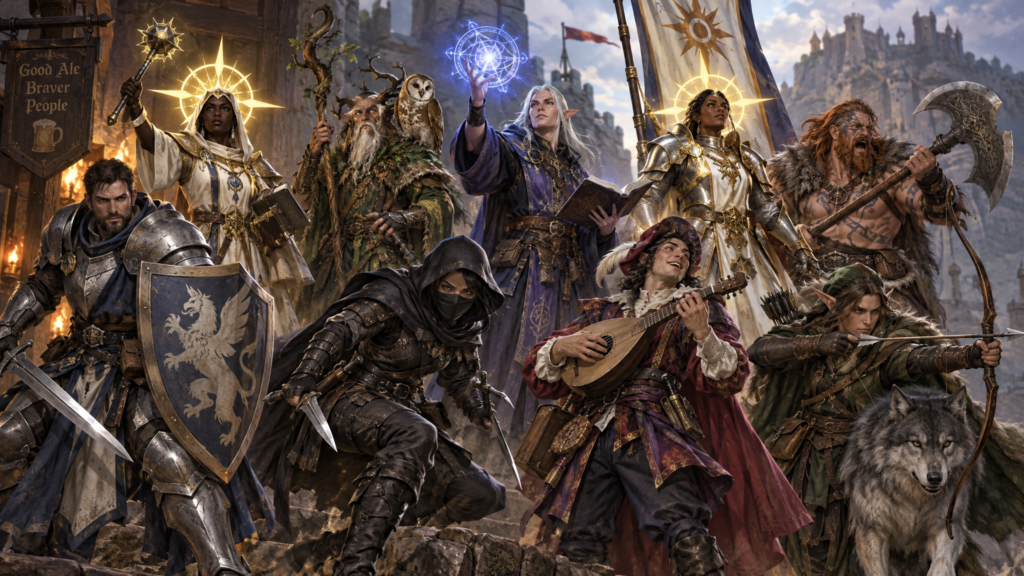
Choosing a class is one of the most important decisions when creating a character in Pathfinder Second Edition (Pathfinder 2e). Your class determines many of your character’s abilities, combat options, magical powers, and role within the adventuring party.
Are you interested in playing a powerful warrior, a mysterious spellcaster, a skilled investigator, or a charismatic performer? Pathfinder 2e offers a wide range of classes, each with its own mechanics and playstyle.
In this Pathfinder 2e classes guide, we explain the main characteristics of all 16 classes featured in the remastered Player Core and Player Core 2 rulebooks. You will learn what each class does, how it contributes to a party, and which type of player might enjoy it most.
Whether you are a complete beginner or an experienced tabletop RPG player, this guide will help you choose the right Pathfinder 2e class for your next character.
What Are Classes in Pathfinder 2e?
In Pathfinder 2e, your class represents your character’s primary adventuring profession and training. It determines your main abilities, class features, and access to special feats as you level up.
For example, a fighter specializes in weapons and combat techniques, while a wizard uses arcane magic to control the battlefield and overcome difficult challenges.
Your class also influences your character’s strengths and weaknesses. Some classes are excellent at dealing damage, others protect their allies, and some specialize in healing, investigation, or magical support.
Pathfinder 2e’s remastered core rulebooks present 16 classes across two volumes: Player Core and Player Core 2. The original Second Edition Core Rulebook contained 12 classes, so players familiar with the original release may notice some differences in how the classes are organized across the newer books.
The remastered Player Core contains eight classes: bard, cleric, druid, fighter, ranger, rogue, witch, and wizard. Player Core 2 adds eight more: alchemist, barbarian, champion, investigator, monk, oracle, sorcerer, and swashbuckler.
These are not all the classes ever published for Pathfinder 2e, but they provide an excellent foundation for understanding the system.
1. Alchemist
Role: Alchemical specialist, support, and versatile problem-solver
Primary playstyle: Crafting, consumable items, and tactical preparation
The alchemist is one of the most unusual classes in Pathfinder 2e. Instead of relying primarily on traditional spellcasting, alchemists use specialized formulas and alchemical items to achieve extraordinary effects.
They can prepare bombs, elixirs, mutagens, and other creations that help them deal damage, support allies, or adapt to dangerous situations.
An alchemist might throw explosive bombs at enemies, prepare healing elixirs for the party, or use mutagens to improve physical abilities.
What Makes the Alchemist Unique?
The alchemist rewards preparation and experimentation. Choosing the right items for a particular encounter can make a significant difference.
Unlike a character who relies on a single weapon or spell, an alchemist can bring a wide range of solutions to different problems.
However, managing formulas, resources, and consumable items requires more planning than some straightforward martial classes.
Best for: Players who enjoy crafting, experimentation, tactical decisions, and flexible support abilities.
2. Barbarian
Role: Front-line damage dealer
Primary playstyle: Aggressive melee combat
The barbarian is a powerful warrior who draws on primal fury to become more dangerous in battle.
Its defining feature is Rage, which increases its offensive potential and supports an aggressive approach to combat. Barbarians are particularly effective when they can engage enemies directly and apply consistent pressure.
Depending on the character’s choices, a barbarian might channel animal instincts, embody destructive fury, or develop another distinctive expression of primal power.
What Makes the Barbarian Unique?
Barbarians excel at dealing substantial damage with physical attacks. They are ideal for players who want a direct and exciting combat experience.
However, their aggressive style does not mean they should ignore positioning, defense, or teamwork. A barbarian who charges into every encounter without a plan can quickly find themselves in danger.
Best for: Players who enjoy powerful melee attacks, dramatic characters, and straightforward offensive gameplay.
3. Bard
Role: Support, spellcasting, and social interaction
Primary playstyle: Buffing allies, controlling enemies, and versatile magic
The bard combines magic, performance, knowledge, and charisma.
Rather than focusing exclusively on dealing damage, bards excel at helping the entire party perform better. Their compositions can strengthen allies, improve combat effectiveness, and provide useful magical support.
Bards also have access to occult spellcasting, giving them tools for influencing minds, manipulating perceptions, and solving problems outside combat.
What Makes the Bard Unique?
The bard is one of the strongest choices for players who want to contribute in several different ways.
A bard can support the fighter during combat, negotiate with an important NPC, investigate a mysterious location, and use magic to overcome unexpected obstacles.
The class rewards players who pay attention to the entire party rather than concentrating only on their own damage output.
Best for: Players who enjoy teamwork, social encounters, magical support, and versatile characters.
4. Champion
Role: Defensive front-line combatant and protector
Primary playstyle: Defense, protection, and martial combat
The champion is a devoted warrior whose powers are connected to divine principles and a sacred cause.
Champions are especially well suited to protecting allies and standing between the party and dangerous enemies. Their defensive abilities and reactions can help reduce incoming damage or punish opponents who threaten their companions.
Their exact abilities depend on the character’s choices and the rules options being used.
What Makes the Champion Unique?
The champion is an excellent option for players who enjoy being the party’s defensive anchor.
Instead of focusing entirely on defeating enemies as quickly as possible, champions often succeed by keeping their allies alive and creating opportunities for the rest of the group.
They also offer strong roleplaying opportunities through their beliefs, commitments, and personal code.
Best for: Players who enjoy defensive combat, protecting allies, and characters guided by powerful ideals.
5. Cleric
Role: Divine spellcaster, healer, and support
Primary playstyle: Divine magic and party assistance
Clerics draw their powers from divine magic and their relationship with a deity or religious tradition.
They are particularly well known for healing and supporting their allies, but their capabilities extend far beyond restoring hit points.
Depending on their build, clerics can deal damage, strengthen companions, protect the party, and use divine spells to overcome supernatural threats.
What Makes the Cleric Unique?
Clerics are highly valuable in parties that need magical healing and support.
Their divine spellcasting also makes them useful when facing undead creatures, curses, and other supernatural dangers.
However, clerics are not restricted to a passive support role. They can be built to contribute directly to combat while maintaining access to important healing abilities.
Best for: Players who enjoy divine magic, supporting companions, religious roleplaying, and versatile spellcasting.
6. Druid
Role: Primal spellcaster and versatile support
Primary playstyle: Nature magic, battlefield control, and adaptation
Druids draw on primal magic associated with nature and the natural world.
They can manipulate the environment, summon or influence natural forces, heal allies, and use spells that control the battlefield.
Depending on their chosen options, druids can also develop abilities connected to animal companions or transformations.
What Makes the Druid Unique?
The druid offers considerable flexibility.
One druid might focus on destructive elemental magic, another on healing and support, and another on fighting alongside an animal companion.
This variety makes the class suitable for players who enjoy combining magical abilities with a strong thematic identity.
Druids can be especially effective when players use their spells creatively rather than relying on damage alone.
Best for: Players who enjoy nature, primal magic, animal companions, and adaptable characters.
7. Fighter
Role: Martial specialist and reliable damage dealer
Primary playstyle: Weapon mastery and tactical combat
The fighter is one of the most straightforward classes to understand, but it also offers considerable tactical depth.
Fighters specialize in weapons and martial techniques. Their combat proficiency makes them particularly reliable when attacking enemies, controlling space, and taking advantage of openings.
A fighter might wield a two-handed weapon, specialize in archery, fight with two weapons, or use a shield to combine offense with defense.
What Makes the Fighter Unique?
The fighter is an excellent example of how Pathfinder 2e makes martial combat interesting without requiring spellcasting.
Positioning, movement, teamwork, and choosing the right actions are all important.
Although the basic concept is easy to understand, fighters gain many opportunities to customize their abilities through class feats.
Best for: Beginners and experienced players who enjoy weapons, tactical combat, and a wide range of martial builds.
8. Investigator
Role: Detective, skill specialist, and tactical problem-solver
Primary playstyle: Investigation, planning, and precision
The investigator is a character who approaches danger through observation, reasoning, and careful preparation.
Rather than relying entirely on brute force or magic, investigators use their analytical abilities to uncover clues, identify threats, and make informed decisions.
Their distinctive mechanics allow them to study situations and use deductions to guide their actions.
Investigators can also be capable combatants, particularly when they can exploit their knowledge of an opponent.
What Makes the Investigator Unique?
The investigator is particularly appealing in campaigns involving mysteries, conspiracies, criminal investigations, and political intrigue.
It is also a class for players who enjoy thinking ahead and finding creative solutions to problems.
However, the class works best when the campaign gives characters opportunities to investigate and use their skills. In a game focused almost entirely on combat, some of its thematic strengths may be less prominent.
Best for: Players who enjoy detective stories, careful planning, intelligence-based characters, and solving mysteries.
9. Monk
Role: Mobile martial combatant
Primary playstyle: Unarmed combat, movement, and specialized techniques
The monk is a martial artist who develops extraordinary physical abilities through disciplined training.
Monks can fight with powerful unarmed attacks, use specialized combat techniques, and move around the battlefield with impressive mobility.
Their abilities make them well suited to characters who prefer speed, precision, and control rather than relying exclusively on heavy armor or large weapons.
What Makes the Monk Unique?
The monk offers a distinctive style of combat built around movement and technique.
A monk can use mobility to reach important targets, disrupt enemy plans, and position themselves where they can best support the party.
Different builds can emphasize unarmed strikes, defensive techniques, or other martial approaches.
Best for: Players who enjoy martial arts, mobile characters, tactical positioning, and disciplined warriors.
10. Oracle
Role: Divine spellcaster with supernatural powers
Primary playstyle: Divine magic, mysteries, and powerful class-specific abilities
The oracle is a spellcaster whose supernatural abilities are connected to a mysterious source of divine power.
Unlike a cleric, who traditionally receives power through devotion to a deity, an oracle’s magic is closely associated with a mystery that shapes their abilities and identity.
Oracles can develop distinctive powers, but their supernatural gifts also come with important complications represented by their class mechanics.
What Makes the Oracle Unique?
The oracle offers a strong narrative identity and a more unusual approach to divine spellcasting.
Its mystery helps determine the character’s themes and abilities, making two oracles potentially very different from one another.
The class can be rewarding for players who enjoy managing distinctive mechanics and incorporating supernatural complications into their character’s story.
Best for: Players who enjoy divine magic, mysterious origins, complex character concepts, and roleplaying supernatural powers.
11. Ranger
Role: Hunter, ranged attacker, and wilderness specialist
Primary playstyle: Tracking, precision, and hunting enemies
The ranger is an experienced hunter who specializes in pursuing dangerous targets and surviving in challenging environments.
Rangers can fight with bows, dual weapons, or other martial equipment. They also have abilities that support tracking, exploration, and dealing with particular enemies.
Depending on their build, a ranger may work alongside an animal companion or specialize in hunting a single dangerous target.
What Makes the Ranger Unique?
The ranger combines practical wilderness skills with effective combat abilities.
This makes the class particularly appealing in campaigns that involve exploration, tracking, wilderness travel, and dangerous creatures.
Rangers are not limited to forests or remote environments, however. Their hunting skills and combat techniques can also be useful in urban adventures and dungeon exploration.
Best for: Players who enjoy archery, hunting, tracking, exploration, and self-reliant adventurers.
12. Rogue
Role: Skill specialist and precision damage dealer
Primary playstyle: Stealth, mobility, and exploiting weaknesses
The rogue is a versatile character who excels at using skills, avoiding danger, and taking advantage of enemy vulnerabilities.
Rogues are particularly effective at sneaking, picking locks, disabling traps, gathering information, and navigating difficult social situations.
In combat, they can deal significant precision damage when they meet the conditions required for their abilities.
What Makes the Rogue Unique?
The rogue is one of the best choices for players who want to contribute both inside and outside combat.
A rogue can help the party infiltrate a guarded building, uncover hidden mechanisms, negotiate through deception, or exploit an enemy’s position during a fight.
The class offers several ways to specialize, so not every rogue needs to be a traditional thief.
Best for: Players who enjoy stealth, skills, tactical combat, and solving problems through cleverness.
13. Sorcerer
Role: Charismatic spellcaster and magical damage dealer
Primary playstyle: Innate magic and flexible spellcasting
The sorcerer possesses magical power through an innate connection to a magical bloodline or another supernatural source.
Unlike a wizard, who learns magic through study, a sorcerer’s abilities arise from their own magical nature.
Their bloodline determines their spell tradition and provides distinctive thematic options.
Depending on the chosen bloodline and spells, a sorcerer might specialize in elemental destruction, enchantment, healing, or many other magical effects.
What Makes the Sorcerer Unique?
The sorcerer is an excellent choice for players who want a character with a strong magical identity and access to a broad selection of spells.
The class also supports charismatic characters who use their personality and magical abilities to influence the world.
Sorcerers generally need to manage their spell resources carefully, but their spellcasting can offer powerful solutions to a wide variety of encounters.
Best for: Players who enjoy powerful magic, charismatic characters, and distinctive magical origins.
14. Swashbuckler
Role: Agile martial combatant
Primary playstyle: Mobility, flair, and precision attacks
The swashbuckler is a daring warrior who combines agility, confidence, and stylish combat techniques.
Rather than relying on heavy armor or overwhelming strength, swashbucklers use movement, skillful actions, and their distinctive panache mechanic to create opportunities for powerful attacks.
Their approach to combat often rewards bold maneuvers and taking advantage of the battlefield.
What Makes the Swashbuckler Unique?
The swashbuckler is ideal for players who want their character to feel dynamic and cinematic.
A swashbuckler might leap across obstacles, perform daring maneuvers, and engage enemies with impressive finesse.
Different styles allow players to emphasize different skills and approaches, so the class is not limited to a single type of duelist.
Best for: Players who enjoy agile fighters, dramatic combat, daring heroes, and stylish martial techniques.
15. Witch
Role: Occult or other tradition-based spellcaster and magical specialist
Primary playstyle: Spellcasting, familiar abilities, and supernatural utility
The witch is a spellcaster whose magic comes through a mysterious patron. The relationship between the witch, the patron, and the witch’s familiar is central to the class’s identity.
Witches can access different spell traditions depending on their choices, allowing them to develop very different magical specialties.
Their familiar is more than a decorative companion: it is an important part of their class identity and magical toolkit.
What Makes the Witch Unique?
The witch combines spellcasting with a distinctive supernatural theme.
Their familiar and patron give the class many roleplaying possibilities, from a mysterious scholar serving an unknown entity to a wandering spellcaster guided by an unusual magical companion.
Witches can also use spells and other abilities to influence encounters in ways that go beyond direct damage.
Best for: Players who enjoy familiars, mysterious patrons, unconventional magic, and supernatural storytelling.
16. Wizard
Role: Arcane spellcaster and magical problem-solver
Primary playstyle: Learned magic, preparation, and battlefield control
The wizard is the classic scholar of arcane magic.
Through study, experimentation, and preparation, wizards learn spells that can damage enemies, control the battlefield, protect allies, and solve problems that would be difficult for other characters.
Their spellbooks are central to their identity, and the spells they prepare can significantly influence how they approach an adventuring day.
What Makes the Wizard Unique?
Wizards offer tremendous magical versatility, particularly when they have access to a wide selection of spells.
A wizard might use fire and lightning to damage enemies, create magical defenses, manipulate movement, or solve an environmental challenge without fighting at all.
However, wizards require planning. Players need to understand their spells and choose preparations that suit the party’s expected challenges.
Best for: Players who enjoy magical research, strategic preparation, arcane knowledge, and solving problems through spells.
Which Pathfinder 2e Class Is Best for Beginners?
If you are new to Pathfinder Second Edition, the best class depends on the type of experience you want.
Fighter: A strong starting point if you want to learn the fundamentals of tactical combat. You can concentrate on weapons, movement, and positioning without managing a large spell list.
Barbarian: A good option if you prefer an aggressive martial character with a clear combat identity.
Rogue: An excellent choice if you enjoy skills, exploration, stealth, and finding creative solutions.
Cleric: A good option if you want to learn spellcasting while providing valuable support to your party.
Bard: A rewarding choice if you enjoy teamwork, social encounters, and helping your companions succeed.
Wizard: A strong choice for players who want to explore the depth of Pathfinder’s magic system, although preparing spells requires more planning.
There is no universally easiest class. Your experience will depend on your familiarity with tabletop RPGs, your preferred playstyle, and how much mechanical complexity you enjoy.
How to Choose the Right Pathfinder 2e Class
Before choosing a class, consider three important questions.
1. What Do You Want to Do in Combat?
If you want to fight directly, consider the fighter, barbarian, monk, or swashbuckler.
If you prefer magical attacks and battlefield control, look at the wizard, sorcerer, druid, or witch.
If you want to protect your companions, the champion and cleric are excellent candidates.
2. What Do You Want to Do Outside Combat?
Some classes have particularly strong thematic connections to specific activities.
Rogues and investigators are excellent for skill-focused adventures. Rangers are well suited to tracking and wilderness exploration. Bards and sorcerers can support charismatic character concepts, while wizards and witches offer many opportunities for magical research and supernatural mysteries.
However, your character’s skills and background also matter. You are not restricted to one type of activity simply because of your class.
3. How Much Complexity Do You Enjoy?
Some classes require relatively direct tactical decisions, while others involve managing spell lists, resources, specialized mechanics, or consumable items.
If you enjoy planning and experimentation, the alchemist, wizard, investigator, and oracle may appeal to you.
If you prefer to focus on positioning and martial techniques, the fighter or monk might be a better fit.
Choose a class that makes you excited to play rather than selecting one simply because it appears powerful.
Final Thoughts
Pathfinder Second Edition offers a wide range of character classes, each with a distinctive approach to combat, exploration, and roleplaying.
The fighter and barbarian excel at martial combat. The cleric and champion provide divine abilities and protection. The bard supports the entire party, while the wizard and sorcerer offer powerful magical options.
Meanwhile, the rogue and investigator reward cleverness, the ranger combines hunting with combat, and the druid brings the power of nature to the battlefield.
The alchemist, oracle, swashbuckler, and witch provide more specialized mechanics and distinctive character concepts for players who want something different.
Ultimately, the best Pathfinder 2e class is the one that fits your preferred playstyle and the character you want to bring to life.
Take time to explore your options, discuss your ideas with your Game Master, and consider how your character will contribute to the party.
With so many combinations available, Pathfinder 2e offers plenty of opportunities to create a memorable adventurer.
Frequently Asked Questions
How many classes are there in Pathfinder 2e?
The remastered Player Core and Player Core 2 rulebooks feature 16 classes in total, with eight classes in each book. Additional official classes have been published in other Pathfinder 2e supplements.
What is the best Pathfinder 2e class for beginners?
The fighter is a strong option for beginners who want to learn tactical combat. The barbarian and rogue are also worth considering. Players interested in magic can start with the cleric or bard, depending on their preferred role.
What is the strongest class in Pathfinder 2e?
There is no universally strongest class. Pathfinder 2e emphasizes teamwork, tactical decisions, and character customization. A class’s effectiveness depends on its build, the campaign, party composition, and the encounters the group faces.
Which Pathfinder 2e classes can use magic?
Many classes have access to magic, including the bard, cleric, druid, oracle, sorcerer, witch, and wizard. Other classes can gain magical abilities through specific class options, feats, or archetypes.
What is the difference between a wizard and a sorcerer in Pathfinder 2e?
A wizard learns and prepares arcane spells through study, usually relying on a spellbook. A sorcerer draws magic from an innate supernatural source, with their bloodline helping determine their magical abilities and spell tradition.
Can you change your class in Pathfinder 2e?
Your character’s class is normally a fundamental part of their identity, but Pathfinder 2e provides options for expanding your abilities through archetypes and multiclass dedications. These options let you incorporate abilities associated with other classes without replacing your original class.
Are Pathfinder 2e classes compatible with the original Second Edition rules?
The remastered rules are designed to remain compatible with existing Pathfinder Second Edition material. However, some classes and mechanics have received updates, so it is important to check which version of the rules your group is using.