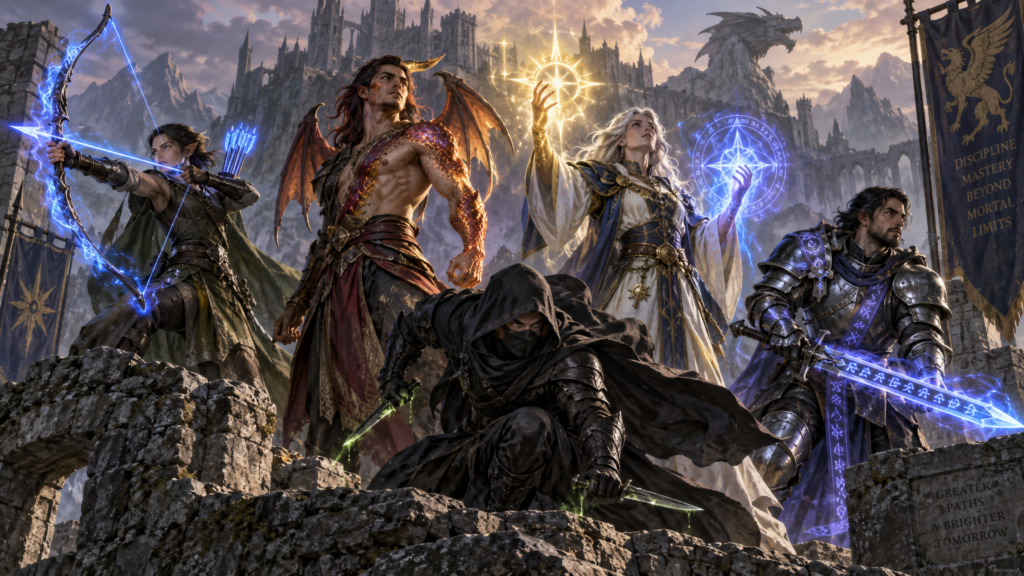
One of the most exciting aspects of tabletop roleplaying games is the ability to develop a character beyond the limits of their starting class.
In Pathfinder, this idea takes an interesting form through Prestige Classes: specialized paths that allow experienced adventurers to acquire unique abilities, develop unusual combinations of skills, and become experts in particular disciplines.
Whether you want to become a master assassin, a powerful dragon-blooded warrior, an arcane archer, or a spellcaster capable of combining divine and arcane magic, Pathfinder offers plenty of possibilities.
But what exactly are Prestige Classes? How do they work? Which ones are worth choosing, and what makes them different from regular character classes?
In this guide, we’ll explore the Prestige Class system in Pathfinder First Edition, introduce some of its most interesting options, and explain how to decide whether one is right for your character.
Important: This article focuses on Pathfinder First Edition (PF1e), where Prestige Classes are a formal character progression system. Pathfinder Second Edition uses a different approach based primarily on archetypes and archetype feats.
1. What Are Prestige Classes in Pathfinder?
Prestige Classes are specialized character progressions that become available after a character meets a series of specific requirements.
Unlike standard classes, which can generally be selected when creating a character, Prestige Classes require characters to demonstrate particular abilities, acquire certain feats, reach specific skill ranks, or fulfill other prerequisites.
For example, a character who wants to become an Arcane Archer must develop both martial and magical abilities before qualifying for the class.
A character interested in becoming an Assassin must demonstrate the appropriate skills and abilities associated with stealth and lethal combat.
Prestige Classes are therefore designed to represent a character who has achieved a particular level of expertise.
How do Prestige Classes work?
In Pathfinder First Edition, most Prestige Classes have a progression of 10 levels.
Once a character meets all the requirements, they can begin taking levels in that Prestige Class instead of continuing to advance in their original class.
For example, a character might begin as a Fighter, develop the necessary magical abilities through multiclassing, and eventually become an Eldritch Knight.
Some Prestige Classes also advance the spellcasting abilities of an existing class. This is particularly important for characters who want to combine martial combat and magic without losing too much spellcasting progression.
However, Prestige Classes are not automatically stronger than regular classes. Entering one can mean delaying or sacrificing important abilities from your original class.
Prestige Classes vs. regular classes
| Feature | Regular Classes | Prestige Classes |
|---|---|---|
| Availability | Usually available at level 1 | Require specific prerequisites |
| Character progression | Generally designed for levels 1–20 | Often designed for 10 levels |
| Specialization | Defines the character’s main role | Develops a specific concept |
| Requirements | Usually minimal | Often include feats, skills, and abilities |
| Spellcasting | Depends on the class | Some advance existing spellcasting |
| Flexibility | Broad class progression | More specialized progression |
2. The Most Popular Pathfinder Prestige Classes
Pathfinder First Edition contains a large number of Prestige Classes across its rulebooks and supplements.
The following are some of the most recognizable and interesting options, including the ten Prestige Classes introduced in the Core Rulebook.
1. Arcane Archer
Best for: Characters who want to combine archery and arcane magic.
The Arcane Archer is a specialist who combines exceptional ranged combat abilities with magical powers.
Rather than choosing between being a powerful archer and a spellcaster, this Prestige Class allows characters to incorporate magic directly into their attacks.
Its signature abilities include:
- Enhance Arrows: Grants magical bonuses to the character’s arrows.
- Imbue Arrow: Allows the character to deliver certain area spells through an arrow.
- Seeker Arrow: Provides a way to strike targets even when conventional targeting is difficult.
- Phase Arrow: Allows attacks to overcome certain physical barriers.
- Hail of Arrows: Enables the character to unleash a powerful volley against multiple targets.
The Arcane Archer is particularly appealing for characters who want a fantasy archer capable of doing much more than firing conventional arrows.
It generally requires a combination of martial proficiency and arcane spellcasting, so players need to plan their character progression carefully.
Ideal character concept: An elven warrior trained in ancient magical archery traditions.
2. Arcane Trickster
Best for: Rogues who want to combine stealth, sneak attacks, and arcane magic.
The Arcane Trickster is one of the most interesting Prestige Classes for players who enjoy unconventional characters.
It combines the skills of a rogue with the magical abilities of an arcane spellcaster.
This creates a character who can infiltrate enemy strongholds, manipulate situations through magic, and deal additional damage through sneak attacks.
Important abilities include:
- Ranged Legerdemain: Allows the character to perform certain rogue-like skills from a distance.
- Impromptu Sneak Attack: Provides opportunities to deal sneak attack damage when the target would not normally be vulnerable.
- Invisible Thief: Improves the character’s ability to perform certain actions while invisible.
- Spell Thief: Allows the character to steal magical effects under specific circumstances.
The Arcane Trickster is particularly effective in campaigns involving exploration, infiltration, deception, and tactical combat.
Its main disadvantage is that entering the class requires careful preparation, especially if you want to maintain strong spellcasting progression.
Ideal character concept: A magical thief who uses illusions and deception to outsmart enemies.
3. Assassin
Best for: Characters focused on stealth, infiltration, and eliminating priority targets.
The Assassin is a specialized Prestige Class for characters who want to become exceptionally dangerous killers.
It combines stealth, surprise attacks, poison, and supernatural abilities associated with assassination.
Its most recognizable feature is the ability to perform deadly assassination attempts against unsuspecting opponents.
Other abilities include:
- Sneak Attack: Additional damage against vulnerable enemies.
- Poison Use: Allows the character to use poison without the usual risk of accidentally poisoning themselves.
- Death Attack: A particularly dangerous ability that can kill or paralyze a target under specific conditions.
- Hide in Plain Sight: Makes it possible to hide even in situations where doing so would normally be difficult.
The Assassin is an excellent choice for campaigns featuring political intrigue, espionage, criminal organizations, and dangerous rivalries.
However, its effectiveness depends heavily on the campaign. A character specialized in assassination may be less useful in encounters where stealth and surprise are difficult to achieve.
Ideal character concept: A professional killer working for a secret organization or powerful noble family.
4. Dragon Disciple
Best for: Characters who want to develop draconic powers.
The Dragon Disciple is one of Pathfinder’s most iconic Prestige Classes.
It represents a character who possesses or develops a connection to dragon ancestry and gradually acquires abilities associated with dragons.
As the character progresses, they become increasingly draconic, gaining physical and supernatural powers.
Some of its most interesting features include:
- Draconic Resistance: Provides resistance to an energy type associated with the character’s dragon ancestry.
- Natural Armor: Improves physical protection.
- Breath Weapon: Grants a dragon-like area attack.
- Wings: Eventually allows the character to fly.
- Dragon Form: At higher levels, the character gains the ability to assume a powerful draconic form.
The Dragon Disciple is especially attractive for characters who want to combine melee combat and magic while gradually transforming into something resembling a dragon.
It is traditionally associated with spontaneous arcane spellcasters who have the appropriate draconic connection.
Ideal character concept: A Sorcerer who discovers that their magical bloodline comes from an ancient dragon.
5. Duelist
Best for: Agile warriors who specialize in one-on-one combat.
The Duelist is a Prestige Class designed for characters who prefer precision, speed, and technical skill over heavy armor and brute force.
It is particularly suited to characters who fight with finesse weapons and rely on Dexterity rather than Strength.
Important abilities include:
- Canny Defense: Adds an additional defensive benefit based on Intelligence when the character meets the relevant conditions.
- Enhanced Mobility: Improves the character’s ability to move around the battlefield.
- Precise Strike: Provides additional damage with qualifying melee attacks.
- Parry and Riposte: Allows the character to defend against attacks and respond with a counterattack.
The Duelist is an excellent option for characters inspired by legendary swordsmen, elegant fencers, and adventurous swashbucklers.
Its main limitation is that it requires a relatively specific combat style. Characters who rely on heavy armor, shields, or two-handed weapons are generally not ideal candidates.
Ideal character concept: A noble swordsman who defeats opponents through speed, precision, and superior technique.
6. Eldritch Knight
Best for: Characters who want to combine martial combat and arcane spellcasting.
The Eldritch Knight is one of the most recognizable magical warrior Prestige Classes in Pathfinder.
It allows characters to combine the offensive potential of a martial class with the magical abilities of an arcane spellcaster.
Unlike a traditional Fighter, an Eldritch Knight can use spells to enhance their attacks, protect themselves, and overcome enemies through magical effects.
Some of its defining features include:
- Spellcasting Progression: Advances the character’s existing arcane spellcasting.
- Bonus Feats: Provides additional combat-related options.
- Spell Critical: Allows the character to cast a spell as part of a successful critical hit, subject to the ability’s rules.
The Eldritch Knight is particularly attractive for characters who want to become versatile warriors capable of handling both magical and physical threats.
It is also a popular option for players who enjoy building characters inspired by classic fantasy battle mages.
Ideal character concept: A heavily armed warrior who combines swordsmanship with powerful offensive spells.
7. Loremaster
Best for: Characters who specialize in knowledge, research, and magical understanding.
The Loremaster is a Prestige Class dedicated to the pursuit of knowledge.
Rather than focusing on physical combat or destructive magic, Loremasters develop exceptional intellectual abilities and acquire a wide range of useful skills.
Its abilities include:
- Secret: Allows the character to acquire special bonuses or additional abilities.
- Lore: Improves the character’s knowledge and ability to identify information.
- Greater Lore: Grants increasingly powerful knowledge-related benefits.
- True Lore: Provides an extraordinary ability to recall information.
The Loremaster is particularly valuable in campaigns featuring ancient civilizations, mysterious artifacts, forgotten magical traditions, and complex historical mysteries.
It is not necessarily the best choice for players who want to maximize damage, but it can be extremely useful in campaigns where information and knowledge are essential.
Ideal character concept: A scholar who travels the world searching for forgotten secrets and ancient magical knowledge.
8. Mystic Theurge
Best for: Characters who want to combine arcane and divine magic.
The Mystic Theurge is one of the most distinctive Prestige Classes in Pathfinder.
It allows characters to advance both arcane and divine spellcasting simultaneously.
For example, a character who has developed abilities as both a Wizard and a Cleric can enter the Mystic Theurge and improve both magical disciplines through the same Prestige Class progression.
Its greatest advantage is obvious: access to two different spellcasting traditions.
A Mystic Theurge can potentially combine:
- Arcane offensive spells.
- Divine healing and protection.
- Magical utility.
- Battlefield control.
- A broad selection of support abilities.
However, there is an important disadvantage.
The character must first invest levels in two different spellcasting classes to qualify, which means entering the Prestige Class later than a single-class spellcaster.
This can delay access to higher-level spells and make the character less effective during certain stages of progression.
Ideal character concept: A scholar-priest who studies both arcane and divine magic in pursuit of ultimate magical knowledge.
9. Pathfinder Chronicler
Best for: Adventurers who enjoy exploration, storytelling, and the Pathfinder Society.
The Pathfinder Chronicler is a Prestige Class associated with the Pathfinder Society, an organization of explorers, historians, scholars, and adventurers.
Rather than focusing exclusively on combat, this class represents someone who documents discoveries, collects information, and preserves the stories of extraordinary adventures.
Its abilities include:
- Bardic Knowledge: Improves access to information and historical knowledge.
- Deep Pockets: Provides useful storage-related benefits.
- Live to Tell the Tale: Offers defensive advantages in dangerous situations.
- Pathfinder’s Focus: Supports the character’s role as an experienced explorer and chronicler.
The Pathfinder Chronicler is particularly appropriate for campaigns involving exploration, ancient ruins, dangerous expeditions, and the discovery of forgotten civilizations.
It is also an interesting choice for players who want their character to have a direct connection to Pathfinder’s setting and lore.
Ideal character concept: An explorer who records the history of every expedition and searches for lost civilizations.
10. Shadowdancer
Best for: Characters who specialize in stealth, darkness, and supernatural mobility.
The Shadowdancer is a mysterious Prestige Class that draws power from darkness and shadows.
It is particularly suited to characters who prefer to operate outside the enemy’s field of vision, infiltrate dangerous locations, and strike when opponents least expect it.
Its abilities include:
- Hide in Plain Sight: Allows the character to hide under conditions that would normally make doing so difficult.
- Shadow Jump: Provides supernatural movement between areas of darkness.
- Summon Shadow: Allows the character to summon a shadow companion.
- Darkvision: Provides the ability to see in darkness.
- Defensive Abilities: Improves survivability through supernatural shadow-related powers.
The Shadowdancer is an excellent choice for characters who want to become masters of infiltration and supernatural movement.
It also provides interesting roleplaying opportunities, particularly in campaigns involving secret societies, assassins, thieves, and mysterious magical organizations.
Ideal character concept: A mysterious rogue who moves through darkness and appears wherever enemies least expect them.
3. Additional Prestige Classes from Pathfinder Supplements
The ten classes described above come from the Pathfinder Core Rulebook, but they represent only a small part of the available options.
Several supplements introduce additional Prestige Classes with very distinctive concepts.
Here are eight particularly interesting examples from the Advanced Player’s Guide.
| Prestige Class | Main specialization |
|---|---|
| Battle Herald | Leadership, tactics, and inspiring allies |
| Holy Vindicator | Divine magic and aggressive combat |
| Horizon Walker | Exploration and mastery of different terrains |
| Master Chymist | Alchemical mutagens and physical transformation |
| Master Spy | Infiltration, disguise, and espionage |
| Nature Warden | Wilderness abilities and animal companions |
| Rage Prophet | Combines barbarian rage and prophetic powers |
| Stalwart Defender | Defensive combat and protecting a position |
These options demonstrate how far Pathfinder allows players to develop a character beyond the traditional Fighter, Wizard, Rogue, or Cleric.
Some are especially useful for specific character concepts, while others offer interesting mechanical combinations.
4. Are Prestige Classes Always Worth Taking?
Not necessarily.
Although Prestige Classes can provide powerful and distinctive abilities, taking levels in one is not automatically the best decision.
There are several important factors to consider before choosing one.
1. Entry requirements
Some Prestige Classes require multiple feats, high skill ranks, specific class abilities, or particular spellcasting capabilities.
Meeting these requirements can force you to make character-building decisions several levels before entering the class.
This is why planning ahead is particularly important.
2. Lost class progression
One of the most important considerations is what you give up by leaving your original class.
For example, a Wizard who takes levels in a Prestige Class that does not advance spellcasting may delay access to higher-level spells.
For a spellcaster, this can represent a substantial loss of power.
3. Spellcasting progression
Some Prestige Classes advance existing spellcasting, while others do not.
The Eldritch Knight and Mystic Theurge are particularly interesting because they allow characters to develop martial and magical abilities or multiple magical traditions.
However, even Prestige Classes with spellcasting progression may have entry requirements that delay access to higher-level spells.
4. Campaign compatibility
Some Prestige Classes are more useful in particular campaign settings.
An Assassin may be extremely effective in a campaign involving espionage and political intrigue, while a Pathfinder Chronicler may be more appropriate for a campaign centered around exploration.
Before choosing one, consider the type of adventures your group will experience.
5. Pathfinder Prestige Classes vs. Pathfinder 2e Archetypes
One important distinction for players exploring the Pathfinder franchise is that Prestige Classes work very differently in the two editions.
In Pathfinder First Edition, Prestige Classes are separate class progressions with specific prerequisites.
In Pathfinder Second Edition, character customization works primarily through archetypes and feats.
Instead of taking levels in a separate Prestige Class, a character can select an archetype dedication feat and gradually acquire additional abilities by choosing archetype feats.
For example, a character who wants to become an expert assassin can choose the Assassin archetype and acquire its abilities as they progress.
Other examples include:
- Duelist: Develops specialized sword-fighting techniques.
- Shadowdancer: Focuses on shadows and supernatural mobility.
- Dragon Disciple: Allows characters to develop draconic abilities.
- Loremaster: Specializes in knowledge and information.
These archetypes can be selected alongside a character’s main class, subject to their prerequisites and the rules for archetype feats.
The result is a more integrated character progression system.
| Feature | Pathfinder 1e | Pathfinder 2e |
|---|---|---|
| Main system | Prestige Classes | Archetypes and feats |
| Entry requirements | Specific class and character requirements | Dedication feat prerequisites |
| Progression | Separate class levels | Additional feats |
| Character development | Specialized class progression | More modular customization |
| Multiclassing | Separate class levels | Multiclass archetypes |
It is important to remember that Pathfinder 2e archetypes are not simply renamed Prestige Classes. They are part of a different character-building system.
Final Thoughts
Prestige Classes are one of the most interesting features of Pathfinder First Edition because they allow players to develop highly specialized characters.
Whether you want to become an Arcane Archer, a mysterious Shadowdancer, a powerful Dragon Disciple, or a Mystic Theurge capable of mastering two magical traditions, there are plenty of possibilities.
However, choosing a Prestige Class requires careful planning.
Some offer powerful abilities that complement an existing character, while others require significant sacrifices in terms of class progression and specialization.
The most important thing is to choose a Prestige Class that supports both your character concept and your preferred playstyle.
For players who enjoy detailed character optimization, Pathfinder’s Prestige Classes provide an enormous amount of creative freedom.
Frequently Asked Questions
What are Prestige Classes in Pathfinder?
Prestige Classes are specialized character progressions in Pathfinder First Edition. Characters must meet specific prerequisites before taking levels in them, and they provide unique abilities beyond those available through standard classes.
How many Prestige Classes are there in Pathfinder 1e?
Pathfinder First Edition includes dozens of Prestige Classes across its Core Rulebook, Advanced Player’s Guide, campaign setting books, and other supplements. The exact number depends on which official publications and options are included.
What is the best Prestige Class in Pathfinder?
There is no universally best Prestige Class. The Eldritch Knight is excellent for martial spellcasters, the Mystic Theurge is attractive for characters combining two spellcasting traditions, and the Arcane Trickster is a strong thematic choice for magical rogues.
Can any Pathfinder class take a Prestige Class?
Not necessarily. Each Prestige Class has its own prerequisites, which may include specific feats, skill ranks, class features, spellcasting abilities, or other requirements.
Are Prestige Classes better than regular classes?
Not automatically. Prestige Classes offer specialized abilities, but taking levels in one can delay or replace important features from a character’s original class.
Does Pathfinder 2e have Prestige Classes?
Pathfinder Second Edition does not use the traditional Prestige Class system found in PF1e. Instead, it uses archetypes and dedication feats to allow characters to develop additional abilities and specializations.
What is the difference between a Prestige Class and an Archetype?
In Pathfinder First Edition, a Prestige Class is a separate class progression with specific prerequisites. In Pathfinder Second Edition, archetypes provide additional character options through dedication feats and further archetype feats.