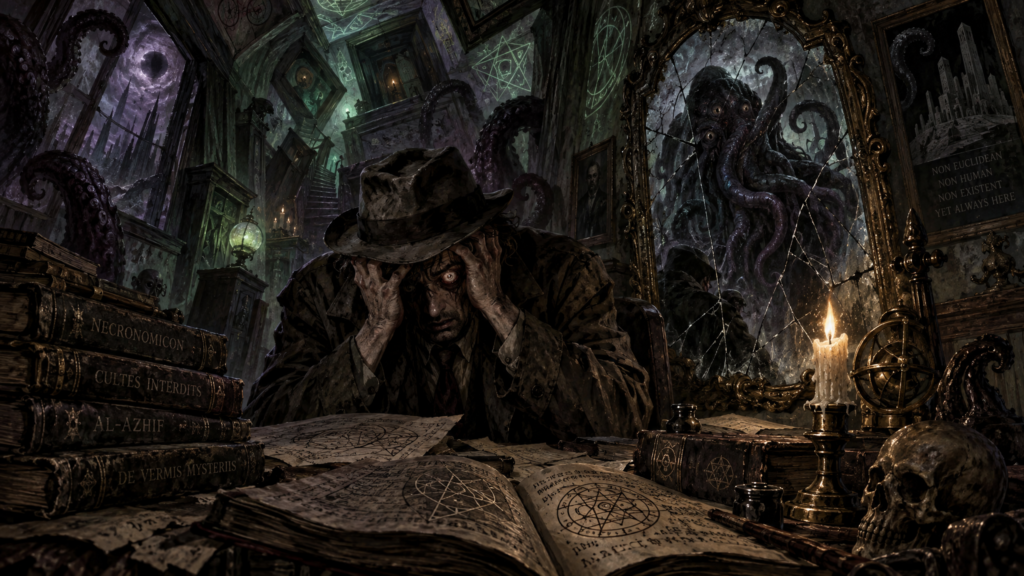
One of the most important mechanics in Call of Cthulhu is also one of the most distinctive: Sanity.
Unlike many traditional tabletop RPGs, Call of Cthulhu is not primarily about becoming stronger, defeating increasingly powerful enemies, and eventually saving the world. Investigators are ordinary people who gradually discover that the universe is far stranger and more terrifying than they imagined.
And sometimes, discovering the truth comes at a terrible price.
In Call of Cthulhu, seeing a monster, witnessing something horrifying, discovering a disturbing secret, or encountering the supernatural can cause an Investigator to lose Sanity points.
Lose enough Sanity, and the Investigator may suffer a Bout of Madness.
Lose even more over the course of their career, and their mental health can become permanently affected.
This guide explains how Sanity works in Call of Cthulhu, how Sanity rolls work, what happens when you lose Sanity, how madness works, and how players can roleplay an Investigator whose understanding of reality is slowly falling apart.
What Is Sanity in Call of Cthulhu?
Sanity, usually abbreviated as SAN, represents an Investigator’s ability to maintain their understanding of reality.
Every Investigator has a Sanity score.
The higher the score, the more psychologically resilient the character generally is.
However, Sanity is not simply a measurement of whether a character is “mentally healthy.”
In Call of Cthulhu, Sanity represents something more specific:
How well can your Investigator continue to function after discovering things that contradict their understanding of the world?
This is particularly important because Call of Cthulhu is based on cosmic horror.
The Mythos is not simply frightening because its creatures are dangerous.
It is frightening because discovering the truth can fundamentally change the way an Investigator understands reality.
A character may discover that:
- Monsters really exist.
- Humanity is insignificant on a cosmic scale.
- Ancient beings existed before humanity.
- Certain supernatural forces cannot be defeated.
- The laws of nature may not work as expected.
- Some apparently impossible events are completely real.
The more an Investigator discovers, the harder it can become to maintain their previous worldview.
How Is Sanity Calculated?
In Call of Cthulhu 7th Edition, an Investigator’s initial Sanity is generally based on their POW (Power) characteristic.
In addition to their current Sanity score, Investigators also have a Sanity maximum.
The Sanity maximum is normally determined by their POW and represents the highest level of Sanity the Investigator can normally regain during play.
This distinction is important.
Your Investigator can lose Sanity during an adventure, recover some of it later, and continue investigating.
However, repeated exposure to the Mythos can permanently change them.
What Is a Sanity Roll?
A Sanity roll is made when an Investigator encounters something sufficiently disturbing to threaten their psychological stability.
The Keeper determines whether a Sanity roll is necessary.
Examples might include:
- Discovering a mutilated corpse.
- Seeing a supernatural creature.
- Witnessing someone die violently.
- Discovering evidence of a supernatural ritual.
- Encountering something that should not exist.
- Learning an especially disturbing piece of Mythos knowledge.
The Keeper then determines how the Sanity roll works and what the Investigator risks losing.
The basic idea is simple:
Something terrible happens → the Keeper calls for a Sanity roll → the player rolls against their Sanity → the result determines the consequences.
What Happens If You Pass a Sanity Roll?
Passing a Sanity roll usually means that the Investigator manages to maintain their psychological stability.
However, passing does not necessarily mean that nothing happens.
Depending on the situation, an Investigator may still lose some Sanity.
The important distinction is that the consequences are generally less severe than they would be after failing the roll.
For example, imagine that an Investigator discovers a corpse in an abandoned house.
The Keeper calls for a Sanity roll.
The Investigator succeeds.
They may still be disturbed by what they have seen, but they are able to keep functioning.
This is one of the important differences between Sanity and a simple “fear save.”
Sanity is not about being completely fearless.
It is about how much psychological damage the experience causes.
What Happens If You Fail a Sanity Roll?
Failing a Sanity roll usually means that the Investigator suffers a greater loss of Sanity.
The exact amount depends on the situation and the scenario.
A relatively disturbing event may cause only a small loss.
A truly horrifying encounter can cause a much larger loss.
For example:
An Investigator enters a dark basement and discovers something that should not exist.
The Keeper calls for a Sanity roll.
The Investigator fails.
They lose Sanity as a result of the encounter.
The Investigator may now have to deal with the immediate psychological consequences as well as the danger presented by whatever they discovered.
This creates one of the central gameplay loops of Call of Cthulhu:
The more you investigate, the more you discover. The more you discover, the more dangerous the truth becomes.
Can You Lose Sanity Without Failing a Roll?
Yes.
This is an important point for new players.
Some situations can cause Sanity loss regardless of whether the Investigator succeeds at the Sanity roll.
The roll can determine whether the character suffers a smaller or larger consequence, depending on the situation.
This means that Sanity rolls should not be thought of as simply:
“Pass = nothing happens.”
Instead, think of them as:
“How badly does this experience affect my Investigator?”
That distinction makes the mechanic much more interesting.
What Is a Bout of Madness?
One of the most famous Call of Cthulhu mechanics is the Bout of Madness.
A Bout of Madness occurs when an Investigator experiences a sufficiently severe loss of Sanity in a short period.
The Investigator temporarily loses their ability to respond normally to the situation.
This can lead to dramatic and sometimes unpredictable behavior.
Examples include:
- Running away in panic.
- Freezing in terror.
- Becoming irrationally aggressive.
- Fleeing from an apparently harmless object.
- Becoming obsessed with a particular idea.
- Experiencing a temporary psychological breakdown.
The exact manifestation depends on the circumstances and the Keeper’s interpretation.
The important point is that a Bout of Madness should ideally become part of the story rather than simply being treated as a punishment.
What Is Temporary Insanity?
Call of Cthulhu distinguishes between temporary psychological effects and more lasting consequences.
A temporary episode can occur when an Investigator loses enough Sanity rapidly.
The character may behave irrationally for a period of time before eventually regaining enough control to continue.
This can create some of the most memorable moments in a Call of Cthulhu game.
Imagine four Investigators discovering a creature in an underground chamber.
One character panics and runs.
Another freezes.
A third starts shouting.
The fourth tries to convince everyone that what they have seen is impossible.
None of these reactions necessarily need to be played as a joke.
Handled correctly, they can make the horror feel much more real.
What Is Indefinite Insanity?
More serious Sanity loss can result in indefinite insanity.
This represents a more significant psychological breakdown that can last much longer than a temporary Bout of Madness.
The effects can influence how an Investigator behaves after the immediate crisis has ended.
An Investigator might develop:
- A phobia.
- A compulsion.
- A recurring fear.
- A behavioral change.
- A psychological obsession.
- Another lasting consequence connected to their experiences.
The important concept is that the Investigator has been changed by what happened.
They are no longer exactly the same person they were before.
What Happens When Sanity Reaches 0?
Reaching 0 Sanity represents an extreme psychological collapse.
At this point, the Investigator is no longer capable of functioning normally as an adventuring character.
This does not necessarily mean that the character is simply “dead.”
Instead, the character may require long-term care or otherwise leave the active investigation.
This is one of the reasons why Call of Cthulhu is fundamentally different from many heroic RPGs.
An Investigator can survive an encounter physically while still being effectively destroyed psychologically.
What Is Mythos Knowledge?
Another important part of Call of Cthulhu’s Sanity system is Cthulhu Mythos knowledge.
Investigators can learn about the Mythos by:
- Reading forbidden books.
- Investigating supernatural events.
- Talking to occultists.
- Witnessing supernatural phenomena.
- Researching ancient civilizations.
- Encountering Mythos creatures.
The more an Investigator learns about the Mythos, the more their understanding of the universe changes.
This creates a fascinating relationship between knowledge and Sanity.
Normally, knowledge is valuable.
In Call of Cthulhu, knowledge can be dangerous.
Sometimes the most useful information you discover is also the information you wish you had never learned.
Can You Regain Sanity?
Yes.
Investigators can regain Sanity in various ways during a campaign.
Recovery can come from things such as:
- Spending time recovering from traumatic experiences.
- Receiving appropriate care.
- Building positive relationships.
- Achieving meaningful goals.
- Successfully dealing with psychological problems.
- Receiving professional help.
However, Sanity recovery is not necessarily unlimited.
An Investigator’s maximum Sanity is affected by their Mythos knowledge, and repeated exposure to the supernatural can permanently reduce how much Sanity they can ultimately retain.
This creates an important long-term consequence:
You can recover from the experience, but you cannot simply forget everything you have learned.
What Happens When You Gain Cthulhu Mythos Knowledge?
This is one of the most interesting ideas in the entire game.
An Investigator can become more knowledgeable while simultaneously becoming less psychologically stable.
Imagine an Investigator who begins a campaign knowing nothing about the Mythos.
They might have a high Sanity score and believe that supernatural creatures do not exist.
After several investigations, they discover:
- The supernatural is real.
- Ancient civilizations knew about it.
- Powerful entities exist beyond human understanding.
- Some of these entities may be aware of humanity.
- Humanity may be almost irrelevant on a cosmic scale.
The Investigator now understands the world better.
But that understanding has come at a cost.
This is the essence of Lovecraftian cosmic horror.
Sanity vs Hit Points: What Is the Difference?
One of the easiest ways to understand Sanity is to compare it with Hit Points.
Hit Points represent physical health.
Sanity represents psychological stability.
An Investigator can therefore suffer two fundamentally different kinds of damage.
Physical Damage
A monster attacks you.
You lose Hit Points.
Psychological Damage
You witness something horrifying.
You lose Sanity.
The important difference is that psychological damage can fundamentally change the way your character behaves.
That makes Sanity much more than a second health bar.
Can You Fight Monsters in Call of Cthulhu?
Yes.
But this is where players coming from D&D often need to change their mindset.
In D&D, encountering a monster frequently leads to:
Roll initiative.
In Call of Cthulhu, encountering a monster may lead to:
Run.
Combat exists, but many Mythos creatures are far more dangerous than the average Investigator.
Even if an Investigator has a firearm, fighting a supernatural creature may be an extremely bad idea.
This creates an important tactical principle:
Knowing when not to fight is one of the most important skills in Call of Cthulhu.
How Should Players Roleplay Sanity Loss?
Sanity loss is much more interesting when players treat it as a roleplaying opportunity.
If your Investigator loses Sanity, ask yourself:
- What exactly frightened them?
- How would they rationalize what happened?
- Would they tell the other Investigators?
- Would they deny what they saw?
- Would they become obsessed with finding an explanation?
- Would they avoid returning to the location?
- Would they become suspicious of other people?
For example, instead of simply saying:
“My character loses 5 Sanity.”
Try thinking:
“My character has just seen something that completely contradicts everything they believe about reality. They are going to have difficulty accepting that it actually happened.”
This makes Sanity an important part of character development.
How Should Keepers Handle Sanity?
Keepers have an important responsibility when running Sanity mechanics.
The goal should not be to punish players.
The goal is to create psychological horror.
A good Keeper should:
1. Build tension before the Sanity roll
Do not immediately reveal everything.
Give players clues.
Let them hear strange sounds.
Show them something that does not quite make sense.
Make them wonder what is happening.
2. Make horror personal
A generic monster may be frightening.
Something connected to an Investigator’s personal fears can be much more effective.
3. Avoid turning madness into comedy
Call of Cthulhu can certainly contain dark humor, but psychological breakdowns should generally be treated seriously.
4. Give players room to roleplay
If a character loses Sanity, allow the player to contribute to the reaction.
The best result is often a collaborative decision between Keeper and player.
5. Remember that players are not their characters
A character suffering from a phobia does not mean the player actually has that fear.
The table should always remain comfortable with the material being played.
Is Losing Sanity Always Bad?
From a purely mechanical perspective, losing Sanity is usually dangerous.
From a storytelling perspective, however, it can be extremely valuable.
Sanity loss can:
- Develop a character.
- Create memorable scenes.
- Reveal personality.
- Increase tension.
- Change relationships between Investigators.
- Make victories feel more meaningful.
- Demonstrate the cost of discovering the truth.
This is one of the reasons Call of Cthulhu can produce stories that feel very different from traditional heroic fantasy.
The Investigator may solve the mystery.
They may save innocent people.
They may even defeat the immediate threat.
But they may never be the same again.
7 Tips for Managing Sanity as a Player
If you are playing Call of Cthulhu for the first time, keep these tips in mind.
1. Do Not Be Afraid of Sanity Loss
Losing Sanity is part of the game.
Do not treat every Sanity point as something that must be protected at all costs.
Sometimes the best stories come from characters who are gradually changed by their experiences.
2. Know When to Run
You do not have to fight every monster.
Running away can be the smartest decision your Investigator ever makes.
3. Keep Notes
Call of Cthulhu investigations often involve many clues, names, locations, and documents.
Writing things down can help you distinguish important information from red herrings.
4. Talk to Your Fellow Investigators
You are part of an investigation team.
Share information.
Discuss theories.
Compare what each character has discovered.
5. Do Not Assume Everything Has a Rational Explanation
Your character might initially assume that there is a logical explanation.
That is perfectly reasonable.
But eventually, the evidence may become impossible to ignore.
6. Embrace Character Development
If your Investigator develops a fear or psychological problem, use it as an opportunity to make the character more interesting.
7. Remember What Makes Call of Cthulhu Different
You are not necessarily trying to become more powerful.
You are trying to discover the truth and survive long enough to do something with it.
Final Thoughts
The Sanity system is one of the defining features of Call of Cthulhu.
It transforms horror from something that happens around the characters into something that happens to the characters themselves.
An Investigator can survive a monster attack but lose their sense of security.
They can discover an ancient secret but lose their ability to see the world in the same way.
They can solve the mystery but realize that the truth was far worse than the original question.
That is what makes Sanity so important.
In Call of Cthulhu, knowledge is power.
But sometimes, knowledge is also the price you pay for looking too closely at the darkness.